
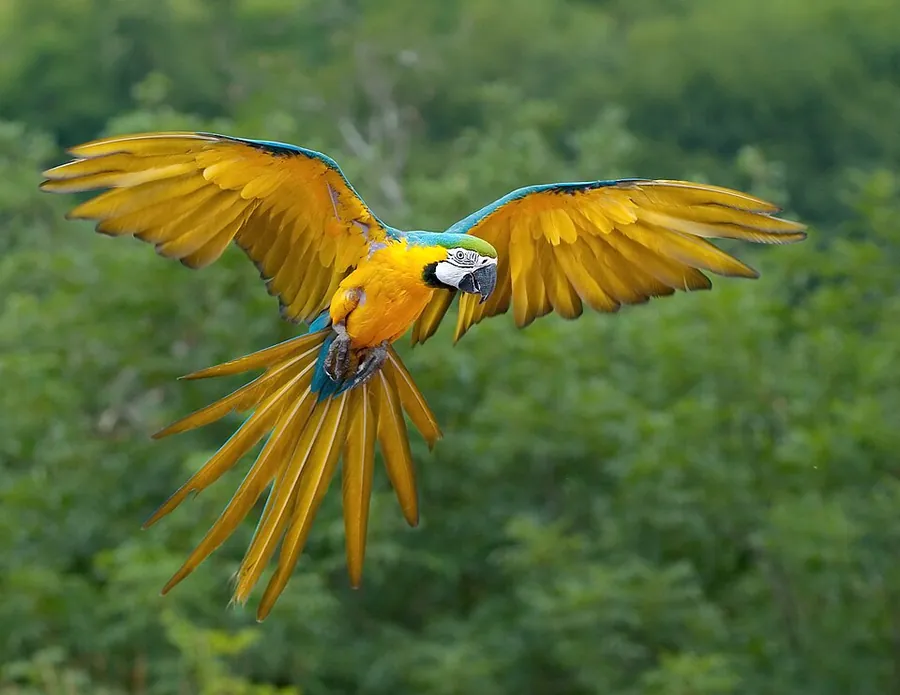
🦜Blue-and-yellow Macaw
The blue-and-yellow macaw, also known as the blue-and-gold macaw, is a large Neotropical parrot with a mostly blue dorsum, light yellow/orange venter, and gradient hues of green on top of its head. It is a member of the large group of neotropical parrots known as macaws. It inhabits forest, woodland, and savannah of tropical Central and South America, as well as the island of Trinidad in the Caribbean. They are popular in aviculture because of their striking color, ability to talk, ready availability in the marketplace, and close bonding to humans. It is the most commonly kept macaw species in captivity worldwide as a pet or companion parrot and is also the cheapest among the large macaws. As of 2025, there are 1 million blue and gold macaws living in captivity worldwide, one of the highest populations of any large parrot in captivity.
Text: Wikipedia, CC BY-SA 4.0.
IUCN Red List assessment, 2018.
- Body mass
- 1.13 kg
- Body length
- not recorded
- Shoulder height
- not recorded
- Top speed
- not recorded
- Bite force
- not recorded
- Maximum lifespan
- 43 years
Everything we know about the Blue-and-yellow Macaw
Typical adult figures. Where a value is an estimate rather than a measurement, it says so.
Body mass1.13 kgAVONETOther figures ↓Hide ↑
Source: AVONET · v1.1 (Tobias et al. 2022) · CC BY 4.0
Figures vary
- 1.03 kgAnAgeAnAge build 15, 2023-07-03 (HAGR)data quality: acceptable
Tail length0.49 mAVONETDetails ↓Hide ↑
Source: AVONET · v1.1 (Tobias et al. 2022) · CC BY 4.0
Wing length0.38 mAVONETDetails ↓Hide ↑
Source: AVONET · v1.1 (Tobias et al. 2022) · CC BY 4.0
Beak length0.07 mAVONETDetails ↓Hide ↑
Source: AVONET · v1.1 (Tobias et al. 2022) · CC BY 4.0
Tarsus length0.03 mAVONETDetails ↓Hide ↑
Source: AVONET · v1.1 (Tobias et al. 2022) · CC BY 4.0
Maximum lifespan43 yearsAnAgeDetails ↓Hide ↑
data quality: acceptable
Source: AnAge · AnAge build 15, 2023-07-03 (HAGR) · CC BY 3.0
Trophic levelHerbivoreAVONETDetails ↓Hide ↑
Source: AVONET · v1.1 (Tobias et al. 2022) · CC BY 4.0
HabitatForestAVONETDetails ↓Hide ↑
Source: AVONET · v1.1 (Tobias et al. 2022) · CC BY 4.0
LifestyleInsessorialAVONETDetails ↓Hide ↑
Source: AVONET · v1.1 (Tobias et al. 2022) · CC BY 4.0
Volume l1.1 LaverageDetails ↓Hide ↑
Body mass at ~1.0 kg/L, the density of vertebrate tissue.
average = a mean across sexes or species in a group.
Not recorded for Blue-and-yellow Macaw yet: body length, shoulder height, top speed, bite force.
Family tree
- kingdomAnimalia
- ›phylumChordata
- ›classAves
- ›orderPsittaciformes
- ›familyPsittacidae
- ›genusAra
- ›speciesAra ararauna
- orderSauria
- classBirds · Aves
- orderParrots · Psittaciformes
- genusAra
All 11 branches ↓Fewer branches ↑
- kingdomMetazoa
- phylumChordata
- subphylumCraniata
- subphylumVertebrata
- superclassGnathostomata
- superclassSarcopterygii
- superclassTetrapoda
- orderSauria
- classBirds · Aves
- orderParrots · Psittaciformes
- genusAra
More about the Blue-and-yellow Macaw


Kameraya yakalanan hayvanlar
Bu sitedeki hayvanların gerçek görüntüleri — avlanırken, kavga ederken, kendi hâllerinde.
Compare the Blue-and-yellow Macaw
Pick a tool — the Blue-and-yellow Macaw is already selected.
Compare every stat with any other animal.
Stand them on the same floor and see who's bigger.
How speed, brain and bite scale with body size. This animal isn't in the sample yet.
See where it sits in the tree of life.