
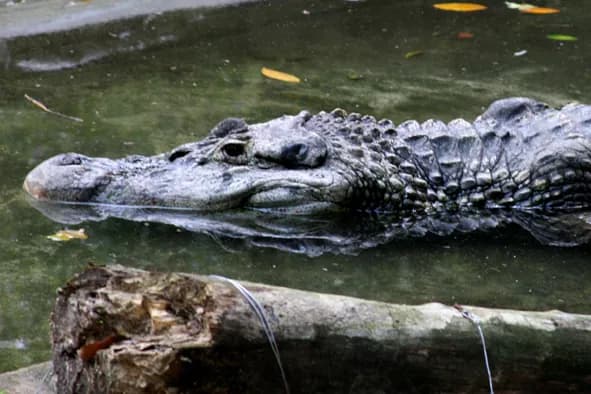
🐊Black caiman
The black caiman is a crocodilian reptile endemic to South America. With a maximum length of around 5 to 6.5 m and a mass of over 450 kg (1,000 lb), it is the largest living species of the family Alligatoridae, and the third-largest crocodilian in the Neotropical realm. True to its common and scientific names, the black caiman has a dark greenish-black coloration as an adult. In some individuals, the pigmentation can appear almost jet-black. It has grey to brown banding on the lower jaw; juveniles have a more vibrant coloration compared to adults, with prominent white-pale yellow banding on the flanks that remains present well into adulthood. The banding on young helps with camouflage by breaking up their body outline, on land or in water, in an effort to avoid predation. The morphology is quite different from other caimans but the bony ridge that occurs in other caimans is present. The head is large and heavy, an advantage in catching larger prey. Like all crocodilians, caimans are long, squat creatures, with big jaws, long tails and short legs. They have thick, scaled skin, and their eyes and noses are located on the tops of their heads. This enables them to see and breathe while the rest of their body is underwater.
Text: Wikipedia, CC BY-SA 4.0.
IUCN Red List assessment, 2025.
- Body mass
- 82 kg
- Body length
- 6 m
- Shoulder height
- not recorded
- Top speed
- not recorded
- Bite force
- not recorded
- Maximum lifespan
- 40 years
Everything we know about the Black caiman
Typical adult figures. Where a value is an estimate rather than a measurement, it says so.
Body mass82 kgrecord 883 kg · ReptTraitsAnAgeDetails ↓Hide ↑
data quality: acceptable
Record: largest individual on record
Source: AnAge · AnAge build 15, 2023-07-03 (HAGR) · CC BY 3.0
Body length6 mmaximum recordedReptTraitsDetails ↓Hide ↑
Source: ReptTraits · v1.2 (Oskyrko et al. 2024) · CC BY 4.0
Maximum lifespan40 yearsrecord 40 years · ReptTraitsAnAgeDetails ↓Hide ↑
data quality: acceptable
Record: largest individual on record
Source: AnAge · AnAge build 15, 2023-07-03 (HAGR) · CC BY 3.0
DietCarnivorousReptTraitsDetails ↓Hide ↑
Source: ReptTraits · v1.2 (Oskyrko et al. 2024) · CC BY 4.0
Activity cycleNocturnalReptTraitsDetails ↓Hide ↑
Source: ReptTraits · v1.2 (Oskyrko et al. 2024) · CC BY 4.0
Foraging modeACTReptTraitsDetails ↓Hide ↑
Source: ReptTraits · v1.2 (Oskyrko et al. 2024) · CC BY 4.0
VenomousNoReptTraitsDetails ↓Hide ↑
Source: ReptTraits · v1.2 (Oskyrko et al. 2024) · CC BY 4.0
Volume l82 LaverageDetails ↓Hide ↑
Body mass at ~1.0 kg/L, the density of vertebrate tissue.
average = a mean across sexes or species in a group.
Not recorded for Black caiman yet: shoulder height, top speed, bite force.
Family tree
- kingdomAnimalia
- ›phylumChordata
- ›classCrocodylia
- ›familyAlligatoridae
- ›genusMelanosuchus
- ›speciesMelanosuchus niger
- orderSauria
- familyAlligatoridae
- subfamilyCaimaninae
- genusMelanosuchus
All 11 branches ↓Fewer branches ↑
- kingdomMetazoa
- phylumChordata
- subphylumCraniata
- subphylumVertebrata
- superclassGnathostomata
- superclassSarcopterygii
- superclassTetrapoda
- orderSauria
- familyAlligatoridae
- subfamilyCaimaninae
- genusMelanosuchus
More about the Black caiman


Kameraya yakalanan hayvanlar
Bu sitedeki hayvanların gerçek görüntüleri — avlanırken, kavga ederken, kendi hâllerinde.
Compare the Black caiman
Pick a tool — the Black caiman is already selected.
Compare every stat with any other animal.
Stand them on the same floor and see who's bigger.
How speed, brain and bite scale with body size. This animal isn't in the sample yet.
See where it sits in the tree of life.