
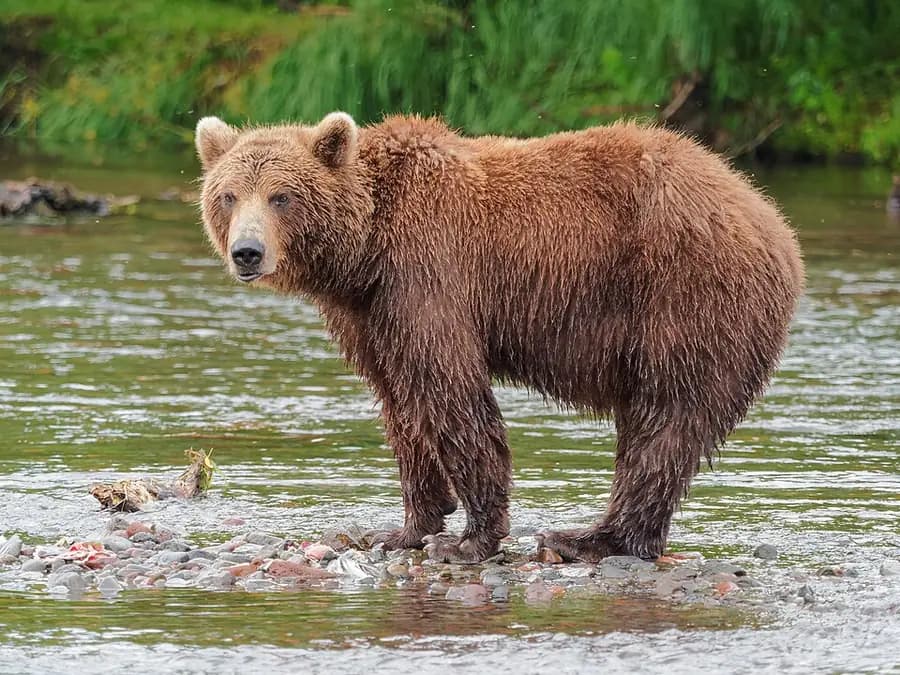
🐻Brown bear
ヒグマ(羆、緋熊、樋熊、学名:Ursus arctos)は、クマ科に属する哺乳類である。ホッキョクグマと並び現生クマ科では最大級である。エゾヒグマは現代の日本列島に生息する最大の陸棲哺乳類であり、現代でも同列島に生息している数少ないメガファウナの一種である。また、ロシアやフィンランドの国獣である。
Text: Wikipedia, CC BY-SA 4.0.
IUCN Red List assessment, 2017.
- Body mass
- 241 kg
- Body length
- 2.29 m
- Shoulder height
- 1.2 m
- Top speed
- 47 km/h
- Bite force
- 751 N
- Maximum lifespan
- 50 years
Everything we know about the Brown bear
Typical adult figures. Where a value is an estimate rather than a measurement, it says so.
Body mass241 kgCOMBINEOther figures ↓Hide ↑
Source: COMBINE · v1 (Soria et al. 2021) · CC BY 4.0
Figures vary
- 278 kgAnAgeAnAge build 15, 2023-07-03 (HAGR)data quality: acceptable
Body length2.29 mCOMBINEDetails ↓Hide ↑
Source: COMBINE · v1 (Soria et al. 2021) · CC BY 4.0
Shoulder height1.2 m0.9–1.5 m · typical rangeat the shoulder (quadruped)Details ↓Hide ↑
"They are 90 to 150 cm tall at the shoulder and can tower at an intimidating height of 8 feet when standing upright on their hind legs." Recorded value is quadruped shoulder height (midpoint of 90-150 cm); the 8-ft figure is an upright hind-leg height stated separately and not recorded here.
Source: Animal Diversity Web (Univ. Michigan), Ursus arctos account, https://animaldiversity.org/accounts/Ursus_arctos/ · see citation
Top speed47 km/hDetails ↓Hide ↑
Sprint over a short distance, not a sustained pace. Compilations give 46.66 and 47.97 km/h.
Source: Bejan & Marden 2006, J Exp Biol 209:238 and Christiansen 2002, Zool J Linn Soc 136:685; compiled in Hirt et al. 2017, Nat Ecol Evol 1:1116, Supplementary Data · see citation
Bite force751 NDetails ↓Hide ↑
Canine bite modelled by the dry-skull method (Thomason 1991) from a prepared skull; static bite at the canines, gape not stated. Not a live measurement. The skull's estimated body mass was 128.8 kg. Estimates span 2.2x. A value of 1410 N is attributed to Christiansen & Wroe 2007, Ecology 88:347 -- that paper is paywalled and the figure could not be verified against its own table. Rozycka et al. 2024 give 1627 N. Do NOT use the 1681 N brown bear figure in Slater et al. 2010: that skull was rescaled to polar-bear size and driven by polar-bear muscle forces.
Source: Wroe, McHenry & Thomason 2005, Proc R Soc B 272:619, Table 1 · see citation
Bite force for its size78Details ↓Hide ↑
Bite force normalised for body mass: the residual of canine bite force regressed on body mass, average across the sample set to 100. Above 100 means the animal bites harder than its size predicts. Do not cross-check against Wikipedia's BFQ table, which silently mixes this paper with Christiansen & Wroe 2007 and cites a popular-science book.
Source: Wroe, McHenry & Thomason 2005, Proc R Soc B 272:619, Table 1 · see citation
Brain mass359 gCOMBINEDetails ↓Hide ↑
Source: COMBINE · v1 (Soria et al. 2021) · CC BY 4.0
Maximum lifespan50 yearsCOMBINEOther figures ↓Hide ↑
Source: COMBINE · v1 (Soria et al. 2021) · CC BY 4.0
Figures vary
- 40 yearsAnAgeAnAge build 15, 2023-07-03 (HAGR)data quality: acceptable
Generation length16 yearsCOMBINEDetails ↓Hide ↑
Source: COMBINE · v1 (Soria et al. 2021) · CC BY 4.0
Age at maturity3.6 yearsCOMBINEDetails ↓Hide ↑
Source: COMBINE · v1 (Soria et al. 2021) · CC BY 4.0
Gestation103 daysCOMBINEOther figures ↓Hide ↑
Source: COMBINE · v1 (Soria et al. 2021) · CC BY 4.0
Figures vary
- 103 daysAnAgeAnAge build 15, 2023-07-03 (HAGR)data quality: acceptable
Litter sizeabout 2COMBINEOther figures ↓Hide ↑
Source: COMBINE · v1 (Soria et al. 2021) · CC BY 4.0
Figures vary
- 2AnAgeAnAge build 15, 2023-07-03 (HAGR)data quality: acceptable
Trophic levelOmnivoreCOMBINEDetails ↓Hide ↑
Source: COMBINE · v1 (Soria et al. 2021) · CC BY 4.0
Activity cycleCrepuscular / mixedCOMBINEDetails ↓Hide ↑
Source: COMBINE · v1 (Soria et al. 2021) · CC BY 4.0
Home range311 km²COMBINEDetails ↓Hide ↑
Source: COMBINE · v1 (Soria et al. 2021) · CC BY 4.0
Population density0.27 per km²COMBINEDetails ↓Hide ↑
Source: COMBINE · v1 (Soria et al. 2021) · CC BY 4.0
Volume l241 LaverageDetails ↓Hide ↑
Body mass at ~1.0 kg/L, the density of vertebrate tissue.
average = a mean across sexes or species in a group.
Family tree
- kingdomAnimalia
- ›phylumChordata
- ›classMammalia
- ›orderCarnivora
- ›familyUrsidae
- ›genusUrsus
- ›speciesUrsus arctos
- classMammals · Mammalia
- orderCarnivorans · Carnivora
- suborderCaniformia
- familyUrsidae
All 13 branches ↓Fewer branches ↑
- kingdomMetazoa
- phylumChordata
- subphylumCraniata
- subphylumVertebrata
- superclassGnathostomata
- superclassSarcopterygii
- superclassTetrapoda
- classMammals · Mammalia
- subclassTheria
- superorderLaurasiatheria
- orderCarnivorans · Carnivora
- suborderCaniformia
- familyUrsidae
More about the Brown bear


カメラがとらえた動物たち
このサイトに登場する動物の実際の映像——狩り、けんか、そしてふだんの暮らしぶりまでそろっています。
Compare the Brown bear
Pick a tool — the Brown bear is already selected.
Compare every stat with any other animal.
Stand them on the same floor and see who's bigger.
Does it punch above its weight? Its stats against what body size predicts.
See where it sits in the tree of life.