
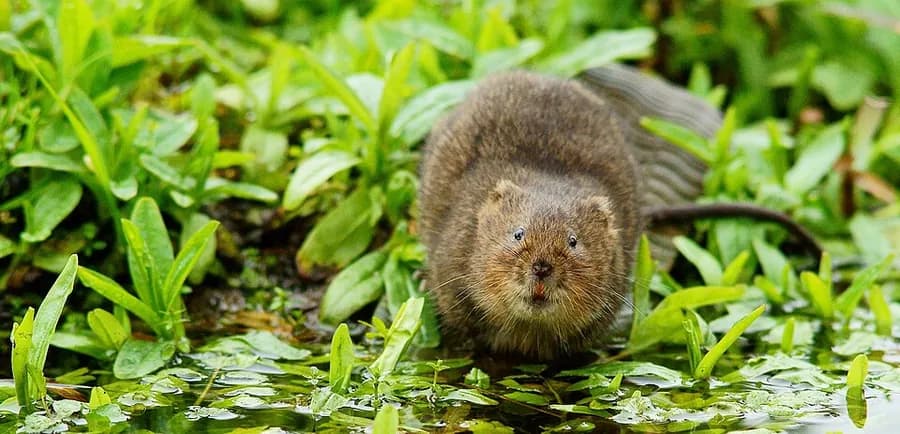
🐭European water vole
ユーラシアミズハタネズミ(学名: Arvicola amphibius)は、齧歯目キヌゲネズミ科ミズハタネズミ属に分類されるネズミの一種。ミズハタネズミ属のタイプ種。ミズハタネズミ(水畑鼠)とも呼ばれる。 一般に知られているネズミより丸い顔で、丸い鼻と短い耳をもち、毛深いため、尾や耳は隠れている。野生種の寿命は平均5か月であり、冬を2度超すことはほとんどないが、個体によっては洞穴の中で5年間生息した記録があると言われる。英語圏では Northern water vole としても知られる。
Text: Wikipedia, CC BY-SA 4.0.
IUCN Red List assessment, 2023.
- Body mass
- 0.11 kg
- Body length
- 0.21 m
- Shoulder height
- not recorded
- Top speed
- not recorded
- Bite force
- not recorded
- Maximum lifespan
- 5 years
Everything we know about the European water vole
Typical adult figures. Where a value is an estimate rather than a measurement, it says so.
Body mass0.11 kgCOMBINEOther figures ↓Hide ↑
Source: COMBINE · v1 (Soria et al. 2021) · CC BY 4.0
Figures vary
- 0.12 kgAnAgeAnAge build 15, 2023-07-03 (HAGR)data quality: acceptable
Body length0.21 mCOMBINEDetails ↓Hide ↑
Source: COMBINE · v1 (Soria et al. 2021) · CC BY 4.0
Brain mass1.64 gCOMBINEDetails ↓Hide ↑
Source: COMBINE · v1 (Soria et al. 2021) · CC BY 4.0
Maximum lifespan5 yearsCOMBINEOther figures ↓Hide ↑
Source: COMBINE · v1 (Soria et al. 2021) · CC BY 4.0
Figures vary
- 2.5 yearsAnAgeAnAge build 15, 2023-07-03 (HAGR)data quality: acceptable
Generation length1.8 yearsCOMBINEDetails ↓Hide ↑
Source: COMBINE · v1 (Soria et al. 2021) · CC BY 4.0
Age at maturity48 daysCOMBINEDetails ↓Hide ↑
Source: COMBINE · v1 (Soria et al. 2021) · CC BY 4.0
Gestation21 daysCOMBINEOther figures ↓Hide ↑
Source: COMBINE · v1 (Soria et al. 2021) · CC BY 4.0
Figures vary
- 21 daysAnAgeAnAge build 15, 2023-07-03 (HAGR)data quality: acceptable
Litter sizeabout 5COMBINEOther figures ↓Hide ↑
Source: COMBINE · v1 (Soria et al. 2021) · CC BY 4.0
Figures vary
- 5.1AnAgeAnAge build 15, 2023-07-03 (HAGR)data quality: acceptable
Trophic levelOmnivoreCOMBINEDetails ↓Hide ↑
Source: COMBINE · v1 (Soria et al. 2021) · CC BY 4.0
Activity cycleCrepuscular / mixedestimatedCOMBINEDetails ↓Hide ↑
Source: COMBINE · v1 (Soria et al. 2021) · CC BY 4.0
Population density57,068 per km²COMBINEDetails ↓Hide ↑
Source: COMBINE · v1 (Soria et al. 2021) · CC BY 4.0
Volume l0.1 LaverageDetails ↓Hide ↑
Body mass at ~1.0 kg/L, the density of vertebrate tissue.
estimated = a model's estimate for a species nobody has measured; average = a mean across sexes or species in a group.
Not recorded for European water vole yet: shoulder height, top speed, bite force.
Family tree
- kingdomAnimalia
- ›phylumChordata
- ›classMammalia
- ›orderRodentia
- ›familyCricetidae
- ›genusArvicola
- ›speciesArvicola amphibius
- classMammals · Mammalia
- orderRodents · Rodentia
- subfamilyArvicolinae
- genusArvicola
All 15 branches ↓Fewer branches ↑
- kingdomMetazoa
- phylumChordata
- subphylumCraniata
- subphylumVertebrata
- superclassGnathostomata
- superclassSarcopterygii
- superclassTetrapoda
- classMammals · Mammalia
- subclassTheria
- superorderEuarchontoglires
- orderRodents · Rodentia
- suborderMyomorpha
- familyCricetidae
- subfamilyArvicolinae
- genusArvicola
More about the European water vole
No videos of the European water vole yet.
We have 44,653 videos so far, and none of them features this animal yet.
All videos →Compare the European water vole
Pick a tool — the European water vole is already selected.
Compare every stat with any other animal.
Stand them on the same floor and see who's bigger.
How speed, brain and bite scale with body size. This animal isn't in the sample yet.
See where it sits in the tree of life.