
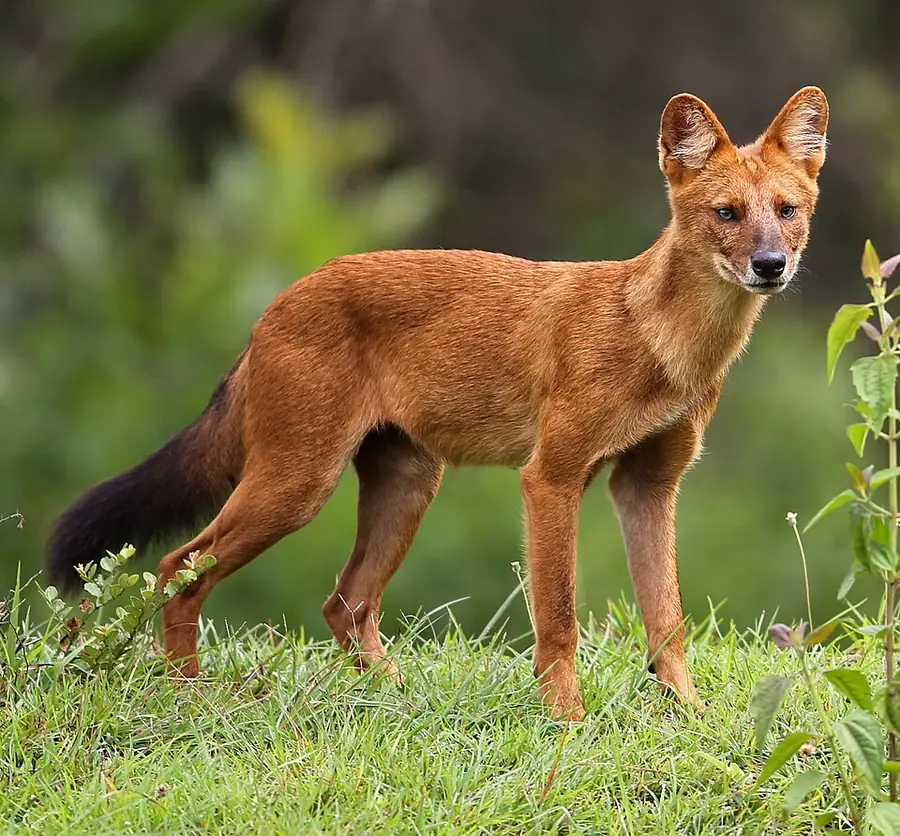
🐕Dhole
Le Dhole (Cuon alpinus) est une espèce de mammifère carnivore de la famille des canidés originaire d'Asie. Bien qu’elle soit parfois appelée « Chien sauvage d’Asie », elle n’est pas apparentée aux chiens et aux loups, qui sont du genre Canis, mais fait partie du genre Cuon, dont elle est la seule représentante actuelle. Dans son aire de répartition originelle, le dhole a terrorisé les populations humaines pendant des siècles. L’imaginaire populaire présente cet animal, malgré sa petite taille, comme une bête féroce attaquant en grand nombre, capable de mettre à mort les plus grands prédateurs comme les léopards ou même les tigres.
Text: Wikipedia, CC BY-SA 4.0.
IUCN Red List assessment, 2015.
- Body mass
- 16 kg
- Body length
- 1.06 m
- Shoulder height
- 0.46 m
- Top speed
- not recorded
- Bite force
- not recorded
- Maximum lifespan
- 16 years
Everything we know about the Dhole
Typical adult figures. Where a value is an estimate rather than a measurement, it says so.
Body mass16 kgCOMBINEOther figures ↓Hide ↑
Source: COMBINE · v1 (Soria et al. 2021) · CC BY 4.0
Figures vary
- 16 kgAnAgeAnAge build 15, 2023-07-03 (HAGR)data quality: acceptable
Body length1.06 mCOMBINEDetails ↓Hide ↑
Source: COMBINE · v1 (Soria et al. 2021) · CC BY 4.0
Shoulder height0.46 m0.42–0.5 m · typical rangenot statedDetails ↓Hide ↑
'Length of head and body is 88 to 113 cm, length of tail, 41 to 50 cm, height, 42 to 50 cm.' The account says 'height' in a body-measurement series, i.e. height at shoulder. Midpoint of the published range. Verified against the account PDF (OCR of p. 1).
Source: Cohen 1978, Cuon alpinus, Mammalian Species 100:1-3, p. 1, https://www.science.smith.edu/departments/Biology/VHAYSSEN/msi/pdf/i0076-3519-100-01-0001.pdf · see citation
Brain mass98 gCOMBINEDetails ↓Hide ↑
Source: COMBINE · v1 (Soria et al. 2021) · CC BY 4.0
Maximum lifespan16 yearsCOMBINEOther figures ↓Hide ↑
Source: COMBINE · v1 (Soria et al. 2021) · CC BY 4.0
Figures vary
- 16 yearsAnAgeAnAge build 15, 2023-07-03 (HAGR)data quality: acceptable
Generation length5.59 yearsCOMBINEDetails ↓Hide ↑
Source: COMBINE · v1 (Soria et al. 2021) · CC BY 4.0
Age at maturity1.0 yearsCOMBINEDetails ↓Hide ↑
Source: COMBINE · v1 (Soria et al. 2021) · CC BY 4.0
Gestation62 daysCOMBINEOther figures ↓Hide ↑
Source: COMBINE · v1 (Soria et al. 2021) · CC BY 4.0
Figures vary
- 61 daysAnAgeAnAge build 15, 2023-07-03 (HAGR)data quality: acceptable
Litter sizeabout 4COMBINEOther figures ↓Hide ↑
Source: COMBINE · v1 (Soria et al. 2021) · CC BY 4.0
Figures vary
- 5AnAgeAnAge build 15, 2023-07-03 (HAGR)data quality: acceptable
Trophic levelCarnivoreCOMBINEDetails ↓Hide ↑
Source: COMBINE · v1 (Soria et al. 2021) · CC BY 4.0
Activity cycleCrepuscular / mixedCOMBINEDetails ↓Hide ↑
Source: COMBINE · v1 (Soria et al. 2021) · CC BY 4.0
Home range34 km²COMBINEDetails ↓Hide ↑
Source: COMBINE · v1 (Soria et al. 2021) · CC BY 4.0
Population density0.32 per km²COMBINEDetails ↓Hide ↑
Source: COMBINE · v1 (Soria et al. 2021) · CC BY 4.0
Volume l16 LaverageDetails ↓Hide ↑
Body mass at ~1.0 kg/L, the density of vertebrate tissue.
average = a mean across sexes or species in a group.
Not recorded for Dhole yet: top speed, bite force.
Family tree
- kingdomAnimalia
- ›phylumChordata
- ›classMammalia
- ›orderCarnivora
- ›familyCanidae
- ›genusCuon
- ›speciesCuon alpinus
- classMammals · Mammalia
- orderCarnivorans · Carnivora
- familyCanidae
- genusCuon
All 14 branches ↓Fewer branches ↑
- kingdomMetazoa
- phylumChordata
- subphylumCraniata
- subphylumVertebrata
- superclassGnathostomata
- superclassSarcopterygii
- superclassTetrapoda
- classMammals · Mammalia
- subclassTheria
- superorderLaurasiatheria
- orderCarnivorans · Carnivora
- suborderCaniformia
- familyCanidae
- genusCuon
More about the Dhole


Les animaux pris sur le vif
De vraies images des animaux de ce site — à la chasse, au combat, ou vaquant simplement à leurs occupations.
Compare the Dhole
Pick a tool — the Dhole is already selected.
Compare every stat with any other animal.
Stand them on the same floor and see who's bigger.
Does it punch above its weight? Its stats against what body size predicts.
See where it sits in the tree of life.