
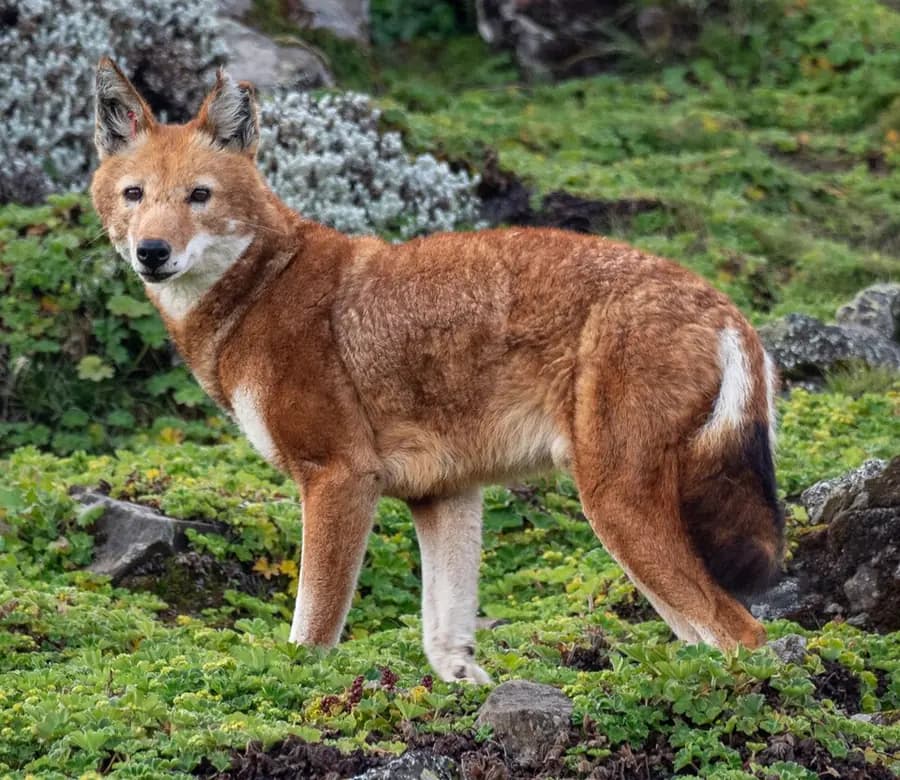
🐺Ethiopian wolf
Canis simensis, le Loup d'Abyssinie ou Loup d'Éthiopie, également connu sous le nom de Cabéru (de l'amharique kebero) ou anciennement sous celui de Chacal du Simien, est une espèce de mammifères de l'ordre des Carnivores et de la famille des Canidés. Bien qu'il soit désigné sous le nom de « loup », il constitue une espèce distincte. Considéré comme le troisième canidé le plus rare au monde après le Renard de Darwin et le Loup rouge, le Loup d'Abyssinie a une population totale estimée à moins de 500 individus à l'état sauvage, dont 300 dans le parc national des monts Balé au centre de l'Éthiopie. À ce titre il est classé espèce en danger par l'Union internationale pour la conservation de la nature (UICN).
Text: Wikipedia, CC BY-SA 4.0.
IUCN Red List assessment, 2011.
- Body mass
- 14 kg
- Body length
- 0.96 m
- Shoulder height
- not recorded
- Top speed
- not recorded
- Bite force
- not recorded
- Maximum lifespan
- 17 years
Everything we know about the Ethiopian wolf
Typical adult figures. Where a value is an estimate rather than a measurement, it says so.
Body mass14 kgCOMBINEDetails ↓Hide ↑
Source: COMBINE · v1 (Soria et al. 2021) · CC BY 4.0
Body length0.96 mCOMBINEDetails ↓Hide ↑
Source: COMBINE · v1 (Soria et al. 2021) · CC BY 4.0
Maximum lifespan17 yearsestimatedCOMBINEDetails ↓Hide ↑
Source: COMBINE · v1 (Soria et al. 2021) · CC BY 4.0
Generation length4 yearsCOMBINEDetails ↓Hide ↑
Source: COMBINE · v1 (Soria et al. 2021) · CC BY 4.0
Age at maturity2.1 yearsCOMBINEDetails ↓Hide ↑
Source: COMBINE · v1 (Soria et al. 2021) · CC BY 4.0
Gestation63 daysCOMBINEDetails ↓Hide ↑
Source: COMBINE · v1 (Soria et al. 2021) · CC BY 4.0
Litter sizeabout 4COMBINEDetails ↓Hide ↑
Source: COMBINE · v1 (Soria et al. 2021) · CC BY 4.0
Trophic levelCarnivoreCOMBINEDetails ↓Hide ↑
Source: COMBINE · v1 (Soria et al. 2021) · CC BY 4.0
Activity cycleCrepuscular / mixedCOMBINEDetails ↓Hide ↑
Source: COMBINE · v1 (Soria et al. 2021) · CC BY 4.0
Home range4.2 km²COMBINEDetails ↓Hide ↑
Source: COMBINE · v1 (Soria et al. 2021) · CC BY 4.0
Population density1.2 per km²COMBINEDetails ↓Hide ↑
Source: COMBINE · v1 (Soria et al. 2021) · CC BY 4.0
Volume l14 LaverageDetails ↓Hide ↑
Body mass at ~1.0 kg/L, the density of vertebrate tissue.
estimated = a model's estimate for a species nobody has measured; average = a mean across sexes or species in a group.
Not recorded for Ethiopian wolf yet: shoulder height, top speed, bite force.
Family tree
- kingdomAnimalia
- ›phylumChordata
- ›classMammalia
- ›orderCarnivora
- ›familyCanidae
- ›genusCanis
- ›speciesCanis simensis
- classMammals · Mammalia
- orderCarnivorans · Carnivora
- suborderCaniformia
- familyCanidae
All 13 branches ↓Fewer branches ↑
- kingdomMetazoa
- phylumChordata
- subphylumCraniata
- subphylumVertebrata
- superclassGnathostomata
- superclassSarcopterygii
- superclassTetrapoda
- classMammals · Mammalia
- subclassTheria
- superorderLaurasiatheria
- orderCarnivorans · Carnivora
- suborderCaniformia
- familyCanidae
More about the Ethiopian wolf


No videos of the Ethiopian wolf yet.
We have 44,653 videos so far, and none of them features this animal yet.
All videos →Compare the Ethiopian wolf
Pick a tool — the Ethiopian wolf is already selected.
Compare every stat with any other animal.
Stand them on the same floor and see who's bigger.
How speed, brain and bite scale with body size. This animal isn't in the sample yet.
See where it sits in the tree of life.