
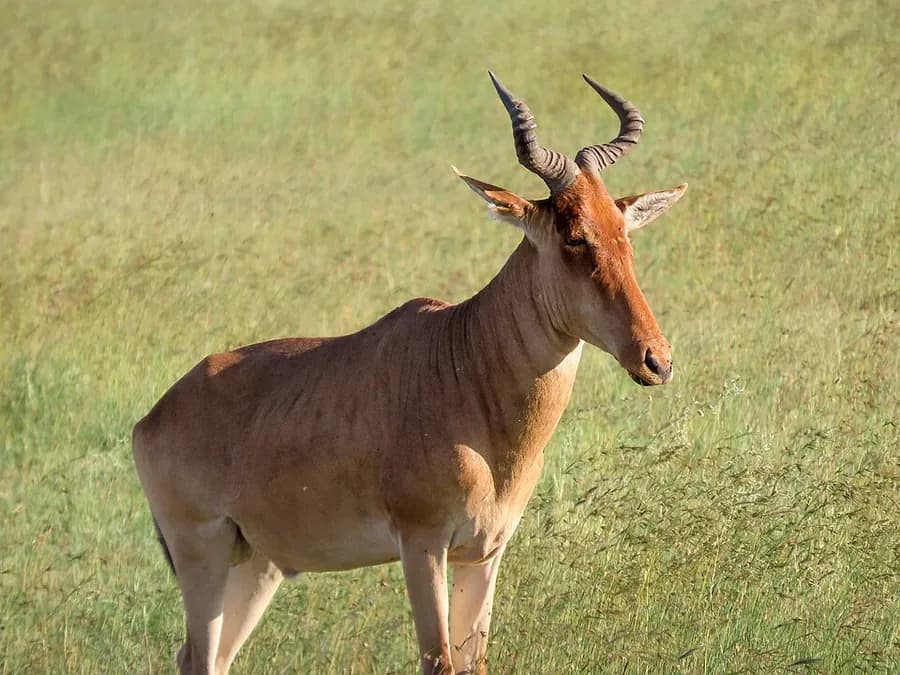
🐃Hartebeest
狷羚(學名:Alcelaphus buselaphus)是一種生活在草原地帶的羚羊,出沒在西非、東非、南非等地區。牠也是唯一歸入狷羚属的動物。 狷羚立高約為1.5米,體重約120-200公斤。雄性狷羚為深褐色,雌性則為黃褐色。雄性及雌性狷羚的角的形狀也是先向外曲,再向前,並且向後尖。角的長度可達70厘米。 狷羚生活在草原或一些灌木林地,以短草為食物。牠們是日間活動,在早上及黃昏時段覓食。族群數目約5-20頭,有些甚至達到350頭的數目。族群由一頭雄性狷羚所帶領,領袖的狷羚是經過打鬥而產生的。 在狷羚下,有以下7個亞種: 北非狷羚(Bubal Hartebeest,學名為Alcelaphus buselaphus buselaphus,已絕種。) 披紅狷羚(Red (Cape) Hartebeest,學名為Alcelaphus buselaphus caama。) 柯氏狷羚(Coke Hartebeest,學名為Alcelaphus buselaphus cokii。) Lelwel Hartebeest,學名為Alcelaphus buselaphus lelwel。 Western Hartebeest,學名為Alcelaphus buselaphus major。 Swayne Hartebeest,學名為Alcelaphus buselaphus swaynei。 Tora Hartebeest,學名為Alcelaphus buselaphus tora。 另外,亦有發現部份亞種互相交配混種所生的品種: Kenya Highland Hartebeest:是由Lelwel Hartebeest與柯氏狷羚混種而生。 Neumann Hartebeest:於伊索匹亞發現,是Lelwel Hartebeest與Swayne Hartebeest混種所生。 除了以上的亞種外,部份學者把利氏麋羚(Lichtenstein's Hartebeest)分類為狷羚的一個亞種,並以Alcelaphus lichtensteinii命名。 在轉角牛羚屬中,有兩個品種亦被稱為狷羚的: 鄂氏牛羚(Korrigum或稱Senegal Hartebeest,其學名為Damaliscus lunatus korrigum。) Tiang (Tiang Hartebeest),其學名為Damaliscus lunatus tiang。
Text: Wikipedia, CC BY-SA 4.0.
IUCN Red List assessment, 2019.
- Body mass
- 160 kg
- Body length
- 2.15 m
- Shoulder height
- not recorded
- Top speed
- not recorded
- Bite force
- not recorded
- Maximum lifespan
- 16 years
Everything we know about the Hartebeest
Typical adult figures. Where a value is an estimate rather than a measurement, it says so.
Body mass160 kgCOMBINEOther figures ↓Hide ↑
Source: COMBINE · v1 (Soria et al. 2021) · CC BY 4.0
Figures vary
- 159 kgAnAgeAnAge build 15, 2023-07-03 (HAGR)data quality: acceptable
Body length2.15 mCOMBINEDetails ↓Hide ↑
Source: COMBINE · v1 (Soria et al. 2021) · CC BY 4.0
Brain mass295 gCOMBINEDetails ↓Hide ↑
Source: COMBINE · v1 (Soria et al. 2021) · CC BY 4.0
Maximum lifespan16 yearsCOMBINEOther figures ↓Hide ↑
Source: COMBINE · v1 (Soria et al. 2021) · CC BY 4.0
Figures vary
- 23 yearsAnAgeAnAge build 15, 2023-07-03 (HAGR)data quality: acceptable
Generation length7.84 yearsCOMBINEDetails ↓Hide ↑
Source: COMBINE · v1 (Soria et al. 2021) · CC BY 4.0
Age at maturity1.9 yearsCOMBINEDetails ↓Hide ↑
Source: COMBINE · v1 (Soria et al. 2021) · CC BY 4.0
Gestation241 daysCOMBINEOther figures ↓Hide ↑
Source: COMBINE · v1 (Soria et al. 2021) · CC BY 4.0
Figures vary
- 247 daysAnAgeAnAge build 15, 2023-07-03 (HAGR)data quality: acceptable
Litter size1COMBINEOther figures ↓Hide ↑
Source: COMBINE · v1 (Soria et al. 2021) · CC BY 4.0
Figures vary
- 1AnAgeAnAge build 15, 2023-07-03 (HAGR)data quality: acceptable
Trophic levelHerbivoreCOMBINEDetails ↓Hide ↑
Source: COMBINE · v1 (Soria et al. 2021) · CC BY 4.0
Activity cycleCrepuscular / mixedCOMBINEDetails ↓Hide ↑
Source: COMBINE · v1 (Soria et al. 2021) · CC BY 4.0
Home range3.57 km²COMBINEDetails ↓Hide ↑
Source: COMBINE · v1 (Soria et al. 2021) · CC BY 4.0
Population density0.97 per km²COMBINEDetails ↓Hide ↑
Source: COMBINE · v1 (Soria et al. 2021) · CC BY 4.0
Volume l160 LaverageDetails ↓Hide ↑
Body mass at ~1.0 kg/L, the density of vertebrate tissue.
average = a mean across sexes or species in a group.
Not recorded for Hartebeest yet: shoulder height, top speed, bite force.
Family tree
- kingdomAnimalia
- ›phylumChordata
- ›classMammalia
- ›orderArtiodactyla
- ›familyBovidae
- ›genusAlcelaphus
- ›speciesAlcelaphus buselaphus
- classMammals · Mammalia
- orderEven-toed hoofed animals · Artiodactyla
- subfamilyAlcelaphinae
- genusAlcelaphus
All 16 branches ↓Fewer branches ↑
- kingdomMetazoa
- phylumChordata
- subphylumCraniata
- subphylumVertebrata
- superclassGnathostomata
- superclassSarcopterygii
- superclassTetrapoda
- classMammals · Mammalia
- subclassTheria
- superorderLaurasiatheria
- orderEven-toed hoofed animals · Artiodactyla
- suborderRuminantia
- infraorderPecora
- familyBovidae
- subfamilyAlcelaphinae
- genusAlcelaphus
More about the Hartebeest


No videos of the Hartebeest yet.
We have 44,653 videos so far, and none of them features this animal yet.
All videos →Compare the Hartebeest
Pick a tool — the Hartebeest is already selected.
Compare every stat with any other animal.
Stand them on the same floor and see who's bigger.
How speed, brain and bite scale with body size. This animal isn't in the sample yet.
See where it sits in the tree of life.