
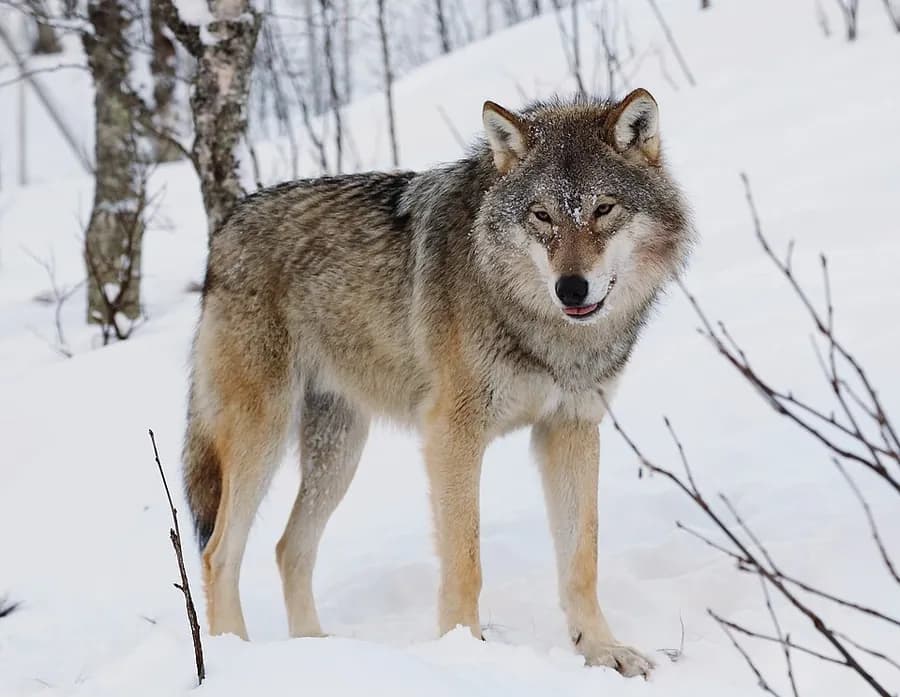
🐺Grey wolf
狼(學名:Canis lupus)又稱豺狼、灰狼、灰豺狗等,哺乳綱,犬科,與狗為同一物種,為現生犬科動物中體型最大的物種。狼曾是地球上分佈地區最廣的哺乳動物,包括北美和歐亞大陸,但如今在西歐、墨西哥與美國大部份地區已然絕跡。它們主要棲息在荒野或偏遠地區,但並不限於此。由于狼对人类及其圈养牲畜的威胁,栖息地曾遭到大量的破坏,现其棲息地已經縮減了三分之一。 目前,狼主要分佈於亞洲、歐洲、北美和中東(主要是北半球的溫帶區域)。它們是生態系統原有的一部分,各地不同生態系統的多樣性,反映了狼這個物種的適應能力。這其中包括而不限於森林、沙漠、山地、寒帶草原、西伯利亞針葉林、草地。 雖然就整個物種而言,狼被世界自然保護聯盟列為絕種威脅程度最小的等級,然而在某些地區,不同亞種的狼被列為瀕臨絕種或是受絕種威脅的動物。現今在很多地區,狼仍然因為活動或是被視為對牲口威脅的原因,而遭受捕獵。 狼是社會性的獵食動物,狼群以群居的形式組成,包括一對配偶、及其子女,有時也包括收養的未成年幼狼。狼屬於典型的食物鏈上層掠食者。在牠們的棲息地中,只有人類和老虎對它們構成實質威脅。它們通常群體行動,由於狼會捕食羊等家畜,因此直到20世紀末期前都被人類大量捕殺,一些亞種如日本狼、紐芬蘭狼等都已經絕種,雖然有一些其它亞種已經確認,但亞種的確切數量仍舊未定。 为濒危野生动植物种国际贸易公约附录II所列的保护动物(除被列入附录Ⅰ的不丹、印度、尼泊尔和巴基斯坦种群以及其家养型,即狗Canis lupus familiaris和澳洲野狗Canis lupus dingo)。
Text: Wikipedia, CC BY-SA 4.0.
IUCN Red List assessment, 2026.
- Body mass
- 29 kg
- Body length
- 1.27 m
- Shoulder height
- 0.73 m
- Top speed
- 62 km/h
- Bite force
- 593 N
- Maximum lifespan
- 29 years
Everything we know about the Grey wolf
Typical adult figures. Where a value is an estimate rather than a measurement, it says so.
Body mass29 kgCOMBINEOther figures ↓Hide ↑
Source: COMBINE · v1 (Soria et al. 2021) · CC BY 4.0
Figures vary
- 27 kgAnAgeAnAge build 15, 2023-07-03 (HAGR)data quality: high
Body length1.27 mCOMBINEDetails ↓Hide ↑
Source: COMBINE · v1 (Soria et al. 2021) · CC BY 4.0
Shoulder height0.73 m0.66–0.81 m · typical rangecarcass, laid on sideDetails ↓Hide ↑
Global range, not sex-split. Young & Goldman 1944 (North America) give 0.66-0.97 m. The Heptner row in this file is USSR-centric and runs higher; prefer this one for a species-level figure.
Source: Hunter 2011, Carnivores of the World, Plate 43 · see citation
Top speed62 km/hDetails ↓Hide ↑
Sprint over a short distance, not a sustained pace. Compilations give 62.06 and 63.97 km/h.
Source: Iriarte-Diaz 2002, J Exp Biol 205:2897 and Christiansen 2002, Zool J Linn Soc 136:685; compiled in Hirt et al. 2017, Nat Ecol Evol 1:1116, Supplementary Data · see citation
Bite force593 NDetails ↓Hide ↑
Canine bite modelled by the dry-skull method (Thomason 1991) from a prepared skull; static bite at the canines, gape not stated. Not a live measurement. The skull's estimated body mass was 34.7 kg. A lever model of captive-animal skulls gives 1141 N for the same species (Rozycka et al. 2024, Animals 14:1367).
Source: Wroe, McHenry & Thomason 2005, Proc R Soc B 272:619, Table 1 · see citation
Bite force for its size136Details ↓Hide ↑
Bite force normalised for body mass: the residual of canine bite force regressed on body mass, average across the sample set to 100. Above 100 means the animal bites harder than its size predicts. Do not cross-check against Wikipedia's BFQ table, which silently mixes this paper with Christiansen & Wroe 2007 and cites a popular-science book.
Source: Wroe, McHenry & Thomason 2005, Proc R Soc B 272:619, Table 1 · see citation
Brain mass136 gCOMBINEDetails ↓Hide ↑
Source: COMBINE · v1 (Soria et al. 2021) · CC BY 4.0
Maximum lifespan29 yearsCOMBINEOther figures ↓Hide ↑
Source: COMBINE · v1 (Soria et al. 2021) · CC BY 4.0
Figures vary
- 21 yearsAnAgeAnAge build 15, 2023-07-03 (HAGR)data quality: high
Generation length7.89 yearsCOMBINEDetails ↓Hide ↑
Source: COMBINE · v1 (Soria et al. 2021) · CC BY 4.0
Age at maturity1.9 yearsCOMBINEDetails ↓Hide ↑
Source: COMBINE · v1 (Soria et al. 2021) · CC BY 4.0
Gestation62 daysCOMBINEOther figures ↓Hide ↑
Source: COMBINE · v1 (Soria et al. 2021) · CC BY 4.0
Figures vary
- 62 daysAnAgeAnAge build 15, 2023-07-03 (HAGR)data quality: high
Litter sizeabout 5COMBINEOther figures ↓Hide ↑
Source: COMBINE · v1 (Soria et al. 2021) · CC BY 4.0
Figures vary
- 6AnAgeAnAge build 15, 2023-07-03 (HAGR)data quality: high
Trophic levelCarnivoreCOMBINEDetails ↓Hide ↑
Source: COMBINE · v1 (Soria et al. 2021) · CC BY 4.0
Activity cycleCrepuscular / mixedCOMBINEDetails ↓Hide ↑
Source: COMBINE · v1 (Soria et al. 2021) · CC BY 4.0
Home range160 km²COMBINEDetails ↓Hide ↑
Source: COMBINE · v1 (Soria et al. 2021) · CC BY 4.0
Population density0.03 per km²COMBINEDetails ↓Hide ↑
Source: COMBINE · v1 (Soria et al. 2021) · CC BY 4.0
Volume l29 LaverageDetails ↓Hide ↑
Body mass at ~1.0 kg/L, the density of vertebrate tissue.
average = a mean across sexes or species in a group.
Family tree
- kingdomAnimalia
- ›phylumChordata
- ›classMammalia
- ›orderCarnivora
- ›familyCanidae
- ›genusCanis
- ›speciesCanis lupus
- classMammals · Mammalia
- orderCarnivorans · Carnivora
- suborderCaniformia
- familyCanidae
All 13 branches ↓Fewer branches ↑
- kingdomMetazoa
- phylumChordata
- subphylumCraniata
- subphylumVertebrata
- superclassGnathostomata
- superclassSarcopterygii
- superclassTetrapoda
- classMammals · Mammalia
- subclassTheria
- superorderLaurasiatheria
- orderCarnivorans · Carnivora
- suborderCaniformia
- familyCanidae
More about the Grey wolf


镜头下的动物
站内动物的实拍影像——捕猎、打斗,还有各自过日子的样子。
Compare the Grey wolf
Pick a tool — the Grey wolf is already selected.
Compare every stat with any other animal.
Stand them on the same floor and see who's bigger.
Does it punch above its weight? Its stats against what body size predicts.
See where it sits in the tree of life.