
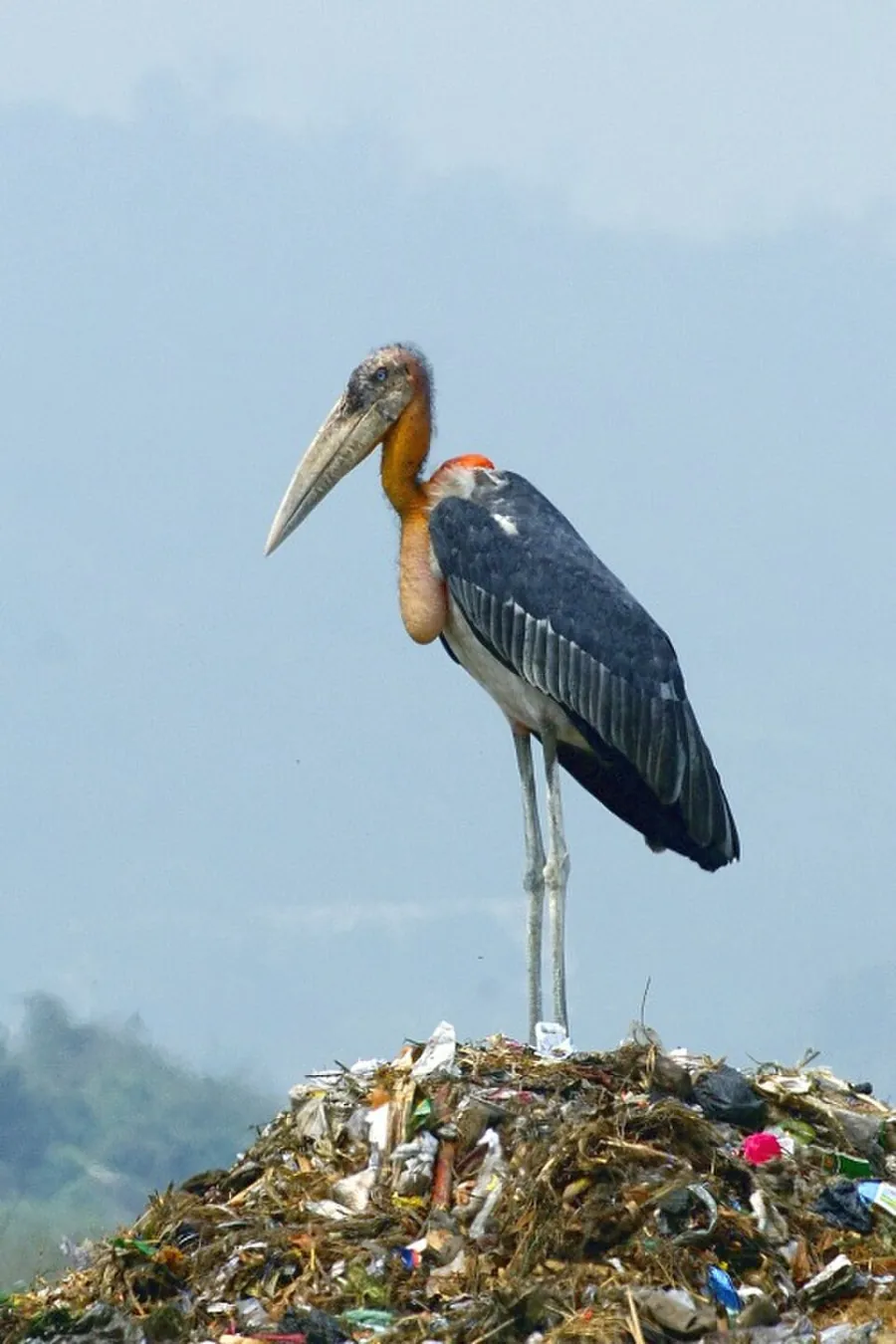
🐦Greater Adjutant
The greater adjutant is a member of the stork family, Ciconiidae. Its genus includes the lesser adjutant of Asia and the marabou stork of Africa. Once found widely across southern Asia and mainland southeast Asia, the greater adjutant is now restricted to a much smaller range with only three breeding populations; two in India, one in the north-eastern state of Assam and a smaller one around Bhagalpur; and another breeding population in Cambodia. They disperse widely after the breeding season. This large stork has a massive wedge-shaped bill, a bare head and a distinctive neck pouch. During the day, it soars in thermals along with vultures with whom it shares the habit of scavenging. They feed mainly on carrion and offal; however, they are opportunistic and will sometimes prey on vertebrates. The English name is derived from their stiff "military" gait when walking on the ground. Large numbers once lived in Asia, but they have declined to the point of endangerment. The total population in 2008 was estimated at around a thousand individuals. In the 19th century, they were especially common in the city of Calcutta, where they were referred to as the "Calcutta adjutant" and included in the coat of arms for the city. Known locally as hargila and considered to be unclean birds, they were largely left undisturbed but sometimes hunted for the use of their meat in folk medicine. Valued as scavengers, they were once depicted in the logo of the Calcutta Municipal Corporation.
Text: Wikipedia, CC BY-SA 4.0.
IUCN Red List assessment, 2023.
- Body mass
- 9.05 kg
- Body length
- not recorded
- Shoulder height
- not recorded
- Top speed
- not recorded
- Bite force
- not recorded
- Maximum lifespan
- 43 years
Everything we know about the Greater Adjutant
Typical adult figures. Where a value is an estimate rather than a measurement, it says so.
Body mass9.05 kgAVONETDetails ↓Hide ↑
Source: AVONET · v1.1 (Tobias et al. 2022) · CC BY 4.0
Tail length0.3 mAVONETDetails ↓Hide ↑
Source: AVONET · v1.1 (Tobias et al. 2022) · CC BY 4.0
Wing length0.76 mAVONETDetails ↓Hide ↑
Source: AVONET · v1.1 (Tobias et al. 2022) · CC BY 4.0
Beak length0.29 mAVONETDetails ↓Hide ↑
Source: AVONET · v1.1 (Tobias et al. 2022) · CC BY 4.0
Tarsus length0.31 mAVONETDetails ↓Hide ↑
Source: AVONET · v1.1 (Tobias et al. 2022) · CC BY 4.0
Maximum lifespan43 yearsAnAgeDetails ↓Hide ↑
data quality: acceptable
Source: AnAge · AnAge build 15, 2023-07-03 (HAGR) · CC BY 3.0
Trophic levelCarnivoreAVONETDetails ↓Hide ↑
Source: AVONET · v1.1 (Tobias et al. 2022) · CC BY 4.0
HabitatWetlandAVONETDetails ↓Hide ↑
Source: AVONET · v1.1 (Tobias et al. 2022) · CC BY 4.0
LifestyleTerrestrialAVONETDetails ↓Hide ↑
Source: AVONET · v1.1 (Tobias et al. 2022) · CC BY 4.0
Volume l9.1 LaverageDetails ↓Hide ↑
Body mass at ~1.0 kg/L, the density of vertebrate tissue.
average = a mean across sexes or species in a group.
Not recorded for Greater Adjutant yet: body length, shoulder height, top speed, bite force.
Family tree
- kingdomAnimalia
- ›phylumChordata
- ›classAves
- ›orderCiconiiformes
- ›familyCiconiidae
- ›genusLeptoptilos
- ›speciesLeptoptilos dubius
- superclassTetrapoda
- orderSauria
- classBirds · Aves
- familyCiconiidae
All 10 branches ↓Fewer branches ↑
- kingdomMetazoa
- phylumChordata
- subphylumCraniata
- subphylumVertebrata
- superclassGnathostomata
- superclassSarcopterygii
- superclassTetrapoda
- orderSauria
- classBirds · Aves
- familyCiconiidae
More about the Greater Adjutant
No videos of the Greater Adjutant yet.
We have 44,653 videos so far, and none of them features this animal yet.
All videos →Compare the Greater Adjutant
Pick a tool — the Greater Adjutant is already selected.
Compare every stat with any other animal.
Stand them on the same floor and see who's bigger.
How speed, brain and bite scale with body size. This animal isn't in the sample yet.
See where it sits in the tree of life.