
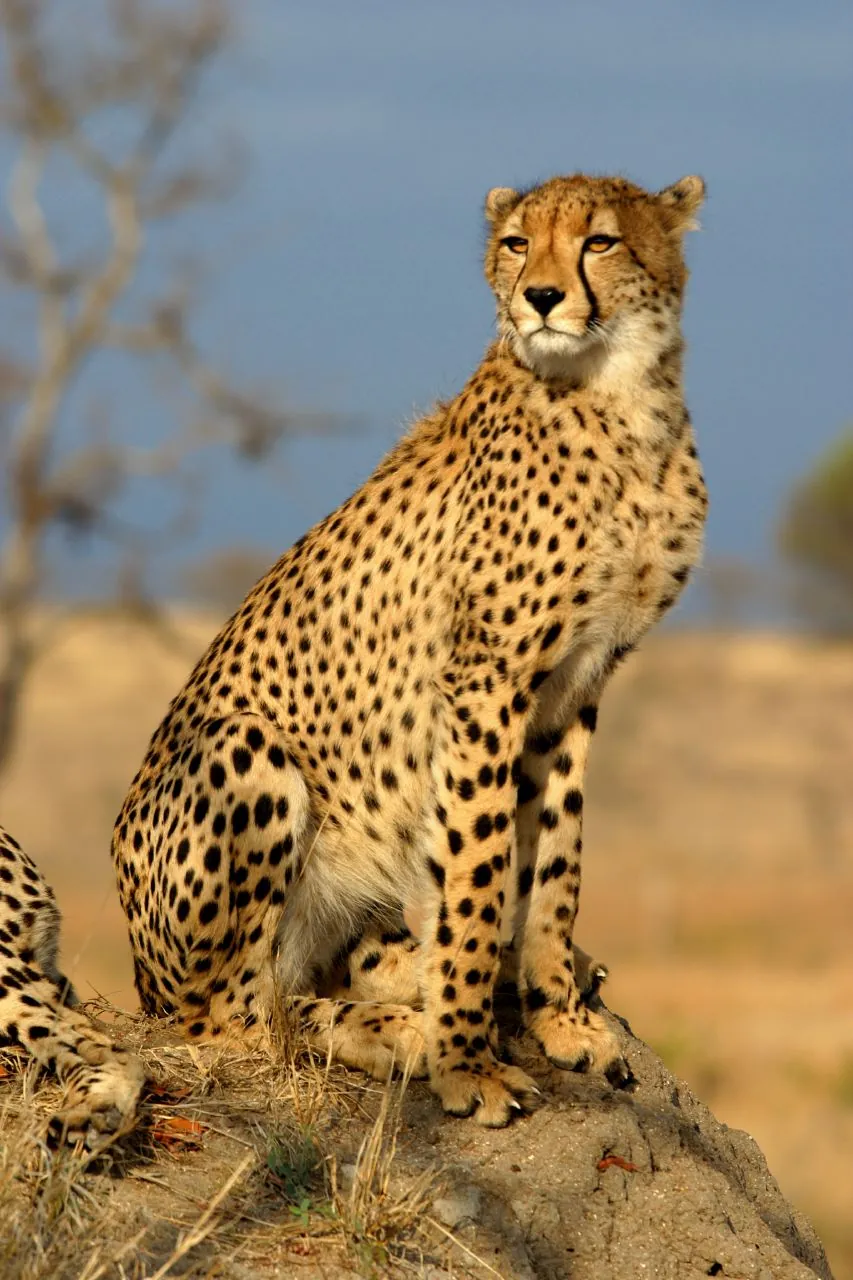
🐆Cheetah
猎豹(學名:Acinonyx jubatus)又称印度豹,是一种隶属于猫科动物中“猫亚科”的大型猫科动物,猎豹属现存唯一的物种。野生种群现分布于非洲和伊朗,历史上还曾见于西亚、中亚与南亚各国,栖息在较为干旱炎热的开阔生境,包括草原、半沙漠及裸岩地区。因被英国殖民时期的印度皇室大量饲养,用于狩猎羚羊和鹿,加之外貌与豹相似,故称猎豹(英文:Cheetah)。;体表遍布黑色斑点,与豹相比其斑点较小且均为实心;头小而圆,吻较短,眼部有白斑,内眼角沿鼻吻部两侧各有一道明显的黑纹。分为4个亞種:东南非猎豹、东北非猎豹、西北非獵豹和亚洲猎豹;其中数量最多、体型最大的为东南非猎豹,成年雄性体重29-71千克,均重45千克,成年雌性21-63千克,均重38千克;其他3个亚种的成年体重一般在35千克以下。 猎豹既可独居,也可由近亲属或配偶组成小群活动,是除狮子外最倾向群居的猫科。与其他猫科主要依靠伏击的捕猎方式不同,猎豹主要依靠奔跑进行追逐式捕猎,并以其惊人的奔跑速度而闻名,最高时速可超过120千米,是世界上跑得最快的动物。 为适应快速奔跑,猎豹演化出了猫科中颇为独特的身体结构。其骨架轻盈,躯干瘦削,四肢修长从而形成高挑的身材,脊椎富有弹性便于舒张,一条长尾在跑步转弯时可保持身体平衡。此外,猎豹是唯一不能伸缩爪子的猫科,其爪子较钝,作用类似跑鞋的鞋钉,能在高速奔跑时紧扣地面,防止摔跤或打滑。这些特征使猎豹一度被认为是猫科中的异类。旧时的形态学分类将其单列为猎豹亚科(Acinonychinae),独立于猫亚科与豹亚科之外;现代遗传学研究则证实猎豹属于猫亚科,与美洲金猫类(美洲狮、細腰貓等)同源,它们的最近共同祖先生活在670万年前的北美草原,约490万年前分化为猎豹类和美洲金猫类。猎豹经白令陸橋进入旧大陆后,其北美的亲族最终于1.1万年前的更新世末灭绝。 由于受到人类侵害,猎豹在许多亚非国家均已绝迹,特别是仅存不足100只的亚洲猎豹,正处于灭亡边缘,致危因素是过去遭大量猎杀,且人类过度放牧造成其栖息地退化和猎物密度降低,以及近代以来频发的交通事故。
Text: Wikipedia, CC BY-SA 4.0.
IUCN Red List assessment, 2024.
- Body mass
- 51 kg
- Body length
- 1.49 m
- Shoulder height
- 0.8 m
- Top speed
- 104 km/h
- Bite force
- 472 N
- Maximum lifespan
- 20 years
Everything we know about the Cheetah
Typical adult figures. Where a value is an estimate rather than a measurement, it says so.
Body mass51 kgCOMBINEOther figures ↓Hide ↑
Source: COMBINE · v1 (Soria et al. 2021) · CC BY 4.0
By sex
- Female35 kgWikidataQ23907
- Male40 kgWikidataQ23907
Figures vary
- 54 kgAnAgeAnAge build 15, 2023-07-03 (HAGR)data quality: high
Body length1.49 mCOMBINEDetails ↓Hide ↑
Source: COMBINE · v1 (Soria et al. 2021) · CC BY 4.0
Shoulder height0.8 m0.7–0.9 m · typical rangeDetails ↓Hide ↑
Sex not specified in source; value is the midpoint of the published range.
Source: Krausman & Morales 2005, Mammalian Species 771, p.2 · see citation
Top speed104 km/hDetails ↓Hide ↑
MEASURED: mean of three timed runs over a 201.2 m course with a running start (29 m/s). The fastest speed ever recorded from a FREE-RANGING cheetah is lower -- 93 km/h across 367 hunts by GPS and inertial collar (Wilson et al. 2013, Nature 498:185) -- and most hunts were far slower. Hirt's 120 km/h is speedofanimals.com.
Source: Sharp 1997, J Zool 241:493 (timed run) · see citation
Bite force472 NDetails ↓Hide ↑
Canine bite modelled by the dry-skull method (Thomason 1991) from a prepared skull; static bite at the canines, gape not stated. Not a live measurement. The skull's estimated body mass was 29.5 kg.
Source: Wroe, McHenry & Thomason 2005, Proc R Soc B 272:619, Table 1 · see citation
Bite force for its size119Details ↓Hide ↑
Bite force normalised for body mass: the residual of canine bite force regressed on body mass, average across the sample set to 100. Above 100 means the animal bites harder than its size predicts. Do not cross-check against Wikipedia's BFQ table, which silently mixes this paper with Christiansen & Wroe 2007 and cites a popular-science book.
Source: Wroe, McHenry & Thomason 2005, Proc R Soc B 272:619, Table 1 · see citation
Brain mass115 gCOMBINEDetails ↓Hide ↑
Source: COMBINE · v1 (Soria et al. 2021) · CC BY 4.0
Maximum lifespan20 yearsCOMBINEOther figures ↓Hide ↑
Source: COMBINE · v1 (Soria et al. 2021) · CC BY 4.0
Figures vary
- 21 yearsAnAgeAnAge build 15, 2023-07-03 (HAGR)data quality: high
Generation length6 yearsCOMBINEDetails ↓Hide ↑
Source: COMBINE · v1 (Soria et al. 2021) · CC BY 4.0
Age at maturity2.0 yearsCOMBINEDetails ↓Hide ↑
Source: COMBINE · v1 (Soria et al. 2021) · CC BY 4.0
Gestation90 daysCOMBINEOther figures ↓Hide ↑
Source: COMBINE · v1 (Soria et al. 2021) · CC BY 4.0
Figures vary
- 88 daysAnAgeAnAge build 15, 2023-07-03 (HAGR)data quality: high
Litter sizeabout 3COMBINEOther figures ↓Hide ↑
Source: COMBINE · v1 (Soria et al. 2021) · CC BY 4.0
Figures vary
- 3AnAgeAnAge build 15, 2023-07-03 (HAGR)data quality: high
Trophic levelCarnivoreCOMBINEDetails ↓Hide ↑
Source: COMBINE · v1 (Soria et al. 2021) · CC BY 4.0
Activity cycleDiurnalCOMBINEDetails ↓Hide ↑
Source: COMBINE · v1 (Soria et al. 2021) · CC BY 4.0
Home range88 km²COMBINEDetails ↓Hide ↑
Source: COMBINE · v1 (Soria et al. 2021) · CC BY 4.0
Population density0.02 per km²COMBINEDetails ↓Hide ↑
Source: COMBINE · v1 (Soria et al. 2021) · CC BY 4.0
Volume l51 LaverageDetails ↓Hide ↑
Body mass at ~1.0 kg/L, the density of vertebrate tissue.
average = a mean across sexes or species in a group.
Family tree
- kingdomAnimalia
- ›phylumChordata
- ›classMammalia
- ›orderCarnivora
- ›familyFelidae
- ›genusAcinonyx
- ›speciesAcinonyx jubatus
- classMammals · Mammalia
- orderCarnivorans · Carnivora
- subfamilyAcinonychinae
- genusAcinonyx
All 15 branches ↓Fewer branches ↑
- kingdomMetazoa
- phylumChordata
- subphylumCraniata
- subphylumVertebrata
- superclassGnathostomata
- superclassSarcopterygii
- superclassTetrapoda
- classMammals · Mammalia
- subclassTheria
- superorderLaurasiatheria
- orderCarnivorans · Carnivora
- suborderFeliformia
- familyFelidae
- subfamilyAcinonychinae
- genusAcinonyx
More about the Cheetah


镜头下的动物
站内动物的实拍影像——捕猎、打斗,还有各自过日子的样子。
Compare the Cheetah
Pick a tool — the Cheetah is already selected.
Compare every stat with any other animal.
Stand them on the same floor and see who's bigger.
Does it punch above its weight? Its stats against what body size predicts.
See where it sits in the tree of life.