
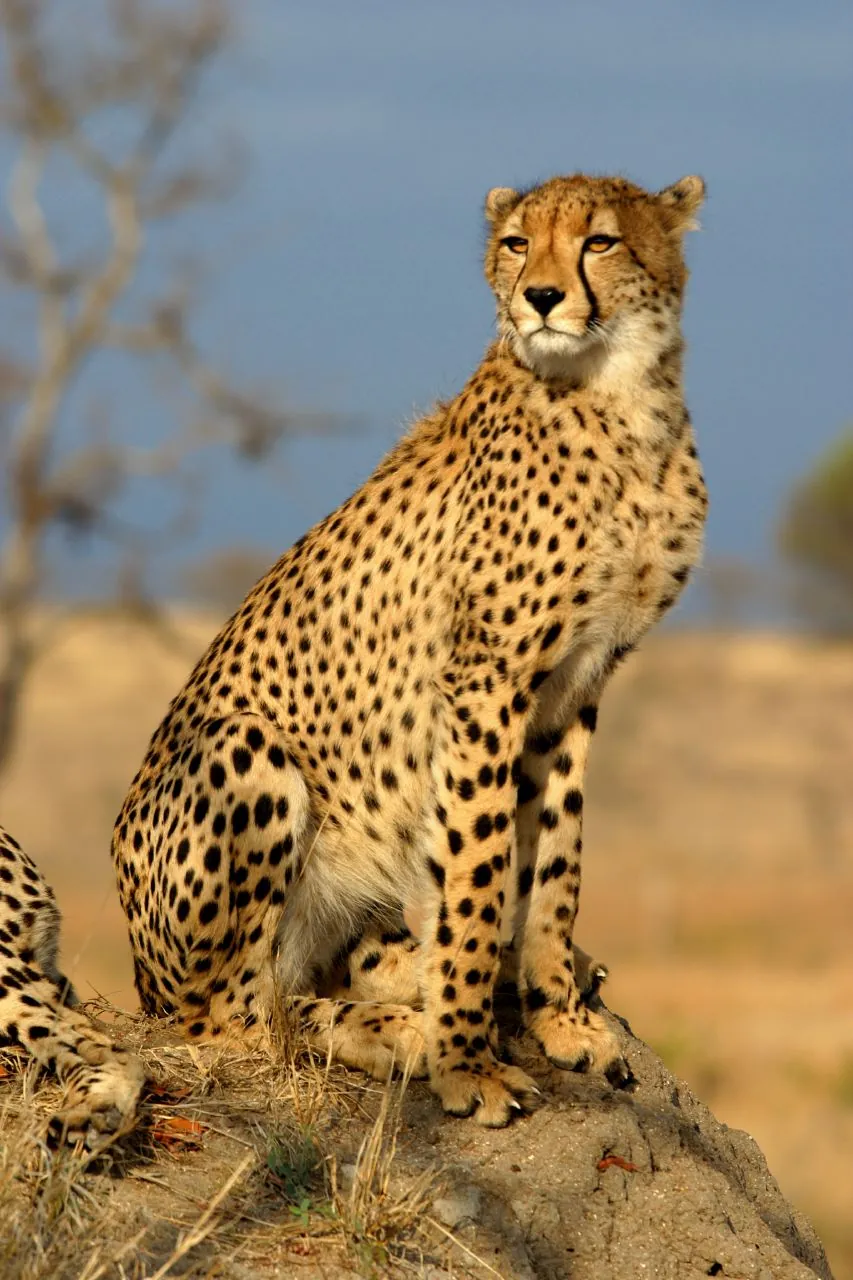
🐆Cheetah
Gepard (Acinonyx jubatus) är ett kattdjur och den enda arten i underfamiljen Acinonychinae och släktet Acinonyx. Den skiljer sig från andra kattdjur däri att den främst jagar dagtid och inte kan dra in klorna fullständigt. Liksom de flesta vilda kattdjur har geparden runda pupiller (endast några få mindre av de vilda kattdjuren har ovala pupiller, som t ex sandkatten och rostfläckig katt). Geparden är det snabbast springande, nu levande, landdäggdjuret på kortdistans och håller sedan 1965 Guinness världsrekord med 104,4 km/h på distansen 200 m. Det finns vissa källor som nämner hastigheter på över 114 km/h och ända upp till 120,7 (eller 75 mph), men de har än så länge blivit misskrediterade eller icke säkerställda.
Text: Wikipedia, CC BY-SA 4.0.
IUCN Red List assessment, 2024.
- Body mass
- 51 kg
- Body length
- 1.49 m
- Shoulder height
- 0.8 m
- Top speed
- 104 km/h
- Bite force
- 472 N
- Maximum lifespan
- 20 years
Everything we know about the Cheetah
Typical adult figures. Where a value is an estimate rather than a measurement, it says so.
Body mass51 kgCOMBINEOther figures ↓Hide ↑
Source: COMBINE · v1 (Soria et al. 2021) · CC BY 4.0
By sex
- Female35 kgWikidataQ23907
- Male40 kgWikidataQ23907
Figures vary
- 54 kgAnAgeAnAge build 15, 2023-07-03 (HAGR)data quality: high
Body length1.49 mCOMBINEDetails ↓Hide ↑
Source: COMBINE · v1 (Soria et al. 2021) · CC BY 4.0
Shoulder height0.8 m0.7–0.9 m · typical rangeDetails ↓Hide ↑
Sex not specified in source; value is the midpoint of the published range.
Source: Krausman & Morales 2005, Mammalian Species 771, p.2 · see citation
Top speed104 km/hDetails ↓Hide ↑
MEASURED: mean of three timed runs over a 201.2 m course with a running start (29 m/s). The fastest speed ever recorded from a FREE-RANGING cheetah is lower -- 93 km/h across 367 hunts by GPS and inertial collar (Wilson et al. 2013, Nature 498:185) -- and most hunts were far slower. Hirt's 120 km/h is speedofanimals.com.
Source: Sharp 1997, J Zool 241:493 (timed run) · see citation
Bite force472 NDetails ↓Hide ↑
Canine bite modelled by the dry-skull method (Thomason 1991) from a prepared skull; static bite at the canines, gape not stated. Not a live measurement. The skull's estimated body mass was 29.5 kg.
Source: Wroe, McHenry & Thomason 2005, Proc R Soc B 272:619, Table 1 · see citation
Bite force for its size119Details ↓Hide ↑
Bite force normalised for body mass: the residual of canine bite force regressed on body mass, average across the sample set to 100. Above 100 means the animal bites harder than its size predicts. Do not cross-check against Wikipedia's BFQ table, which silently mixes this paper with Christiansen & Wroe 2007 and cites a popular-science book.
Source: Wroe, McHenry & Thomason 2005, Proc R Soc B 272:619, Table 1 · see citation
Brain mass115 gCOMBINEDetails ↓Hide ↑
Source: COMBINE · v1 (Soria et al. 2021) · CC BY 4.0
Maximum lifespan20 yearsCOMBINEOther figures ↓Hide ↑
Source: COMBINE · v1 (Soria et al. 2021) · CC BY 4.0
Figures vary
- 21 yearsAnAgeAnAge build 15, 2023-07-03 (HAGR)data quality: high
Generation length6 yearsCOMBINEDetails ↓Hide ↑
Source: COMBINE · v1 (Soria et al. 2021) · CC BY 4.0
Age at maturity2.0 yearsCOMBINEDetails ↓Hide ↑
Source: COMBINE · v1 (Soria et al. 2021) · CC BY 4.0
Gestation90 daysCOMBINEOther figures ↓Hide ↑
Source: COMBINE · v1 (Soria et al. 2021) · CC BY 4.0
Figures vary
- 88 daysAnAgeAnAge build 15, 2023-07-03 (HAGR)data quality: high
Litter sizeabout 3COMBINEOther figures ↓Hide ↑
Source: COMBINE · v1 (Soria et al. 2021) · CC BY 4.0
Figures vary
- 3AnAgeAnAge build 15, 2023-07-03 (HAGR)data quality: high
Trophic levelCarnivoreCOMBINEDetails ↓Hide ↑
Source: COMBINE · v1 (Soria et al. 2021) · CC BY 4.0
Activity cycleDiurnalCOMBINEDetails ↓Hide ↑
Source: COMBINE · v1 (Soria et al. 2021) · CC BY 4.0
Home range88 km²COMBINEDetails ↓Hide ↑
Source: COMBINE · v1 (Soria et al. 2021) · CC BY 4.0
Population density0.02 per km²COMBINEDetails ↓Hide ↑
Source: COMBINE · v1 (Soria et al. 2021) · CC BY 4.0
Volume l51 LaverageDetails ↓Hide ↑
Body mass at ~1.0 kg/L, the density of vertebrate tissue.
average = a mean across sexes or species in a group.
Family tree
- kingdomAnimalia
- ›phylumChordata
- ›classMammalia
- ›orderCarnivora
- ›familyFelidae
- ›genusAcinonyx
- ›speciesAcinonyx jubatus
- classMammals · Mammalia
- orderCarnivorans · Carnivora
- subfamilyAcinonychinae
- genusAcinonyx
All 15 branches ↓Fewer branches ↑
- kingdomMetazoa
- phylumChordata
- subphylumCraniata
- subphylumVertebrata
- superclassGnathostomata
- superclassSarcopterygii
- superclassTetrapoda
- classMammals · Mammalia
- subclassTheria
- superorderLaurasiatheria
- orderCarnivorans · Carnivora
- suborderFeliformia
- familyFelidae
- subfamilyAcinonychinae
- genusAcinonyx
More about the Cheetah


Djur fångade på film
Riktig film på djuren här på sajten – när de jagar, slåss och bara lever sina liv.
Compare the Cheetah
Pick a tool — the Cheetah is already selected.
Compare every stat with any other animal.
Stand them on the same floor and see who's bigger.
Does it punch above its weight? Its stats against what body size predicts.
See where it sits in the tree of life.