
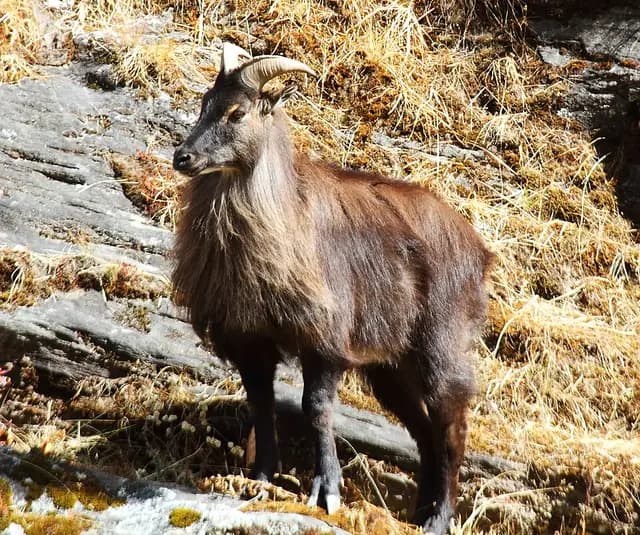
🐃Himalayan tahr
Гималайский тар, или тар (лат. Hemitragus jemlahicus) — животное из семейства полорогих. Тар относится к крупным диким животным. Ареал таров состоит из трёх участков: в Гималаях, горы Нилгири (нилгирийский тар) и на северо-восточной оконечности Аравийского полуострова (аравийский тар) — в Омане. Держатся тары небольшими группами до 20—40 голов. Ранее считалось, что все три вида тара относятся к одному роду, однако результаты недавних генетических исследований заставили пересмотреть эту точку зрения. Вид, живущий в Аравии, был отнесён к роду Arabitragus, а вид живущий в горах Нилгири — к роду Nilgiritragus. Длина тела самца тара 130—170 см, высота — 60—100 см, масса до 105 кг. Продолжительность жизни тара 10—14 лет. Тар внесён в Красную книгу Международного союза охраны природы.
Text: Wikipedia, CC BY-SA 4.0.
IUCN Red List assessment, 2020.
- Body mass
- 35 kg
- Body length
- 1.4 m
- Shoulder height
- not recorded
- Top speed
- not recorded
- Bite force
- not recorded
- Maximum lifespan
- 22 years
Everything we know about the Himalayan tahr
Typical adult figures. Where a value is an estimate rather than a measurement, it says so.
Body mass35 kgCOMBINEOther figures ↓Hide ↑
Source: COMBINE · v1 (Soria et al. 2021) · CC BY 4.0
Figures vary
- 35 kgAnAgeAnAge build 15, 2023-07-03 (HAGR)data quality: acceptable
Body length1.4 mCOMBINEDetails ↓Hide ↑
Source: COMBINE · v1 (Soria et al. 2021) · CC BY 4.0
Maximum lifespan22 yearsCOMBINEOther figures ↓Hide ↑
Source: COMBINE · v1 (Soria et al. 2021) · CC BY 4.0
Figures vary
- 24 yearsAnAgeAnAge build 15, 2023-07-03 (HAGR)data quality: acceptable
Generation length7 yearsCOMBINEDetails ↓Hide ↑
Source: COMBINE · v1 (Soria et al. 2021) · CC BY 4.0
Age at maturity4.2 yearsCOMBINEDetails ↓Hide ↑
Source: COMBINE · v1 (Soria et al. 2021) · CC BY 4.0
Gestation183 daysCOMBINEOther figures ↓Hide ↑
Source: COMBINE · v1 (Soria et al. 2021) · CC BY 4.0
Figures vary
- 183 daysAnAgeAnAge build 15, 2023-07-03 (HAGR)data quality: acceptable
Litter size1COMBINEOther figures ↓Hide ↑
Source: COMBINE · v1 (Soria et al. 2021) · CC BY 4.0
Figures vary
- 1AnAgeAnAge build 15, 2023-07-03 (HAGR)data quality: acceptable
Trophic levelHerbivoreCOMBINEDetails ↓Hide ↑
Source: COMBINE · v1 (Soria et al. 2021) · CC BY 4.0
Activity cycleCrepuscular / mixedCOMBINEDetails ↓Hide ↑
Source: COMBINE · v1 (Soria et al. 2021) · CC BY 4.0
Volume l35 LaverageDetails ↓Hide ↑
Body mass at ~1.0 kg/L, the density of vertebrate tissue.
average = a mean across sexes or species in a group.
Not recorded for Himalayan tahr yet: shoulder height, top speed, bite force.
Family tree
- kingdomAnimalia
- ›phylumChordata
- ›classMammalia
- ›orderArtiodactyla
- ›familyBovidae
- ›genusHemitragus
- ›speciesHemitragus jemlahicus
- classMammals · Mammalia
- orderEven-toed hoofed animals · Artiodactyla
- subfamilyCaprinae
- genusHemitragus
All 16 branches ↓Fewer branches ↑
- kingdomMetazoa
- phylumChordata
- subphylumCraniata
- subphylumVertebrata
- superclassGnathostomata
- superclassSarcopterygii
- superclassTetrapoda
- classMammals · Mammalia
- subclassTheria
- superorderLaurasiatheria
- orderEven-toed hoofed animals · Artiodactyla
- suborderRuminantia
- infraorderPecora
- familyBovidae
- subfamilyCaprinae
- genusHemitragus
More about the Himalayan tahr


No videos of the Himalayan tahr yet.
We have 44,653 videos so far, and none of them features this animal yet.
All videos →Compare the Himalayan tahr
Pick a tool — the Himalayan tahr is already selected.
Compare every stat with any other animal.
Stand them on the same floor and see who's bigger.
How speed, brain and bite scale with body size. This animal isn't in the sample yet.
See where it sits in the tree of life.