
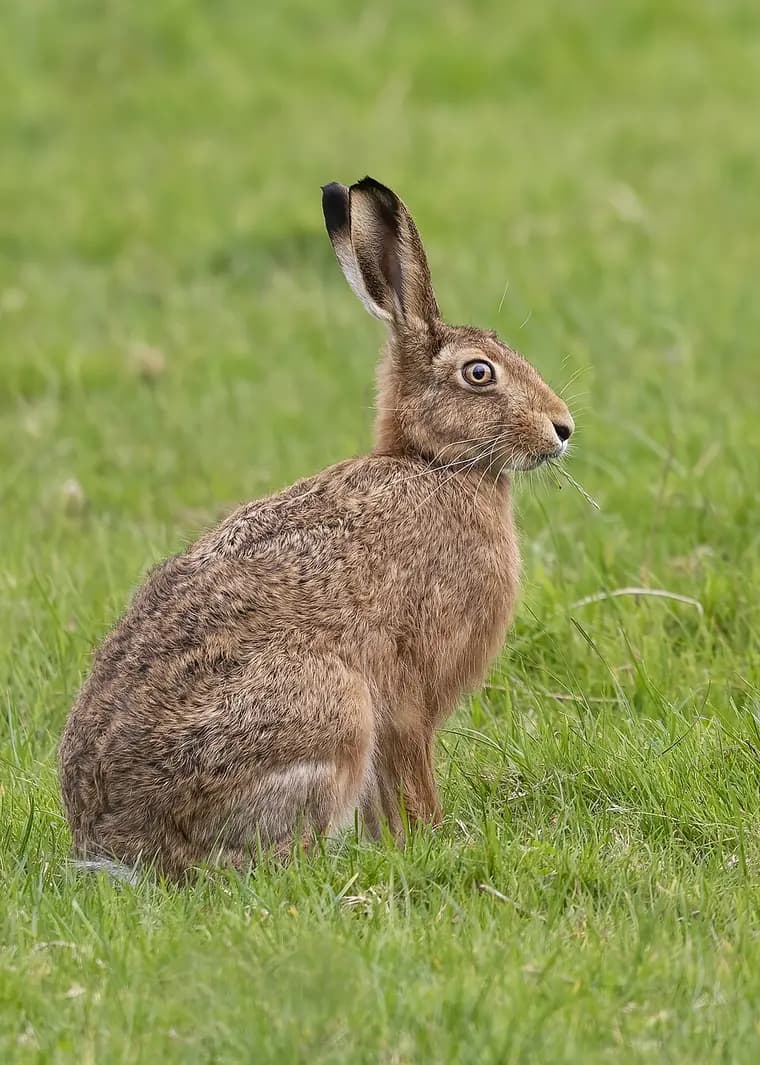
🐇European hare
A lebre-comum ou lebre-europeia (Lepus europaeus) é um animal muito conhecido, que se encontra entre as principais espécies cinegéticas. De origem estepária, abunda sobretudo em zonas agrícolas pouco humanizadas. Existe em toda a Europa com exceção da Península Escandinava, parte da Península Ibérica e de algumas ilhas do Mar Mediterrâneo. Ocorre também no Norte de África e na Ásia Ocidental. Ao contrário do coelho, a lebre abriga-se em tocas pouco profundas já que conta com a sua coloração mimética para se dissimular na paisagem. Vive solitariamente, com exceção do período do cio. O cio ocorre de Janeiro a Outubro e as crias já nascem com pelo e aptas a ver. As lebres comuns foram introduzidas na América do Sul por europeus e vivem em campos e dunas, sendo animais noturnos que, ao anoitecer, saem para se alimentarem e acasalar-se. As lebres alimentam-se com brotos de gramas, folhas de amendoim, milho, feijão, alface e, principalmente, raízes de mandioca. As lebres não têm o hábito de dormir em tocas e dormem sob arbustos, sempre viradas para um ponto de saída estratégica em caso de ataque de seus predadores.
Text: Wikipedia, CC BY-SA 4.0.
IUCN Red List assessment, 2019.
- Body mass
- 3.67 kg
- Body length
- 0.61 m
- Shoulder height
- not recorded
- Top speed
- not recorded
- Bite force
- not recorded
- Maximum lifespan
- 12 years
Everything we know about the European hare
Typical adult figures. Where a value is an estimate rather than a measurement, it says so.
Body mass3.67 kgCOMBINEOther figures ↓Hide ↑
Source: COMBINE · v1 (Soria et al. 2021) · CC BY 4.0
Figures vary
- 4.17 kgAnAgeAnAge build 15, 2023-07-03 (HAGR)data quality: acceptable
Body length0.61 mCOMBINEDetails ↓Hide ↑
Source: COMBINE · v1 (Soria et al. 2021) · CC BY 4.0
Brain mass14 gCOMBINEDetails ↓Hide ↑
Source: COMBINE · v1 (Soria et al. 2021) · CC BY 4.0
Maximum lifespan12 yearsCOMBINEOther figures ↓Hide ↑
Source: COMBINE · v1 (Soria et al. 2021) · CC BY 4.0
Figures vary
- 11 yearsAnAgeAnAge build 15, 2023-07-03 (HAGR)data quality: acceptable
Generation length2 yearsCOMBINEDetails ↓Hide ↑
Source: COMBINE · v1 (Soria et al. 2021) · CC BY 4.0
Age at maturity211 daysCOMBINEDetails ↓Hide ↑
Source: COMBINE · v1 (Soria et al. 2021) · CC BY 4.0
Gestation42 daysCOMBINEOther figures ↓Hide ↑
Source: COMBINE · v1 (Soria et al. 2021) · CC BY 4.0
Figures vary
- 42 daysAnAgeAnAge build 15, 2023-07-03 (HAGR)data quality: acceptable
Litter sizeabout 2COMBINEOther figures ↓Hide ↑
Source: COMBINE · v1 (Soria et al. 2021) · CC BY 4.0
Figures vary
- 2AnAgeAnAge build 15, 2023-07-03 (HAGR)data quality: acceptable
Trophic levelHerbivoreCOMBINEDetails ↓Hide ↑
Source: COMBINE · v1 (Soria et al. 2021) · CC BY 4.0
Activity cycleNocturnalCOMBINEDetails ↓Hide ↑
Source: COMBINE · v1 (Soria et al. 2021) · CC BY 4.0
Home range0.31 km²COMBINEDetails ↓Hide ↑
Source: COMBINE · v1 (Soria et al. 2021) · CC BY 4.0
Population density47 per km²COMBINEDetails ↓Hide ↑
Source: COMBINE · v1 (Soria et al. 2021) · CC BY 4.0
Volume l3.7 LaverageDetails ↓Hide ↑
Body mass at ~1.0 kg/L, the density of vertebrate tissue.
average = a mean across sexes or species in a group.
Not recorded for European hare yet: shoulder height, top speed, bite force.
Family tree
- kingdomAnimalia
- ›phylumChordata
- ›classMammalia
- ›orderLagomorpha
- ›familyLeporidae
- ›genusLepus
- ›speciesLepus europaeus
- classMammals · Mammalia
- orderRabbits & hares · Lagomorpha
- familyLeporidae
- genusLepus
All 13 branches ↓Fewer branches ↑
- kingdomMetazoa
- phylumChordata
- subphylumCraniata
- subphylumVertebrata
- superclassGnathostomata
- superclassSarcopterygii
- superclassTetrapoda
- classMammals · Mammalia
- subclassTheria
- superorderEuarchontoglires
- orderRabbits & hares · Lagomorpha
- familyLeporidae
- genusLepus
More about the European hare


No videos of the European hare yet.
We have 44,653 videos so far, and none of them features this animal yet.
All videos →Compare the European hare
Pick a tool — the European hare is already selected.
Compare every stat with any other animal.
Stand them on the same floor and see who's bigger.
How speed, brain and bite scale with body size. This animal isn't in the sample yet.
See where it sits in the tree of life.