
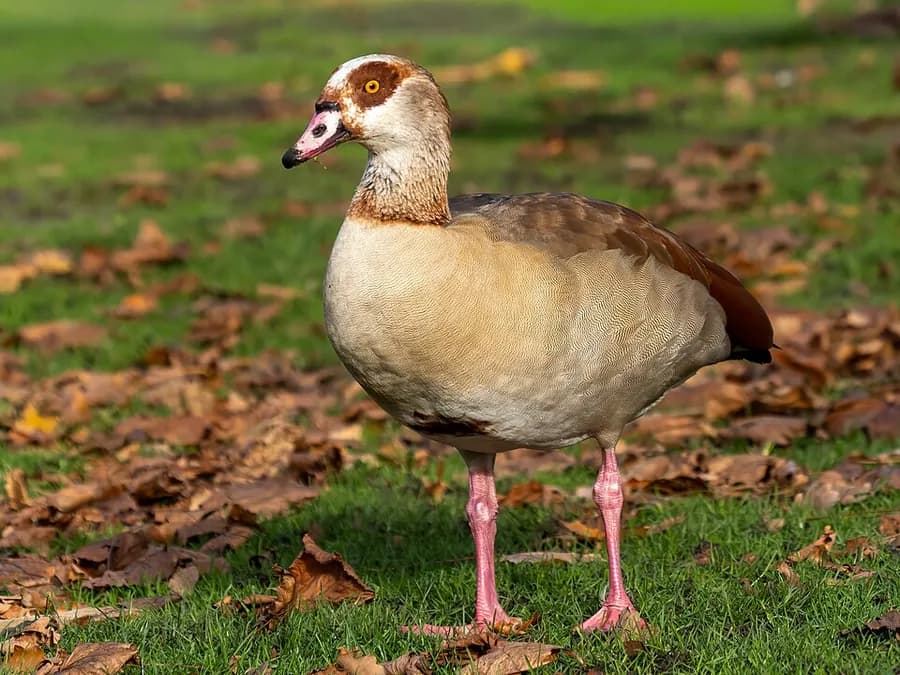
🦆Egyptian Goose
O ganso-do-egito (Alopochen aegyptiaca) é uma ave anseriforme do grupo dos gansos. A sua área de distribuição inclui a Europa e a África. É especialmente comum no sul do Saara e vale do Nilo. Embora não seja uma espécie autóctone, trata-se de uma ave selvagem que formou uma população estável em Portugal, especialmente na região do Alentejo. No século XVIII, esta espécie foi introduzida na Grã-Bretanha, onde desenvolveu uma população importante. Por igual, esta espécie também já se difundiu pelos Países Baixos, Bélgica e Alemanha. Era considerado sagrado no Antigo Egito e estava presente em muitas obras de arte. Graças à sua popularidade como ave ornamental, fugitivos são comuns e populações ferais foram estabelecidas na Europa Ocidental, nos Estados Unidos e na Nova Zelândia. O ganso-do-egito evita zonas densamente arborizadas e pode ser normalmente encontrado em prados, relvados e campos agrícolas. Passa a maior parte do tempo em rios, lagos e terras alagadas. Pode ser encontrado em altitudes elevadas de até cerca de 4 000 metros.
Text: Wikipedia, CC BY-SA 4.0.
IUCN Red List assessment, 2018.
- Body mass
- 1.87 kg
- Body length
- not recorded
- Shoulder height
- not recorded
- Top speed
- not recorded
- Bite force
- not recorded
- Maximum lifespan
- 26 years
Everything we know about the Egyptian Goose
Typical adult figures. Where a value is an estimate rather than a measurement, it says so.
Body mass1.87 kgAVONETOther figures ↓Hide ↑
Source: AVONET · v1.1 (Tobias et al. 2022) · CC BY 4.0
Figures vary
- 1.9 kgAnAgeAnAge build 15, 2023-07-03 (HAGR)data quality: acceptable
Tail length0.13 mAVONETDetails ↓Hide ↑
Source: AVONET · v1.1 (Tobias et al. 2022) · CC BY 4.0
Wing length0.36 mAVONETDetails ↓Hide ↑
Source: AVONET · v1.1 (Tobias et al. 2022) · CC BY 4.0
Beak length0.05 mAVONETDetails ↓Hide ↑
Source: AVONET · v1.1 (Tobias et al. 2022) · CC BY 4.0
Tarsus length0.08 mAVONETDetails ↓Hide ↑
Source: AVONET · v1.1 (Tobias et al. 2022) · CC BY 4.0
Maximum lifespan26 yearsAnAgeDetails ↓Hide ↑
data quality: acceptable
Source: AnAge · AnAge build 15, 2023-07-03 (HAGR) · CC BY 3.0
Gestation29 daysAnAgeDetails ↓Hide ↑
data quality: acceptable
Source: AnAge · AnAge build 15, 2023-07-03 (HAGR) · CC BY 3.0
Litter sizeabout 7AnAgeDetails ↓Hide ↑
data quality: acceptable
Source: AnAge · AnAge build 15, 2023-07-03 (HAGR) · CC BY 3.0
Trophic levelHerbivoreAVONETDetails ↓Hide ↑
Source: AVONET · v1.1 (Tobias et al. 2022) · CC BY 4.0
HabitatWetlandAVONETDetails ↓Hide ↑
Source: AVONET · v1.1 (Tobias et al. 2022) · CC BY 4.0
LifestyleGeneralistAVONETDetails ↓Hide ↑
Source: AVONET · v1.1 (Tobias et al. 2022) · CC BY 4.0
Volume l1.9 LaverageDetails ↓Hide ↑
Body mass at ~1.0 kg/L, the density of vertebrate tissue.
average = a mean across sexes or species in a group.
Not recorded for Egyptian Goose yet: body length, shoulder height, top speed, bite force.
Family tree
- kingdomAnimalia
- ›phylumChordata
- ›classAves
- ›orderAnseriformes
- ›familyAnatidae
- ›genusAlopochen
- ›speciesAlopochen aegyptiaca
- classBirds · Aves
- orderDucks, geese & swans · Anseriformes
- familyAnatidae
- genusAlopochen
All 13 branches ↓Fewer branches ↑
- kingdomMetazoa
- phylumChordata
- subphylumCraniata
- subphylumVertebrata
- superclassGnathostomata
- superclassSarcopterygii
- superclassTetrapoda
- orderSauria
- classBirds · Aves
- superorderGalloanserae
- orderDucks, geese & swans · Anseriformes
- familyAnatidae
- genusAlopochen
More about the Egyptian Goose


Animais flagrados pela câmera
Imagens reais dos animais deste site — caçando, brigando e levando a vida.
Compare the Egyptian Goose
Pick a tool — the Egyptian Goose is already selected.
Compare every stat with any other animal.
Stand them on the same floor and see who's bigger.
How speed, brain and bite scale with body size. This animal isn't in the sample yet.
See where it sits in the tree of life.