
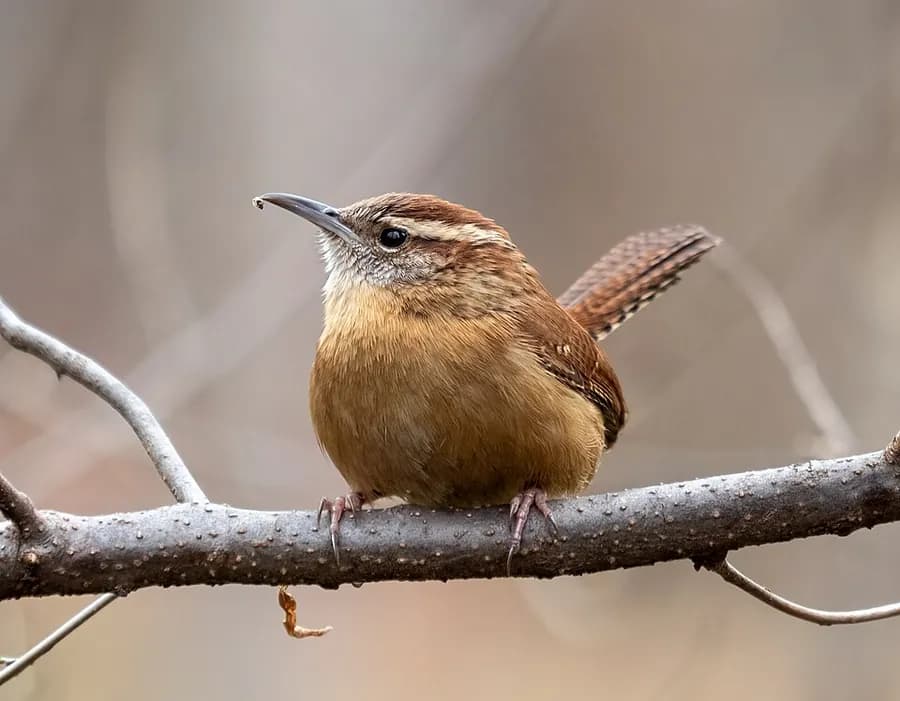
🐦Carolina wren
A corruíra-da-carolina (Thryothorus ludovicianus) é uma espécie comum de trogloditídeo residente no leste dos Estados Unidos, no extremo sul de Ontário, no Canadá, e no extremo nordeste do México. Invernos rigorosos restringem os limites norte de sua área de distribuição, enquanto condições climáticas favoráveis levam a uma extensão da área de reprodução para o norte. Seu habitat preferido é a cobertura densa em florestas, bordas florestais e áreas suburbanas. Essa corruíra é o pássaro oficial do estado da Carolina do Sul. Sete subespécies reconhecidas ocorrem em toda a área de distribuição desses trogloditídeos e diferem ligeiramente em seu canto e aparência. As aves geralmente são discretas, evitando ficar ao ar livre por longos períodos de tempo. Quando estão ao ar livre, investigam seus arredores e raramente ficam paradas. Depois de encontrar um parceiro, os pares mantêm um território e permanecem juntos por vários anos. Tanto os machos quanto as fêmeas emitem chamadas de alerta, mas somente os machos cantam para anunciar o território. As corruíras-da-carolina criam várias ninhadas durante a estação de reprodução no verão, mas podem ser vítimas de parasitismo de ninhadas por chupins-mulatos, entre outras espécies. Algumas populações foram afetadas pela contaminação por mercúrio.
Text: Wikipedia, CC BY-SA 4.0.
IUCN Red List assessment, 2021.
- Body mass
- 0.02 kg
- Body length
- not recorded
- Shoulder height
- not recorded
- Top speed
- not recorded
- Bite force
- not recorded
- Maximum lifespan
- 9.2 years
Everything we know about the Carolina wren
Typical adult figures. Where a value is an estimate rather than a measurement, it says so.
Body mass0.02 kgAVONETOther figures ↓Hide ↑
Source: AVONET · v1.1 (Tobias et al. 2022) · CC BY 4.0
Figures vary
- 0.02 kgAnAgeAnAge build 15, 2023-07-03 (HAGR)data quality: acceptable
Tail length0.05 mAVONETDetails ↓Hide ↑
Source: AVONET · v1.1 (Tobias et al. 2022) · CC BY 4.0
Wing length0.06 mAVONETDetails ↓Hide ↑
Source: AVONET · v1.1 (Tobias et al. 2022) · CC BY 4.0
Beak length0.02 mAVONETDetails ↓Hide ↑
Source: AVONET · v1.1 (Tobias et al. 2022) · CC BY 4.0
Tarsus length0.02 mAVONETDetails ↓Hide ↑
Source: AVONET · v1.1 (Tobias et al. 2022) · CC BY 4.0
Maximum lifespan9.2 yearsAnAgeDetails ↓Hide ↑
data quality: acceptable
Source: AnAge · AnAge build 15, 2023-07-03 (HAGR) · CC BY 3.0
Gestation14 daysAnAgeDetails ↓Hide ↑
data quality: acceptable
Source: AnAge · AnAge build 15, 2023-07-03 (HAGR) · CC BY 3.0
Litter sizeabout 4AnAgeDetails ↓Hide ↑
data quality: acceptable
Source: AnAge · AnAge build 15, 2023-07-03 (HAGR) · CC BY 3.0
Trophic levelCarnivoreAVONETDetails ↓Hide ↑
Source: AVONET · v1.1 (Tobias et al. 2022) · CC BY 4.0
HabitatWoodlandAVONETDetails ↓Hide ↑
Source: AVONET · v1.1 (Tobias et al. 2022) · CC BY 4.0
LifestyleInsessorialAVONETDetails ↓Hide ↑
Source: AVONET · v1.1 (Tobias et al. 2022) · CC BY 4.0
Volume l0 LaverageDetails ↓Hide ↑
Body mass at ~1.0 kg/L, the density of vertebrate tissue.
average = a mean across sexes or species in a group.
Not recorded for Carolina wren yet: body length, shoulder height, top speed, bite force.
Family tree
- kingdomAnimalia
- ›phylumChordata
- ›classAves
- ›orderPasseriformes
- ›familyTroglodytidae
- ›genusThryothorus
- ›speciesThryothorus ludovicianus
- orderSauria
- classBirds · Aves
- orderPerching birds · Passeriformes
- subfamilyTroglodytinae
All 11 branches ↓Fewer branches ↑
- kingdomMetazoa
- phylumChordata
- subphylumCraniata
- subphylumVertebrata
- superclassGnathostomata
- superclassSarcopterygii
- superclassTetrapoda
- orderSauria
- classBirds · Aves
- orderPerching birds · Passeriformes
- subfamilyTroglodytinae
More about the Carolina wren


No videos of the Carolina wren yet.
We have 44,653 videos so far, and none of them features this animal yet.
All videos →Compare the Carolina wren
Pick a tool — the Carolina wren is already selected.
Compare every stat with any other animal.
Stand them on the same floor and see who's bigger.
How speed, brain and bite scale with body size. This animal isn't in the sample yet.
See where it sits in the tree of life.