
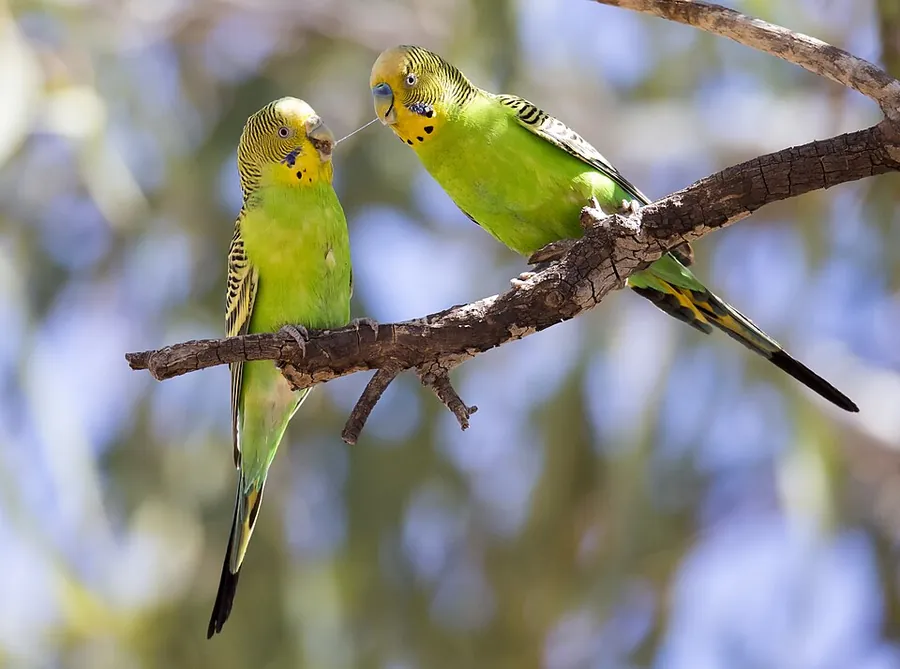
🦜Budgerigar
O periquito-australiano ou periquito-comum ou, no popular em inglês, budgerigar (normalmente azul ou verde-amarelo), conhecido cientificamente por Melopsittacus undulatus, é uma pequena espécie de ave psitaciforme de cauda longa, pertencente à família Psittaculidae, que se alimenta de sementes e é a única espécie do gênero Melopsittacus. Foi registrada pela primeira vez em 1805, e hoje é o terceiro animal de estimação mais famoso no mundo, atrás somente do cão e do gato. Na natureza vive em grandes bandos, e outra característica é o fato de emitir vários sons durante o voo e quando está repousando em galhos de árvores. Em condições climáticas favoráveis, é possível verificar uma grande colônia de periquitos ali habitando. Caso o espaço anterior venha a se tornar seco, tende a migrar para áreas mais frescas e com maior abundância de grãos e sementes. O periquito-australiano está intimamente ligado com o lóris e o papagaio-do-figo. Eles pertencem ao grupo de periquito, um termo não taxonômico que se refere a qualquer papagaio de pequeno porte com cauda longa, plana e cônica. Tanto em cativeiro quanto na natureza se reproduz de forma oportunista e em pares.
Text: Wikipedia, CC BY-SA 4.0.
IUCN Red List assessment, 2018.
- Body mass
- 0.03 kg
- Body length
- not recorded
- Shoulder height
- not recorded
- Top speed
- not recorded
- Bite force
- not recorded
- Maximum lifespan
- 21 years
Everything we know about the Budgerigar
Typical adult figures. Where a value is an estimate rather than a measurement, it says so.
Body mass0.03 kgAVONETOther figures ↓Hide ↑
Source: AVONET · v1.1 (Tobias et al. 2022) · CC BY 4.0
Figures vary
- 0.03 kgAnAgeAnAge build 15, 2023-07-03 (HAGR)data quality: high
Tail length0.09 mAVONETDetails ↓Hide ↑
Source: AVONET · v1.1 (Tobias et al. 2022) · CC BY 4.0
Wing length0.1 mAVONETDetails ↓Hide ↑
Source: AVONET · v1.1 (Tobias et al. 2022) · CC BY 4.0
Beak length0.01 mAVONETDetails ↓Hide ↑
Source: AVONET · v1.1 (Tobias et al. 2022) · CC BY 4.0
Tarsus length0.01 mAVONETDetails ↓Hide ↑
Source: AVONET · v1.1 (Tobias et al. 2022) · CC BY 4.0
Maximum lifespan21 yearsAnAgeDetails ↓Hide ↑
data quality: high
Source: AnAge · AnAge build 15, 2023-07-03 (HAGR) · CC BY 3.0
Gestation18 daysAnAgeDetails ↓Hide ↑
data quality: high
Source: AnAge · AnAge build 15, 2023-07-03 (HAGR) · CC BY 3.0
Litter sizeabout 5AnAgeDetails ↓Hide ↑
data quality: high
Source: AnAge · AnAge build 15, 2023-07-03 (HAGR) · CC BY 3.0
Trophic levelHerbivoreAVONETDetails ↓Hide ↑
Source: AVONET · v1.1 (Tobias et al. 2022) · CC BY 4.0
HabitatWoodlandAVONETDetails ↓Hide ↑
Source: AVONET · v1.1 (Tobias et al. 2022) · CC BY 4.0
LifestyleGeneralistAVONETDetails ↓Hide ↑
Source: AVONET · v1.1 (Tobias et al. 2022) · CC BY 4.0
Volume l0 LaverageDetails ↓Hide ↑
Body mass at ~1.0 kg/L, the density of vertebrate tissue.
average = a mean across sexes or species in a group.
Not recorded for Budgerigar yet: body length, shoulder height, top speed, bite force.
Family tree
- kingdomAnimalia
- ›phylumChordata
- ›classAves
- ›orderPsittaciformes
- ›familyPsittacidae
- ›genusMelopsittacus
- ›speciesMelopsittacus undulatus
- orderSauria
- classBirds · Aves
- orderParrots · Psittaciformes
- genusMelopsittacus
All 11 branches ↓Fewer branches ↑
- kingdomMetazoa
- phylumChordata
- subphylumCraniata
- subphylumVertebrata
- superclassGnathostomata
- superclassSarcopterygii
- superclassTetrapoda
- orderSauria
- classBirds · Aves
- orderParrots · Psittaciformes
- genusMelopsittacus
More about the Budgerigar


Animais flagrados pela câmera
Imagens reais dos animais deste site — caçando, brigando e levando a vida.
Compare the Budgerigar
Pick a tool — the Budgerigar is already selected.
Compare every stat with any other animal.
Stand them on the same floor and see who's bigger.
How speed, brain and bite scale with body size. This animal isn't in the sample yet.
See where it sits in the tree of life.