
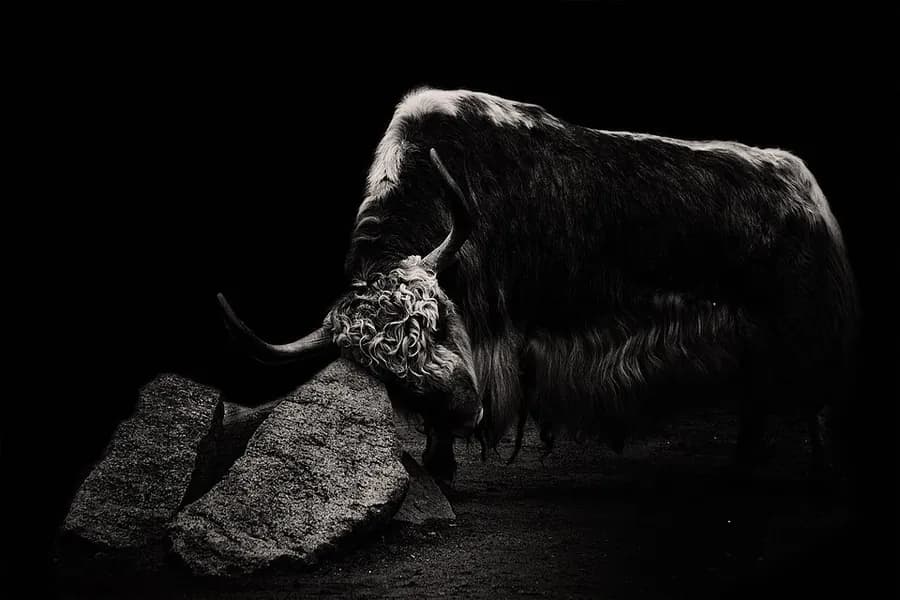
🐃Domestic yak
O iaque (Bos grunniens ou Bos mutus ou Poephagus grunniens ou Poephagus mutus, um sinônimo não universalmente aceito) é um herbívoro de pelagem longa encontrado na região do Himalaia, no sul da Ásia Central, Qinghai, no Planalto do Tibete, até à Mongólia, a norte. Além de uma grande população doméstica, há uma população pequena e vulnerável de iaques selvagens. Em Tibetano, a palavra gyag refere-se só ao macho da espécie; uma fêmea é uma dri ou nak. O resultado do cruzamento de um iaque com o zebu é conhecido como "chauri". Os iaques são animais de rebanho. Os iaques macho selvagens podem atingir 2,2 metros de comprimento, as fêmeas aproximadamente um terço daquele tamanho, e iaques domesticados 1,6-1,8 metros. Ambos os tipos têm o pelo longo e desgrenhado para isolá-los do frio. Os iaques selvagens podem ser marrons ou pretos. Os domesticados também podem ser brancos. Tanto os machos como as fêmeas têm chifres. Os iaques domésticos acasalam por volta de Setembro; as fêmeas podem conceber com 3-4 anos de idade, parem de Abril a Junho cada dois ou três anos, ao que parece dependendo da provisão alimentar. O período de gestação é de aproximadamente nove meses. Os bezerros são desmamados em um ano e ficam independentes logo depois disso. Os iaques podem viver mais de 20 anos.
Text: Wikipedia, CC BY-SA 4.0.
The IUCN Red List has not assessed Bos grunniens yet.
- Body mass
- 667 kg
- Body length
- not recorded
- Shoulder height
- 1.2 m
- Top speed
- not recorded
- Bite force
- not recorded
- Maximum lifespan
- 26 years
Everything we know about the Domestic yak
Typical adult figures. Where a value is an estimate rather than a measurement, it says so.
Body mass667 kgAnAgeDetails ↓Hide ↑
data quality: high
Source: AnAge · AnAge build 15, 2023-07-03 (HAGR) · CC BY 3.0
Shoulder height1.2 maverageOther figures ↓Hide ↑
Species-level value synthesised as the mean of: both.
By sex
- Both1.2 mWiener, Han & Long 2003, The Yak (2nd ed), FAO Regional Office for Asia and the Pacific, Ch. 6, Table 6.9, https://www.fao.org/4/AD347E/ad347e0c.htmDomestic yak. Table 6.9 'Height at withers (cm)': breed/location means for adults span 103.0 (Huanhu F: '103.0 +/- 0.3') to 137.5 cm (Sichuan Jiulong M: '137.5 +/- 8.8'); e.g., 'Tibet Alpine M 39 122.2 +/- 3.5 ... F 529 110.1 +/- 4.8'. Value is the midpoint of that span of breed means, not a population range. Wild yak (Bos mutus) bulls are far taller: 'a shoulder height for adult wild yak bulls of 175 - 203 cm' (Schaller 1998, quoted in the same FAO book, Ch. 1).
Maximum lifespan26 yearsAnAgeDetails ↓Hide ↑
data quality: high
Source: AnAge · AnAge build 15, 2023-07-03 (HAGR) · CC BY 3.0
Gestation274 daysAnAgeDetails ↓Hide ↑
data quality: high
Source: AnAge · AnAge build 15, 2023-07-03 (HAGR) · CC BY 3.0
Litter size1AnAgeDetails ↓Hide ↑
data quality: high
Source: AnAge · AnAge build 15, 2023-07-03 (HAGR) · CC BY 3.0
Volume l667 LaverageDetails ↓Hide ↑
Body mass at ~1.0 kg/L, the density of vertebrate tissue.
average = a mean across sexes or species in a group.
Not recorded for Domestic yak yet: body length, top speed, bite force.
Family tree
- kingdomAnimalia
- ›phylumChordata
- ›classMammalia
- ›orderArtiodactyla
- ›familyBovidae
- ›genusBos
- ›speciesBos grunniens
- classMammals · Mammalia
- orderEven-toed hoofed animals · Artiodactyla
- familyBovidae
- subfamilyBovinae
All 15 branches ↓Fewer branches ↑
- kingdomMetazoa
- phylumChordata
- subphylumCraniata
- subphylumVertebrata
- superclassGnathostomata
- superclassSarcopterygii
- superclassTetrapoda
- classMammals · Mammalia
- subclassTheria
- superorderLaurasiatheria
- orderEven-toed hoofed animals · Artiodactyla
- suborderRuminantia
- infraorderPecora
- familyBovidae
- subfamilyBovinae
More about the Domestic yak


Animais flagrados pela câmera
Imagens reais dos animais deste site — caçando, brigando e levando a vida.
Compare the Domestic yak
Pick a tool — the Domestic yak is already selected.
Compare every stat with any other animal.
Stand them on the same floor and see who's bigger.
How speed, brain and bite scale with body size. This animal isn't in the sample yet.
See where it sits in the tree of life.