
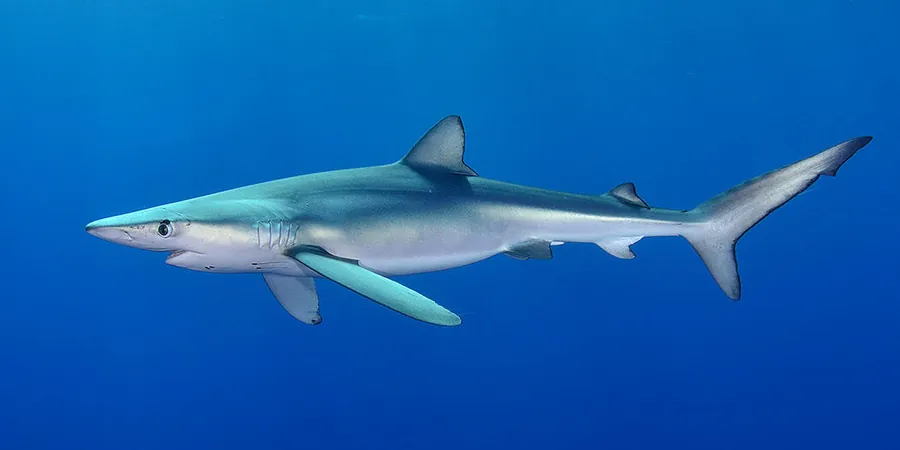
🦈Blue shark
Tubarão-azul (nome científico: Prionace glauca), também conhecido popularmente como cação-azul, bico-doce, focinhudo, mole-mole, tintureira ou tubarão-de-focinho, é uma espécie de tubarão da família dos carcarrinídeos (Carcharhinidae), o qual habita as zonas profundas dos oceanos, em águas temperadas e tropicais. Por preferir águas mais frias, os tubarões-azuis migram longas distâncias, eventualmente da Nova Inglaterra à América do Sul. A espécie está listada como quase ameaçada pela União Internacional para a Conservação da Natureza (UICN / IUCN). Embora geralmente letárgico, esses tubarões podem se mover de forma muito rápida. São vivíparos e notáveis pelas suas grandes ninhadas de 25 a 100 filhotes. Alimentam-se primariamente de pequenos peixes e lulas, embora possam capturar presas maiores. A expectativa máxima de vida ainda não é conhecida, mas acredita-se que eles possam viver até vinte anos.
Text: Wikipedia, CC BY-SA 4.0.
IUCN Red List assessment, 2019.
- Body mass
- 113 kg
- Body length
- 3.35 m
- Shoulder height
- not recorded
- Top speed
- not recorded
- Bite force
- not recorded
- Maximum lifespan
- 20 years
Everything we know about the Blue shark
Typical adult figures. Where a value is an estimate rather than a measurement, it says so.
Body mass113 kgrecord 206 kg · FishBaseAnAgeDetails ↓Hide ↑
data quality: acceptable
Record: largest individual on record
Source: AnAge · AnAge build 15, 2023-07-03 (HAGR) · CC BY 3.0
Body length3.35 mrecord 4 m · FishBasetypical adultFishBaseDetails ↓Hide ↑
Record: largest individual on record
Source: FishBase · v25.04 · CC BY-NC 4.0
Maximum lifespan20 yearsrecord 20 years · FishBaseAnAgeDetails ↓Hide ↑
data quality: acceptable
Record: largest individual on record
Source: AnAge · AnAge build 15, 2023-07-03 (HAGR) · CC BY 3.0
Litter sizeabout 30AnAgeDetails ↓Hide ↑
data quality: acceptable
Source: AnAge · AnAge build 15, 2023-07-03 (HAGR) · CC BY 3.0
Trophic level4.35FishBaseDetails ↓Hide ↑
Source: FishBase · v25.04, estimate table · CC BY-NC 4.0
DietcarnivoreaverageDetails ↓Hide ↑
From trophic level 4.35 (FishBase): <2.2 herbivore, 2.2–2.8 omnivore, >2.8 carnivore.
Danger to humanstraumatogenicFishBaseDetails ↓Hide ↑
Source: FishBase · v25.04 · CC BY-NC 4.0
Volume l113 LaverageDetails ↓Hide ↑
Body mass at ~1.0 kg/L, the density of vertebrate tissue.
average = a mean across sexes or species in a group.
Not recorded for Blue shark yet: shoulder height, top speed, bite force.
Family tree
- kingdomAnimalia
- ›phylumChordata
- ›classElasmobranchii
- ›orderCarcharhiniformes
- ›familyCarcharhinidae
- ›genusPrionace
- ›speciesPrionace glauca
- superclassGnathostomata
- classSharks & rays · Chondrichthyes
- subclassElasmobranchii
- genusPrionace
All 8 branches ↓Fewer branches ↑
- kingdomMetazoa
- phylumChordata
- subphylumCraniata
- subphylumVertebrata
- superclassGnathostomata
- classSharks & rays · Chondrichthyes
- subclassElasmobranchii
- genusPrionace
More about the Blue shark


Animais flagrados pela câmera
Imagens reais dos animais deste site — caçando, brigando e levando a vida.
Compare the Blue shark
Pick a tool — the Blue shark is already selected.
Compare every stat with any other animal.
Stand them on the same floor and see who's bigger.
How speed, brain and bite scale with body size. This animal isn't in the sample yet.
See where it sits in the tree of life.