
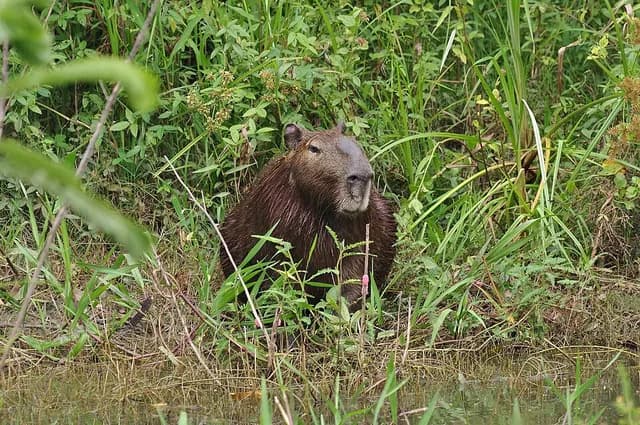
🐭Lesser capybara
Kapibara mała (Hydrochoerus isthmius) – gatunek gryzonia z rodziny kawiowatych (Caviidae). Wyodrębniony do rangi gatunku z H. hydrocharis. Występuje od Panamy do zachodniej Wenezueli i zachodniej Kolumbii. Zamieszkuje bagna, ujścia rzek, wzdłuż rzek i strumieni. W zależności od siedliska występuje w grupach lub pojedynczo. Prowadzi dzienny lub nocny tryb życia, który zależy od pożywienia lub pór roku. Ciąża u samic trwa około 120 dni, po którym rodzi się 1–7 młodych (średnio 3,5). Kariotyp wynosi 2n=64 and FN=104. W Czerwonej księdze gatunków zagrożonych Międzynarodowej Unii Ochrony Przyrody i Jej Zasobów został zaliczony do kategorii DD (brak danych). Gatunek ten jest powszechny w Panamie oraz rzadki w Wenezueli. Stan populacji w Kolumbii nieznany. Zagrożeniami dla tego ssaka jest wylesianie i ekspansja rolnictwa. W Kolumbii intensywnie poławiany jak również jest niszczony habitat tego gryzonia, poprzez osuszanie bagien w ujściu rzeki Magdalena.
Text: Wikipedia, CC BY-SA 4.0.
IUCN Red List assessment, 2016.
- Body mass
- 21 kg
- Body length
- 0.89 m
- Shoulder height
- not recorded
- Top speed
- not recorded
- Bite force
- not recorded
- Maximum lifespan
- 15 years
Everything we know about the Lesser capybara
Typical adult figures. Where a value is an estimate rather than a measurement, it says so.
Body mass21 kgCOMBINEDetails ↓Hide ↑
Source: COMBINE · v1 (Soria et al. 2021) · CC BY 4.0
Body length0.89 mestimatedCOMBINEDetails ↓Hide ↑
Source: COMBINE · v1 (Soria et al. 2021) · CC BY 4.0
Maximum lifespan15 yearsestimatedCOMBINEDetails ↓Hide ↑
Source: COMBINE · v1 (Soria et al. 2021) · CC BY 4.0
Generation length5.4 yearsestimatedCOMBINEDetails ↓Hide ↑
Source: COMBINE · v1 (Soria et al. 2021) · CC BY 4.0
Gestation108 daysCOMBINEDetails ↓Hide ↑
Source: COMBINE · v1 (Soria et al. 2021) · CC BY 4.0
Litter sizeabout 5COMBINEDetails ↓Hide ↑
Source: COMBINE · v1 (Soria et al. 2021) · CC BY 4.0
Trophic levelHerbivoreCOMBINEDetails ↓Hide ↑
Source: COMBINE · v1 (Soria et al. 2021) · CC BY 4.0
Activity cycleDiurnalCOMBINEDetails ↓Hide ↑
Source: COMBINE · v1 (Soria et al. 2021) · CC BY 4.0
Volume l21 LaverageDetails ↓Hide ↑
Body mass at ~1.0 kg/L, the density of vertebrate tissue.
estimated = a model's estimate for a species nobody has measured; average = a mean across sexes or species in a group.
Not recorded for Lesser capybara yet: shoulder height, top speed, bite force.
Family tree
- kingdomAnimalia
- ›phylumChordata
- ›classMammalia
- ›orderRodentia
- ›familyCaviidae
- ›genusHydrochoerus
- ›speciesHydrochoerus isthmius
- classMammals · Mammalia
- orderRodents · Rodentia
- familyHydrochaeridae
- genusHydrochoerus
All 14 branches ↓Fewer branches ↑
- kingdomMetazoa
- phylumChordata
- subphylumCraniata
- subphylumVertebrata
- superclassGnathostomata
- superclassSarcopterygii
- superclassTetrapoda
- classMammals · Mammalia
- subclassTheria
- superorderEuarchontoglires
- orderRodents · Rodentia
- suborderHystricomorpha
- familyHydrochaeridae
- genusHydrochoerus
More about the Lesser capybara
No videos of the Lesser capybara yet.
We have 44,653 videos so far, and none of them features this animal yet.
All videos →Compare the Lesser capybara
Pick a tool — the Lesser capybara is already selected.
Compare every stat with any other animal.
Stand them on the same floor and see who's bigger.
How speed, brain and bite scale with body size. This animal isn't in the sample yet.
See where it sits in the tree of life.