
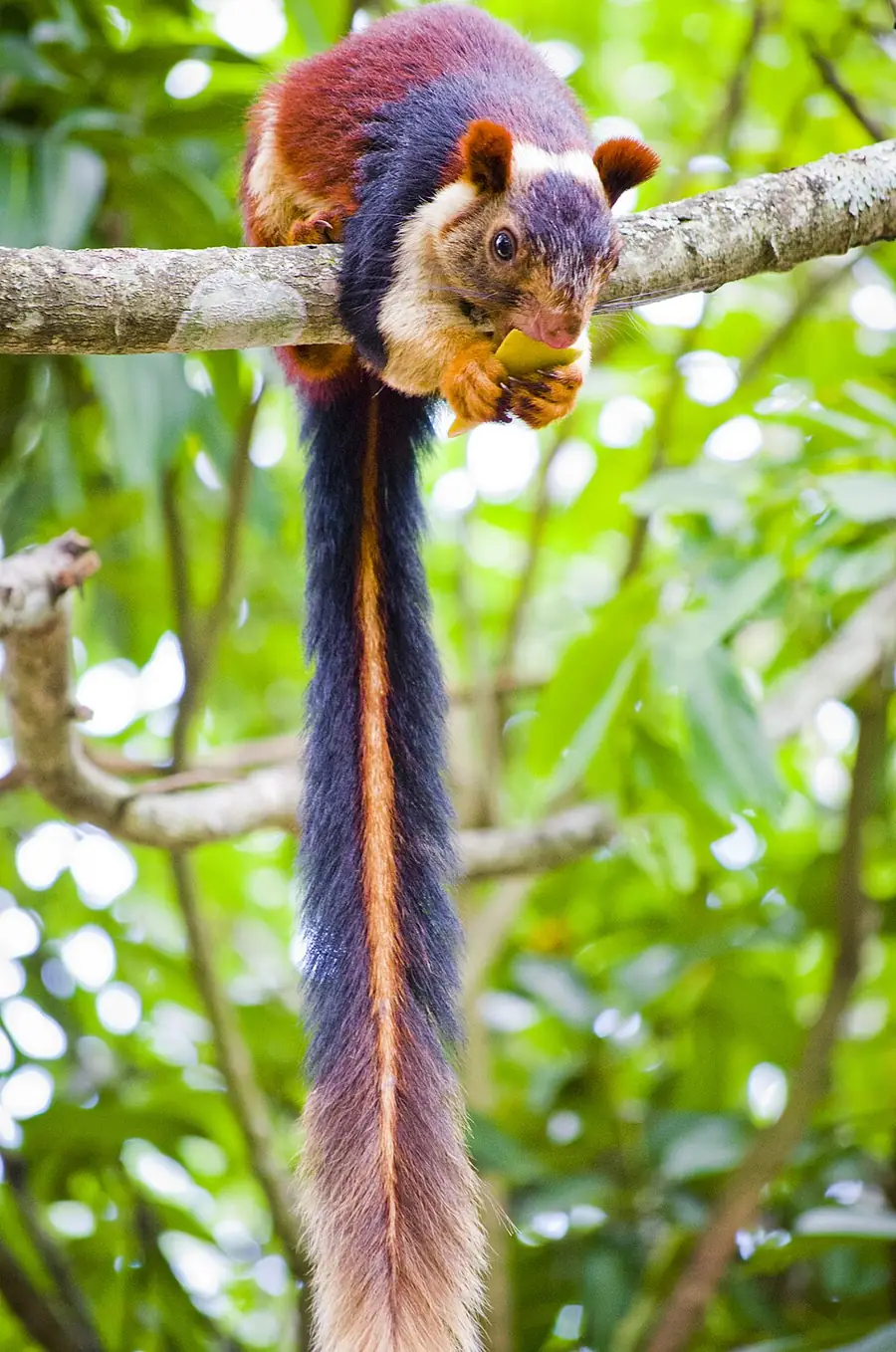
🐿️Indian giant squirrel
Wiewióra dekańska (Ratufa indica) – gatunek gryzonia z rodziny wiewiórkowatych (podrodzina Ratufinae). Po raz pierwszy został opisany przez walijskiego przyrodnika Thomasa Pennanta w 1771, lecz naukowiec nie nadał zwierzęciu nazwy naukowej. W 1777 naukowego opisu dokonał niemiecki przyrodnik Johann Christian Erxleben i nadał gatunkowi nazwę naukową Sciurus indicus. Typowa lokalizacja: Indie Wschodnie („in India orientali”); Bombaj, Indie. Do rodzaju Ratufa gatunek włączył brytyjski zoolog John Edward Gray w 1867. Wiewióra dekańska występuje w centralnej i południowej części Indii (na wysokości do ok. 180–2300 m n.p.m.), z wyłączeniem centralnych nizin. Międzynarodowa Unia Ochrony Przyrody (IUCN) wymienia Sciurus indica w Czerwonej księdze gatunków zagrożonych jako gatunek najmniejszej troski (LC – least concern). Ratufa indica obejmuje 4 podgatunki.
Text: Wikipedia, CC BY-SA 4.0.
IUCN Red List assessment, 2016.
- Body mass
- 1.06 kg
- Body length
- 0.46 m
- Shoulder height
- not recorded
- Top speed
- not recorded
- Bite force
- not recorded
- Maximum lifespan
- 20 years
Everything we know about the Indian giant squirrel
Typical adult figures. Where a value is an estimate rather than a measurement, it says so.
Body mass1.06 kgCOMBINEOther figures ↓Hide ↑
Source: COMBINE · v1 (Soria et al. 2021) · CC BY 4.0
Figures vary
- 2 kgAnAgeAnAge build 15, 2023-07-03 (HAGR)data quality: acceptable
Body length0.46 mCOMBINEDetails ↓Hide ↑
Source: COMBINE · v1 (Soria et al. 2021) · CC BY 4.0
Brain mass12 gCOMBINEDetails ↓Hide ↑
Source: COMBINE · v1 (Soria et al. 2021) · CC BY 4.0
Maximum lifespan20 yearsCOMBINEOther figures ↓Hide ↑
Source: COMBINE · v1 (Soria et al. 2021) · CC BY 4.0
Figures vary
- 20 yearsAnAgeAnAge build 15, 2023-07-03 (HAGR)data quality: acceptable
Generation length7.99 yearsCOMBINEDetails ↓Hide ↑
Source: COMBINE · v1 (Soria et al. 2021) · CC BY 4.0
Gestation84 daysCOMBINEOther figures ↓Hide ↑
Source: COMBINE · v1 (Soria et al. 2021) · CC BY 4.0
Figures vary
- 84 daysAnAgeAnAge build 15, 2023-07-03 (HAGR)data quality: acceptable
Litter size1COMBINEOther figures ↓Hide ↑
Source: COMBINE · v1 (Soria et al. 2021) · CC BY 4.0
Figures vary
- 1AnAgeAnAge build 15, 2023-07-03 (HAGR)data quality: acceptable
Trophic levelOmnivoreCOMBINEDetails ↓Hide ↑
Source: COMBINE · v1 (Soria et al. 2021) · CC BY 4.0
Activity cycleDiurnalCOMBINEDetails ↓Hide ↑
Source: COMBINE · v1 (Soria et al. 2021) · CC BY 4.0
Population density6.85 per km²COMBINEDetails ↓Hide ↑
Source: COMBINE · v1 (Soria et al. 2021) · CC BY 4.0
Volume l1.1 LaverageDetails ↓Hide ↑
Body mass at ~1.0 kg/L, the density of vertebrate tissue.
average = a mean across sexes or species in a group.
Not recorded for Indian giant squirrel yet: shoulder height, top speed, bite force.
Family tree
- kingdomAnimalia
- ›phylumChordata
- ›classMammalia
- ›orderRodentia
- ›familySciuridae
- ›genusRatufa
- ›speciesRatufa indica
- classMammals · Mammalia
- orderRodents · Rodentia
- subfamilyRatufinae
- genusRatufa
All 15 branches ↓Fewer branches ↑
- kingdomMetazoa
- phylumChordata
- subphylumCraniata
- subphylumVertebrata
- superclassGnathostomata
- superclassSarcopterygii
- superclassTetrapoda
- classMammals · Mammalia
- subclassTheria
- superorderEuarchontoglires
- orderRodents · Rodentia
- suborderSciuromorpha
- familySciuridae
- subfamilyRatufinae
- genusRatufa
More about the Indian giant squirrel
No videos of the Indian giant squirrel yet.
We have 44,653 videos so far, and none of them features this animal yet.
All videos →Compare the Indian giant squirrel
Pick a tool — the Indian giant squirrel is already selected.
Compare every stat with any other animal.
Stand them on the same floor and see who's bigger.
How speed, brain and bite scale with body size. This animal isn't in the sample yet.
See where it sits in the tree of life.