
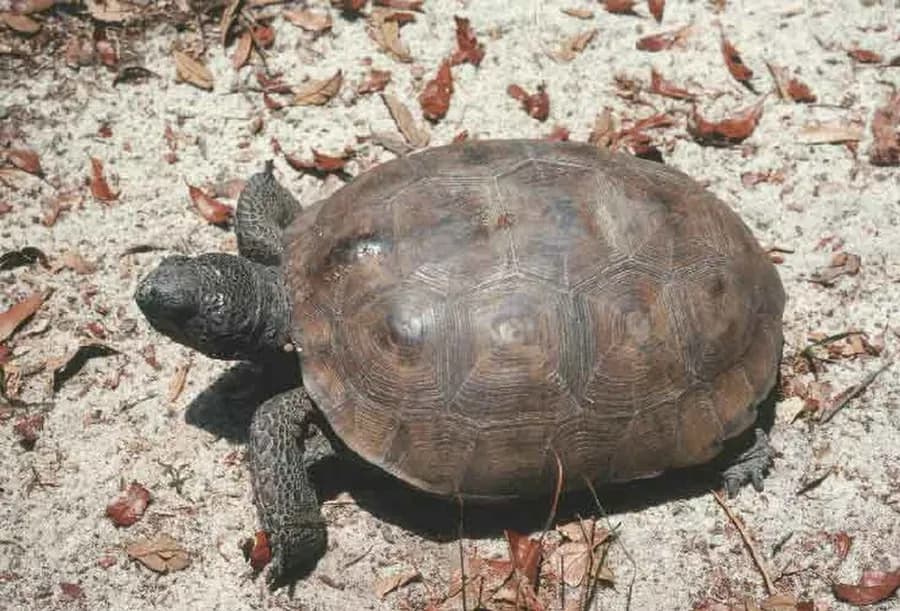
🐢Gopher tortoise
Żółw norowy (Gopherus polyphemus) – gatunek gada z podrzędu żółwi skrytoszyjnych z rodziny żółwi lądowych (Testudinidae). Morfologia Karapaks mocno wydłużony i spłaszczony (rzadkość wśród żółwi lądowych). Plastron samca ma z przodu rogowy wyrostek służący do podważania pancerza i kaleczenia rywala w czasie walki o samicę. Służy także do wygrzebywania jam w ziemi, który działa niczym pług, także szerokie i mocne przednie odnóża służą do tego celu. Karapaks ciemnobrązowy z jasnymi plamami. Rozmiary Długość karapaksu do 35 cm.Masa ciała do 4,1 kg. Biotop Ściśle lądowy tryb życia: tereny suche częściowo piaszczyste ze skąpą roślinnością trawiastą, krzaczastą i słabo zalesione. Pokarm Liście, pędy i owoce roślin w tym kaktusy, sporadycznie owady. Behawior Wygrzebuje długie i obszerne nory od 3 do 12 m długości służące mu za schronienie, które opuszczają rankiem i wieczorem, gdy temperatura powietrza nie jest zbyt wysoka. Rozmnażanie Samica składa do jam w ziemi od 4 do 7 jaj. Występowanie Endemit południowo-wschodnich USA; występuje w stanach Floryda, Georgia, Karolina Południowa, Alabama, Missisipi i Luizjana. Taksonomia Jest to gatunek monotypowy. Dawniej za jego podgatunki uznawane były: Gopherus agassizii, Gopherus berlandieri i Gopherus flavomarginatus.
Text: Wikipedia, CC BY-SA 4.0.
IUCN Red List assessment, 2026.
- Body mass
- 5.5 kg
- Body length
- not recorded
- Shoulder height
- not recorded
- Top speed
- not recorded
- Bite force
- not recorded
- Maximum lifespan
- 60 years
Everything we know about the Gopher tortoise
Typical adult figures. Where a value is an estimate rather than a measurement, it says so.
Body mass5.5 kgrecord 10 kg · ReptTraitsAnAgeDetails ↓Hide ↑
data quality: low
Record: largest individual on record
Source: AnAge · AnAge build 15, 2023-07-03 (HAGR) · CC BY 3.0
Maximum lifespan60 yearsmaximum recordedReptTraitsDetails ↓Hide ↑
Source: ReptTraits · v1.2 (Oskyrko et al. 2024) · CC BY 4.0
Gestation90 daysAnAgeDetails ↓Hide ↑
data quality: low
Source: AnAge · AnAge build 15, 2023-07-03 (HAGR) · CC BY 3.0
Litter sizeabout 8AnAgeDetails ↓Hide ↑
data quality: low
Source: AnAge · AnAge build 15, 2023-07-03 (HAGR) · CC BY 3.0
DietHerbivorousReptTraitsDetails ↓Hide ↑
Source: ReptTraits · v1.2 (Oskyrko et al. 2024) · CC BY 4.0
Activity cycleDiurnalReptTraitsDetails ↓Hide ↑
Source: ReptTraits · v1.2 (Oskyrko et al. 2024) · CC BY 4.0
Foraging modeACTReptTraitsDetails ↓Hide ↑
Source: ReptTraits · v1.2 (Oskyrko et al. 2024) · CC BY 4.0
VenomousNoReptTraitsDetails ↓Hide ↑
Source: ReptTraits · v1.2 (Oskyrko et al. 2024) · CC BY 4.0
Snout–vent length0.28 mmaximum recordedReptTraitsDetails ↓Hide ↑
Source: ReptTraits · v1.2 (Oskyrko et al. 2024) · CC BY 4.0
Volume l5.5 LaverageDetails ↓Hide ↑
Body mass at ~1.0 kg/L, the density of vertebrate tissue.
average = a mean across sexes or species in a group.
Not recorded for Gopher tortoise yet: body length, shoulder height, top speed, bite force.
Family tree
- kingdomAnimalia
- ›phylumChordata
- ›classTestudines
- ›familyTestudinidae
- ›genusGopherus
- ›speciesGopherus polyphemus
- orderTurtles & tortoises · Testudines
- superfamilyTestudinoidea
- familyTestudinidae
- genusGopherus
All 13 branches ↓Fewer branches ↑
- kingdomMetazoa
- phylumChordata
- subphylumCraniata
- subphylumVertebrata
- superclassGnathostomata
- superclassSarcopterygii
- superclassTetrapoda
- orderSauria
- orderTurtles & tortoises · Testudines
- suborderCryptodira
- superfamilyTestudinoidea
- familyTestudinidae
- genusGopherus
More about the Gopher tortoise


No videos of the Gopher tortoise yet.
We have 44,653 videos so far, and none of them features this animal yet.
All videos →Compare the Gopher tortoise
Pick a tool — the Gopher tortoise is already selected.
Compare every stat with any other animal.
Stand them on the same floor and see who's bigger.
How speed, brain and bite scale with body size. This animal isn't in the sample yet.
See where it sits in the tree of life.