
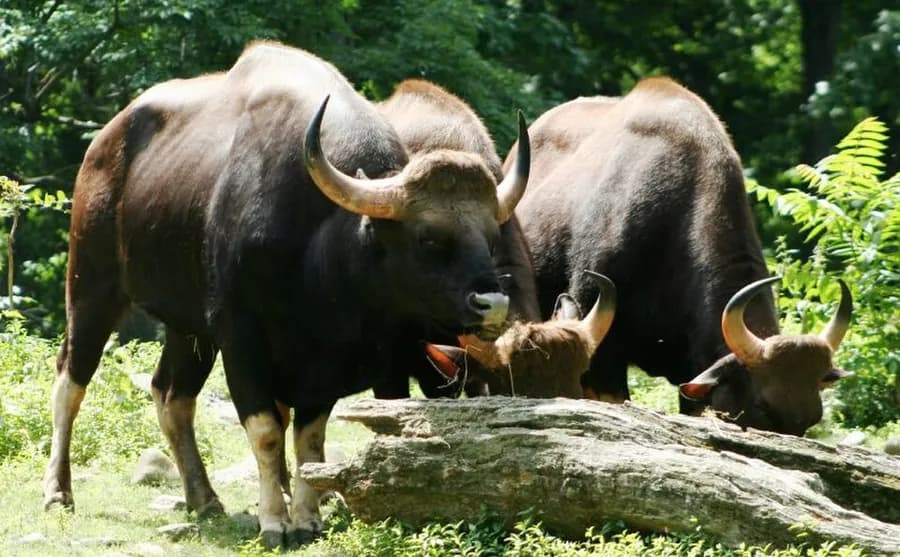
🐃Gaur
Gaur indyjski (Bos gaurus) – gatunek dużego ssaka z rodziny wołowatych (Bovidae). Jeden z największych wołowatych. Osiąga od 250 do 330 cm długości głowy i tułowia, ważąc do 1000 kg, samce więcej niż samice. Mają także znacznie większe rogi. Ubarwiony ciemnobrązowo bądź czarno. Wyróżnia się 2, rzadziej 3 obecne podgatunki, kolejny wyginął. Zamieszkuje lasy i tereny trawiaste Azji Południowej i Południowo-Wschodniej. Prowadzi stadny tryb życia, samce mogą też żyć samotnie. Krowa rodzi po raz pierwszy w trzecim roku życia po trwającej około 270 dni ciąży pojedyncze młode. Cielę ssie 8 miesięcy. Gaur żywi się niską i wyższą roślinnością, pożera liczne gatunki. Pada ofiarą zwłaszcza tygrysa, lamparta i człowieka. Jest narażony na wyginięcie, zasiedla jednak liczne tereny chronione.
Text: Wikipedia, CC BY-SA 4.0.
IUCN Red List assessment, 2016.
- Body mass
- 813 kg
- Body length
- 3 m
- Shoulder height
- 1.93 m
- Top speed
- not recorded
- Bite force
- not recorded
- Maximum lifespan
- 26 years
Everything we know about the Gaur
Typical adult figures. Where a value is an estimate rather than a measurement, it says so.
Body mass813 kgCOMBINEDetails ↓Hide ↑
Source: COMBINE · v1 (Soria et al. 2021) · CC BY 4.0
Body length3 mCOMBINEDetails ↓Hide ↑
Source: COMBINE · v1 (Soria et al. 2021) · CC BY 4.0
Shoulder height1.93 m1.65–2.2 m · typical rangenot statedDetails ↓Hide ↑
"Shoulder height is 1.65 to 2.2 meters." Range-only; value is the midpoint. ADW files the gaur under the synonym Bos frontalis; no account exists under Bos gaurus.
Source: Lundrigan & Zachariah 2000, Animal Diversity Web account: Bos frontalis (gaur), https://animaldiversity.org/accounts/Bos_frontalis/ · see citation
Maximum lifespan26 yearsCOMBINEDetails ↓Hide ↑
Source: COMBINE · v1 (Soria et al. 2021) · CC BY 4.0
Generation length8.99 yearsCOMBINEDetails ↓Hide ↑
Source: COMBINE · v1 (Soria et al. 2021) · CC BY 4.0
Age at maturity1.7 yearsCOMBINEDetails ↓Hide ↑
Source: COMBINE · v1 (Soria et al. 2021) · CC BY 4.0
Gestation275 daysCOMBINEDetails ↓Hide ↑
Source: COMBINE · v1 (Soria et al. 2021) · CC BY 4.0
Litter size1COMBINEDetails ↓Hide ↑
Source: COMBINE · v1 (Soria et al. 2021) · CC BY 4.0
Trophic levelHerbivoreCOMBINEDetails ↓Hide ↑
Source: COMBINE · v1 (Soria et al. 2021) · CC BY 4.0
Activity cycleDiurnalCOMBINEDetails ↓Hide ↑
Source: COMBINE · v1 (Soria et al. 2021) · CC BY 4.0
Population density0.86 per km²COMBINEDetails ↓Hide ↑
Source: COMBINE · v1 (Soria et al. 2021) · CC BY 4.0
Volume l813 LaverageDetails ↓Hide ↑
Body mass at ~1.0 kg/L, the density of vertebrate tissue.
average = a mean across sexes or species in a group.
Not recorded for Gaur yet: top speed, bite force.
Family tree
- kingdomAnimalia
- ›phylumChordata
- ›classMammalia
- ›orderArtiodactyla
- ›familyBovidae
- ›genusBos
- ›speciesBos frontalis
- classMammals · Mammalia
- orderEven-toed hoofed animals · Artiodactyla
- familyBovidae
- subfamilyBovinae
All 15 branches ↓Fewer branches ↑
- kingdomMetazoa
- phylumChordata
- subphylumCraniata
- subphylumVertebrata
- superclassGnathostomata
- superclassSarcopterygii
- superclassTetrapoda
- classMammals · Mammalia
- subclassTheria
- superorderLaurasiatheria
- orderEven-toed hoofed animals · Artiodactyla
- suborderRuminantia
- infraorderPecora
- familyBovidae
- subfamilyBovinae
More about the Gaur


No videos of the Gaur yet.
We have 44,653 videos so far, and none of them features this animal yet.
All videos →Compare the Gaur
Pick a tool — the Gaur is already selected.
Compare every stat with any other animal.
Stand them on the same floor and see who's bigger.
How speed, brain and bite scale with body size. This animal isn't in the sample yet.
See where it sits in the tree of life.