
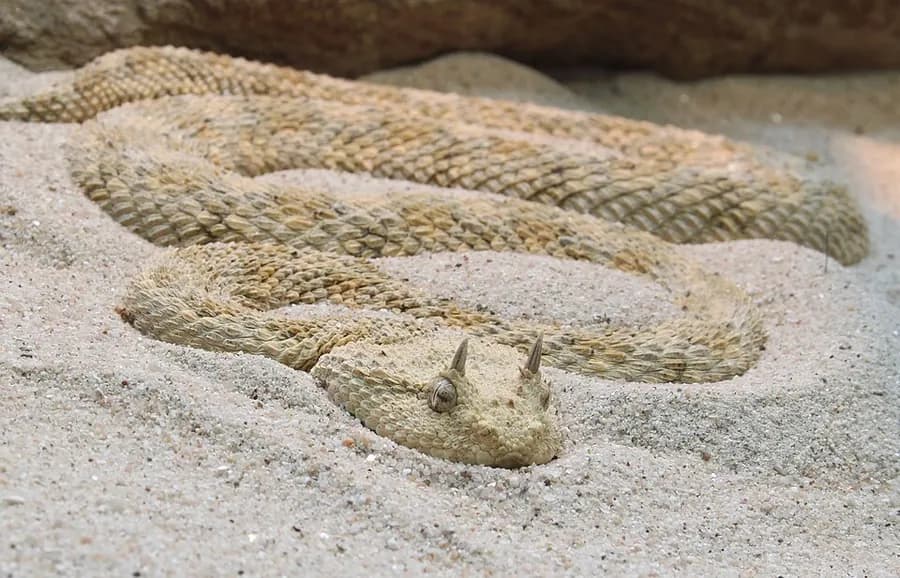
🐍Cerastes cerastes
Żmija rogata (Cerastes cerastes) – gatunek jadowitego węża z rodziny żmijowatych (Viperidae). Występowanie Występuje w Afryce na Saharze i dalej przez Synaj po Izrael, także w południowo-zachodniej części Półwyspu Arabskiego. Opis Występuje w kolorach: szary, żółtobrązowy lub jasnożółty w ciemne, nierównomiernie rozmieszczone plamy. Brzuch żmii jest biały. Tułów znacznie dłuższy i grubszy niż ogon. Trójkątna głowa posiada nad oczami kilkumilimetrowe wyrostki skórne przypominające małe różki. Źrenice oczu pionowe. Porusza się, wijąc ciało po piasku w bok. Gatunek bardzo jadowity. Rozmiary Dorasta do 60–80 cm długości. Biotop Występuje na piaszczystych lub kamienno-piaszczystych pustyniach. Pokarm Młode żywią się szarańczakami zaś starsze osobniki drobnymi kręgowcami (gryzonie, ptaki, jaszczurki). Rozmnażanie Gatunek jajorodny. Okres składania jaj przypada na lipiec i sierpień. Samice jednorazowo składają od 8 do 20 jaj. Wykluwają się po 6–8 tygodniach. Młode mierzą 14,5 do 17,5 cm długości. Podgatunki Wyróżnia się dwa podgatunki Cerastes cerastes: Cerastes cerastes cerastes (Linnaeus, 1758) – od Sahary po Izrael Cerastes cerastes hoofieni Werner & Sivan, 1999 – południowo-zachodnia część Półwyspu Arabskiego Dawniej za podgatunek C. cerastes uznawano także występującego na Bliskim Wschodzie C. gasperettii.
Text: Wikipedia, CC BY-SA 4.0.
IUCN Red List assessment, 2021.
- Body mass
- 0.37 kg
- Body length
- 0.89 m
- Shoulder height
- not recorded
- Top speed
- not recorded
- Bite force
- not recorded
- Maximum lifespan
- 18 years
Everything we know about the Cerastes cerastes
Typical adult figures. Where a value is an estimate rather than a measurement, it says so.
Body mass0.37 kgmaximum recordedReptTraitsDetails ↓Hide ↑
Source: ReptTraits · v1.2 (Oskyrko et al. 2024) · CC BY 4.0
Body length0.89 mmaximum recordedReptTraitsDetails ↓Hide ↑
Source: ReptTraits · v1.2 (Oskyrko et al. 2024) · CC BY 4.0
Maximum lifespan18 yearsrecord 18 years · ReptTraitsAnAgeDetails ↓Hide ↑
data quality: acceptable
Record: largest individual on record
Source: AnAge · AnAge build 15, 2023-07-03 (HAGR) · CC BY 3.0
Activity cycleCathemeralReptTraitsDetails ↓Hide ↑
Source: ReptTraits · v1.2 (Oskyrko et al. 2024) · CC BY 4.0
Foraging modeMixedReptTraitsDetails ↓Hide ↑
Source: ReptTraits · v1.2 (Oskyrko et al. 2024) · CC BY 4.0
VenomousYesReptTraitsDetails ↓Hide ↑
Source: ReptTraits · v1.2 (Oskyrko et al. 2024) · CC BY 4.0
Snout–vent length0.53 mmaximum recordedReptTraitsDetails ↓Hide ↑
Source: ReptTraits · v1.2 (Oskyrko et al. 2024) · CC BY 4.0
Volume l0.4 LaverageDetails ↓Hide ↑
Body mass at ~1.0 kg/L, the density of vertebrate tissue.
average = a mean across sexes or species in a group.
Not recorded for Cerastes cerastes yet: shoulder height, top speed, bite force.
Family tree
- orderLizards & snakes · Squamata
- infraorderSnakes · Serpentes
- subfamilyViperinae
- genusCerastes
All 14 branches ↓Fewer branches ↑
- kingdomMetazoa
- phylumChordata
- subphylumCraniata
- subphylumVertebrata
- superclassGnathostomata
- superclassSarcopterygii
- superclassTetrapoda
- orderSauria
- superorderLepidosauria
- orderLizards & snakes · Squamata
- infraorderSnakes · Serpentes
- familyViperidae
- subfamilyViperinae
- genusCerastes
More about the Cerastes cerastes


No videos of the Cerastes cerastes yet.
We have 44,653 videos so far, and none of them features this animal yet.
All videos →Compare the Cerastes cerastes
Pick a tool — the Cerastes cerastes is already selected.
Compare every stat with any other animal.
Stand them on the same floor and see who's bigger.
How speed, brain and bite scale with body size. This animal isn't in the sample yet.
See where it sits in the tree of life.