
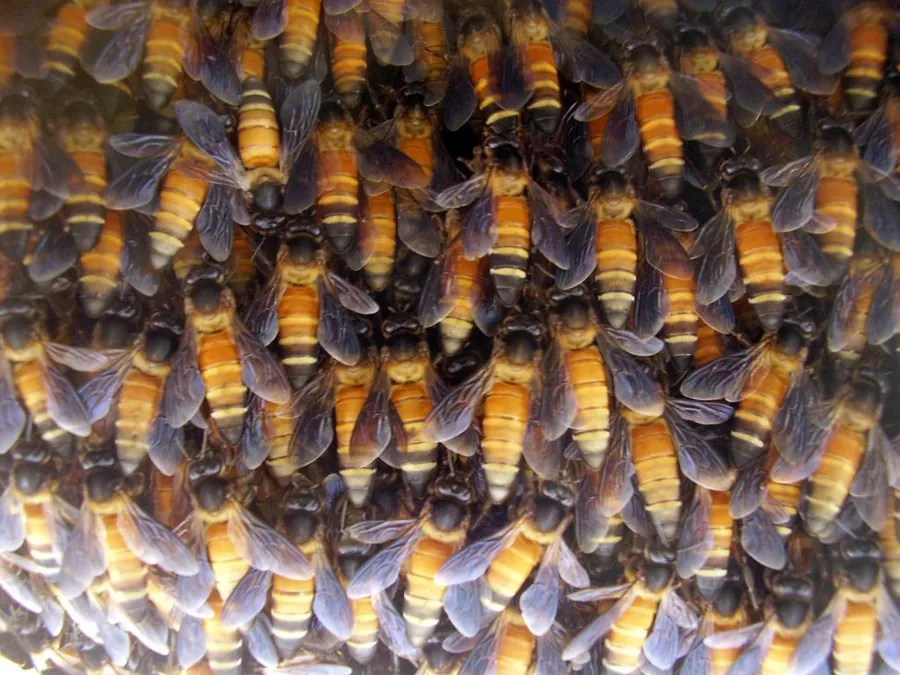
🪲Apis dorsata
Apis dorsata, the rock bee or giant honey bee, is a honey bee of South and Southeast Asia. They are typically around 17–20 mm (0.7–0.8 in) long and nests are mainly built in exposed places far off the ground, like on tree limbs, under cliff overhangs, and under buildings. These social bees are known for their aggressive defense strategies and vicious behavior when disturbed. Though the species is not domesticated, indigenous peoples have traditionally used it as a source of honey and beeswax, a practice known as honey hunting.
Text: Wikipedia, CC BY-SA 4.0.
The IUCN Red List has not assessed Apis dorsata yet.
- Body mass
- not recorded
- Body length
- not recorded
- Shoulder height
- not recorded
- Top speed
- not recorded
- Bite force
- not recorded
- Maximum lifespan
- not recorded
Everything we know about the Apis dorsata
Typical adult figures. Where a value is an estimate rather than a measurement, it says so.
No measurements for Apis dorsata yet.
Family tree
- kingdomAnimalia
- ›phylumArthropoda
- ›classInsecta
- ›orderHymenoptera
- ›familyApidae
- ›genusApis
- ›speciesApis dorsata
- classInsects · Insecta
- subclassPterygota
- orderAnts, bees & wasps · Hymenoptera
- superfamilyApoidea
All 7 branches ↓Fewer branches ↑
- kingdomMetazoa
- phylumArthropoda
- subphylumHexapoda
- classInsects · Insecta
- subclassPterygota
- orderAnts, bees & wasps · Hymenoptera
- superfamilyApoidea
More about the Apis dorsata


No videos of the Apis dorsata yet.
We have 44,653 videos so far, and none of them features this animal yet.
All videos →Compare the Apis dorsata
Pick a tool — the Apis dorsata is already selected.
Compare every stat with any other animal.
Stand them on the same floor and see who's bigger.
How speed, brain and bite scale with body size. This animal isn't in the sample yet.
See where it sits in the tree of life.