
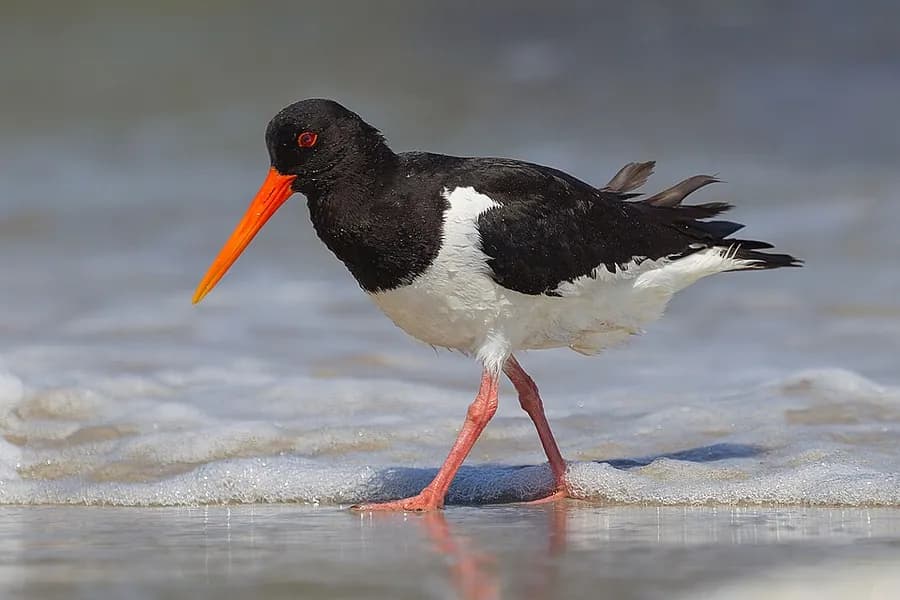
🐦Eurasian Oystercatcher
L'Huîtrier pie (Haematopus ostralegus), aussi appelé Pie de mer, est une espèce d'oiseaux Charadriiformes de la famille des Haematopodidae. Seul huîtrier vivant en Europe, il est très reconnaissable à son plumage noir sur le dessus et blanc sur le dessous et à son long bec orange vif. Mesurant environ 40 cm de long et 80 cm d'envergure, il présente un léger dimorphisme sexuel, les femelles étant souvent un peu plus imposantes que les mâles, avec un bec plus long et fin. Le bec de l'Huîtrier pie a fait l'objet de nombreuses études : sa croissance rapide et sa forme sont étroitement corrélées à son régime alimentaire. Un bec long et fin signale un individu qui se nourrit principalement de vers marins et de petits coquillages, tandis qu'un bec émoussé signale un individu qui se nourrit de gros coquillages martelés, d'autres individus enfin possédant des formes intermédiaires.
Text: Wikipedia, CC BY-SA 4.0.
IUCN Red List assessment, 2019.
- Body mass
- 0.53 kg
- Body length
- not recorded
- Shoulder height
- not recorded
- Top speed
- not recorded
- Bite force
- not recorded
- Maximum lifespan
- 43 years
Everything we know about the Eurasian Oystercatcher
Typical adult figures. Where a value is an estimate rather than a measurement, it says so.
Body mass0.53 kgAVONETOther figures ↓Hide ↑
Source: AVONET · v1.1 (Tobias et al. 2022) · CC BY 4.0
Figures vary
- 0.48 kgAnAgeAnAge build 15, 2023-07-03 (HAGR)data quality: acceptable
Tail length0.11 mAVONETDetails ↓Hide ↑
Source: AVONET · v1.1 (Tobias et al. 2022) · CC BY 4.0
Wing length0.25 mAVONETDetails ↓Hide ↑
Source: AVONET · v1.1 (Tobias et al. 2022) · CC BY 4.0
Beak length0.08 mAVONETDetails ↓Hide ↑
Source: AVONET · v1.1 (Tobias et al. 2022) · CC BY 4.0
Tarsus length0.05 mAVONETDetails ↓Hide ↑
Source: AVONET · v1.1 (Tobias et al. 2022) · CC BY 4.0
Maximum lifespan43 yearsAnAgeDetails ↓Hide ↑
data quality: acceptable
Source: AnAge · AnAge build 15, 2023-07-03 (HAGR) · CC BY 3.0
Trophic levelCarnivoreAVONETDetails ↓Hide ↑
Source: AVONET · v1.1 (Tobias et al. 2022) · CC BY 4.0
HabitatCoastalAVONETDetails ↓Hide ↑
Source: AVONET · v1.1 (Tobias et al. 2022) · CC BY 4.0
LifestyleTerrestrialAVONETDetails ↓Hide ↑
Source: AVONET · v1.1 (Tobias et al. 2022) · CC BY 4.0
Danger to humansharmlessSeaLifeBaseDetails ↓Hide ↑
Source: SeaLifeBase · v25.04 · CC BY-NC 4.0
Volume l0.5 LaverageDetails ↓Hide ↑
Body mass at ~1.0 kg/L, the density of vertebrate tissue.
average = a mean across sexes or species in a group.
Not recorded for Eurasian Oystercatcher yet: body length, shoulder height, top speed, bite force.
Family tree
- kingdomAnimalia
- ›phylumChordata
- ›classAves
- ›orderCharadriiformes
- ›familyHaematopodidae
- ›genusHaematopus
- ›speciesHaematopus ostralegus
- orderSauria
- classBirds · Aves
- familyHaematopodidae
- genusHaematopus
All 11 branches ↓Fewer branches ↑
- kingdomMetazoa
- phylumChordata
- subphylumCraniata
- subphylumVertebrata
- superclassGnathostomata
- superclassSarcopterygii
- superclassTetrapoda
- orderSauria
- classBirds · Aves
- familyHaematopodidae
- genusHaematopus
More about the Eurasian Oystercatcher


No videos of the Eurasian Oystercatcher yet.
We have 44,653 videos so far, and none of them features this animal yet.
All videos →Compare the Eurasian Oystercatcher
Pick a tool — the Eurasian Oystercatcher is already selected.
Compare every stat with any other animal.
Stand them on the same floor and see who's bigger.
How speed, brain and bite scale with body size. This animal isn't in the sample yet.
See where it sits in the tree of life.