
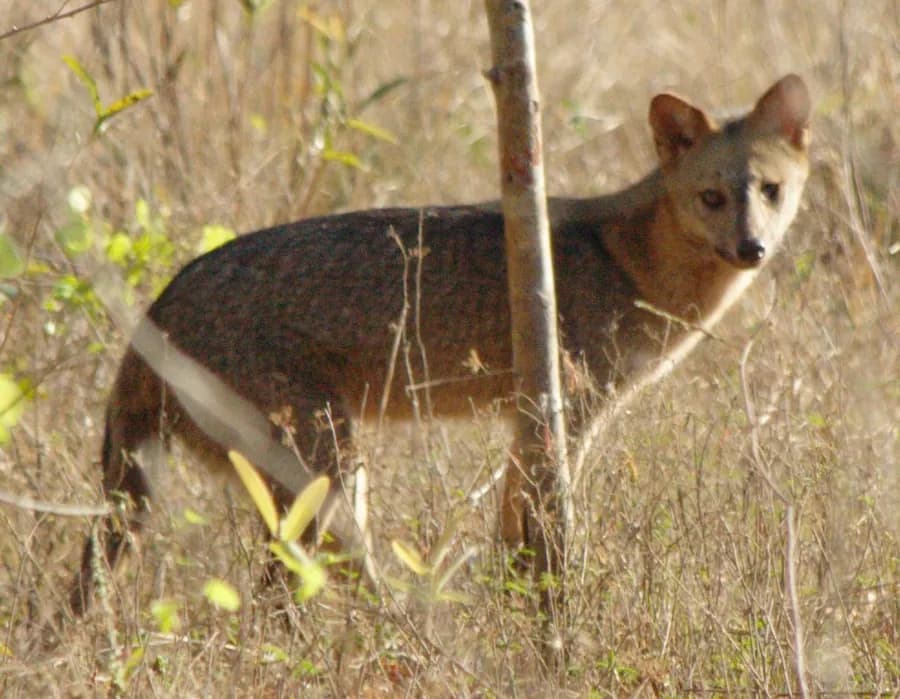
🐺Crab-eating fox
Le Renard crabier (Cerdocyon thous), également connu sous le nom de Renard des savanes, ou plus rarement sous le nom de Maikong, est une espèce de mammifère carnivore de la famille des canidés. Bien qu’il soit désigné sous le nom de « renard » de par son apparence particulière, due à un processus de convergence évolutive de par une écologie comparable, ce canidé originaire d’Amérique du Sud fait partie d’un genre bien plus proche de celui des loups et des chacals (canini) : Cerdocyon, dont il est le seul représentant actuel.
Text: Wikipedia, CC BY-SA 4.0.
IUCN Red List assessment, 2015.
- Body mass
- 5.74 kg
- Body length
- 0.67 m
- Shoulder height
- not recorded
- Top speed
- not recorded
- Bite force
- not recorded
- Maximum lifespan
- 13 years
Everything we know about the Crab-eating fox
Typical adult figures. Where a value is an estimate rather than a measurement, it says so.
Body mass5.74 kgCOMBINEOther figures ↓Hide ↑
Source: COMBINE · v1 (Soria et al. 2021) · CC BY 4.0
Figures vary
- 6.5 kgAnAgeAnAge build 15, 2023-07-03 (HAGR)data quality: acceptable
Body length0.67 mCOMBINEDetails ↓Hide ↑
Source: COMBINE · v1 (Soria et al. 2021) · CC BY 4.0
Brain mass40 gCOMBINEDetails ↓Hide ↑
Source: COMBINE · v1 (Soria et al. 2021) · CC BY 4.0
Maximum lifespan13 yearsCOMBINEOther figures ↓Hide ↑
Source: COMBINE · v1 (Soria et al. 2021) · CC BY 4.0
Figures vary
- 13 yearsAnAgeAnAge build 15, 2023-07-03 (HAGR)data quality: acceptable
Generation length4.19 yearsCOMBINEDetails ↓Hide ↑
Source: COMBINE · v1 (Soria et al. 2021) · CC BY 4.0
Age at maturity279 daysCOMBINEDetails ↓Hide ↑
Source: COMBINE · v1 (Soria et al. 2021) · CC BY 4.0
Gestation56 daysCOMBINEOther figures ↓Hide ↑
Source: COMBINE · v1 (Soria et al. 2021) · CC BY 4.0
Figures vary
- 55 daysAnAgeAnAge build 15, 2023-07-03 (HAGR)data quality: acceptable
Litter sizeabout 4COMBINEOther figures ↓Hide ↑
Source: COMBINE · v1 (Soria et al. 2021) · CC BY 4.0
Figures vary
- 4AnAgeAnAge build 15, 2023-07-03 (HAGR)data quality: acceptable
Trophic levelOmnivoreCOMBINEDetails ↓Hide ↑
Source: COMBINE · v1 (Soria et al. 2021) · CC BY 4.0
Activity cycleNocturnalCOMBINEDetails ↓Hide ↑
Source: COMBINE · v1 (Soria et al. 2021) · CC BY 4.0
Home range1.41 km²COMBINEDetails ↓Hide ↑
Source: COMBINE · v1 (Soria et al. 2021) · CC BY 4.0
Population density0.4 per km²COMBINEDetails ↓Hide ↑
Source: COMBINE · v1 (Soria et al. 2021) · CC BY 4.0
Volume l5.7 LaverageDetails ↓Hide ↑
Body mass at ~1.0 kg/L, the density of vertebrate tissue.
average = a mean across sexes or species in a group.
Not recorded for Crab-eating fox yet: shoulder height, top speed, bite force.
Family tree
- kingdomAnimalia
- ›phylumChordata
- ›classMammalia
- ›orderCarnivora
- ›familyCanidae
- ›genusCerdocyon
- ›speciesCerdocyon thous
- classMammals · Mammalia
- orderCarnivorans · Carnivora
- familyCanidae
- genusCerdocyon
All 14 branches ↓Fewer branches ↑
- kingdomMetazoa
- phylumChordata
- subphylumCraniata
- subphylumVertebrata
- superclassGnathostomata
- superclassSarcopterygii
- superclassTetrapoda
- classMammals · Mammalia
- subclassTheria
- superorderLaurasiatheria
- orderCarnivorans · Carnivora
- suborderCaniformia
- familyCanidae
- genusCerdocyon
More about the Crab-eating fox
No videos of the Crab-eating fox yet.
We have 44,653 videos so far, and none of them features this animal yet.
All videos →Compare the Crab-eating fox
Pick a tool — the Crab-eating fox is already selected.
Compare every stat with any other animal.
Stand them on the same floor and see who's bigger.
How speed, brain and bite scale with body size. This animal isn't in the sample yet.
See where it sits in the tree of life.