
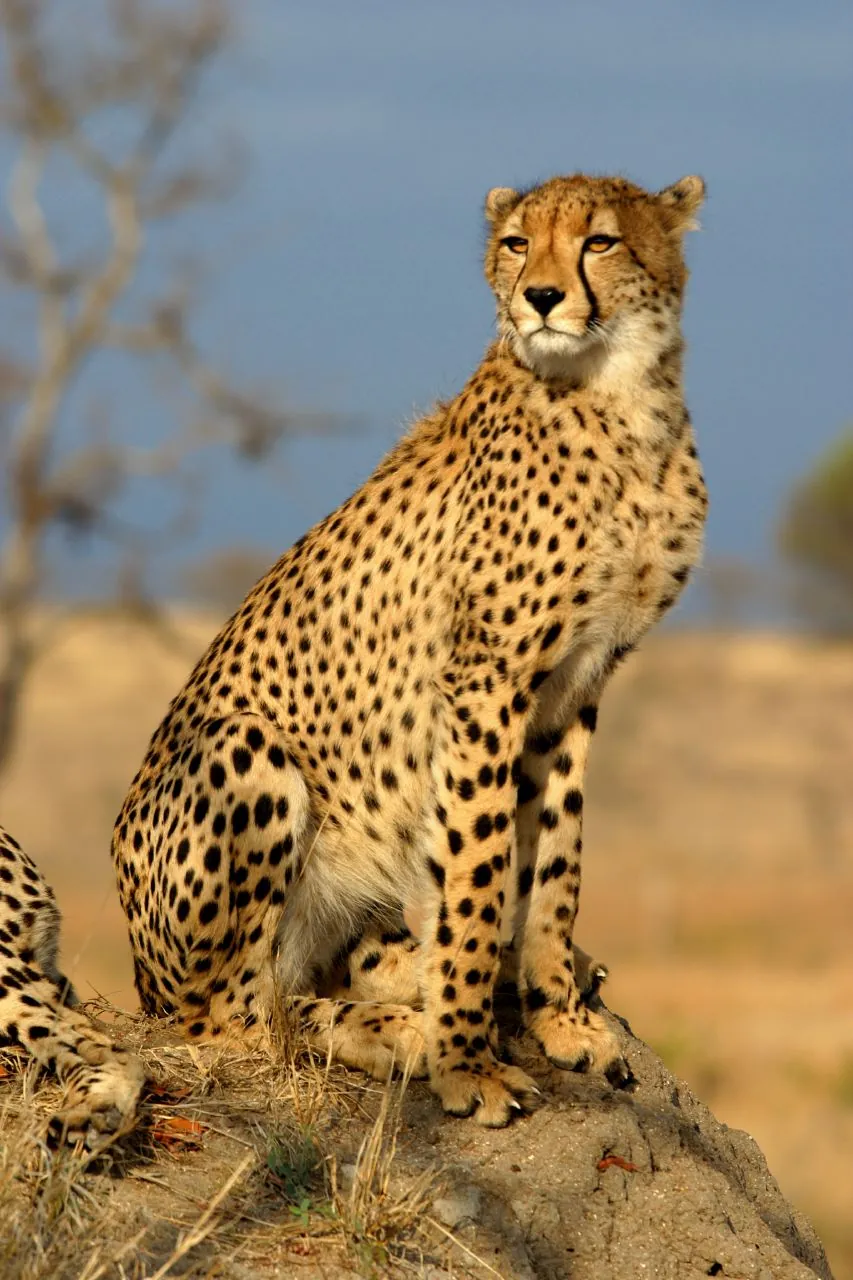
🐆Cheetah
Le guépard (Acinonyx jubatus) est une espèce de mammifère carnivore de la famille des félidés vivant en Afrique et en Asie de l'Ouest. Le guépard a une allure svelte et fine, avec de longues pattes élancées (aux griffes semi-rétractiles ou non-rétractiles selon les sources), et une face au museau court marquée par deux traces noires partant des yeux. Son pelage est entièrement tacheté de noir sur un fond fauve à beige très clair ; les petits sont pourvus d'une courte crinière qui disparaît à l'âge adulte. Il est considéré comme l'animal terrestre le plus rapide au monde, sa vitesse à la course pouvant atteindre 112 km/h, mais seulement pendant quelques secondes. Classé vulnérable par l'Union internationale pour la conservation de la nature, le guépard fait actuellement l'objet de diverses tentatives de protection, incluant des procédés de clonage. L'espèce est divisée en cinq sous-espèces présentant des différences mineures de morphologie ou de comportement. Parmi celles-ci, le guépard asiatique, le guépard du Sahara et le guépard d'Afrique du Nord-Est sont classées en danger critique d'extinction. La population de guépards est passée de 100 000 individus au début du XXe siècle à 7 100 en 2019.
Text: Wikipedia, CC BY-SA 4.0.
IUCN Red List assessment, 2024.
- Body mass
- 51 kg
- Body length
- 1.49 m
- Shoulder height
- 0.8 m
- Top speed
- 104 km/h
- Bite force
- 472 N
- Maximum lifespan
- 20 years
Everything we know about the Cheetah
Typical adult figures. Where a value is an estimate rather than a measurement, it says so.
Body mass51 kgCOMBINEOther figures ↓Hide ↑
Source: COMBINE · v1 (Soria et al. 2021) · CC BY 4.0
By sex
- Female35 kgWikidataQ23907
- Male40 kgWikidataQ23907
Figures vary
- 54 kgAnAgeAnAge build 15, 2023-07-03 (HAGR)data quality: high
Body length1.49 mCOMBINEDetails ↓Hide ↑
Source: COMBINE · v1 (Soria et al. 2021) · CC BY 4.0
Shoulder height0.8 m0.7–0.9 m · typical rangeDetails ↓Hide ↑
Sex not specified in source; value is the midpoint of the published range.
Source: Krausman & Morales 2005, Mammalian Species 771, p.2 · see citation
Top speed104 km/hDetails ↓Hide ↑
MEASURED: mean of three timed runs over a 201.2 m course with a running start (29 m/s). The fastest speed ever recorded from a FREE-RANGING cheetah is lower -- 93 km/h across 367 hunts by GPS and inertial collar (Wilson et al. 2013, Nature 498:185) -- and most hunts were far slower. Hirt's 120 km/h is speedofanimals.com.
Source: Sharp 1997, J Zool 241:493 (timed run) · see citation
Bite force472 NDetails ↓Hide ↑
Canine bite modelled by the dry-skull method (Thomason 1991) from a prepared skull; static bite at the canines, gape not stated. Not a live measurement. The skull's estimated body mass was 29.5 kg.
Source: Wroe, McHenry & Thomason 2005, Proc R Soc B 272:619, Table 1 · see citation
Bite force for its size119Details ↓Hide ↑
Bite force normalised for body mass: the residual of canine bite force regressed on body mass, average across the sample set to 100. Above 100 means the animal bites harder than its size predicts. Do not cross-check against Wikipedia's BFQ table, which silently mixes this paper with Christiansen & Wroe 2007 and cites a popular-science book.
Source: Wroe, McHenry & Thomason 2005, Proc R Soc B 272:619, Table 1 · see citation
Brain mass115 gCOMBINEDetails ↓Hide ↑
Source: COMBINE · v1 (Soria et al. 2021) · CC BY 4.0
Maximum lifespan20 yearsCOMBINEOther figures ↓Hide ↑
Source: COMBINE · v1 (Soria et al. 2021) · CC BY 4.0
Figures vary
- 21 yearsAnAgeAnAge build 15, 2023-07-03 (HAGR)data quality: high
Generation length6 yearsCOMBINEDetails ↓Hide ↑
Source: COMBINE · v1 (Soria et al. 2021) · CC BY 4.0
Age at maturity2.0 yearsCOMBINEDetails ↓Hide ↑
Source: COMBINE · v1 (Soria et al. 2021) · CC BY 4.0
Gestation90 daysCOMBINEOther figures ↓Hide ↑
Source: COMBINE · v1 (Soria et al. 2021) · CC BY 4.0
Figures vary
- 88 daysAnAgeAnAge build 15, 2023-07-03 (HAGR)data quality: high
Litter sizeabout 3COMBINEOther figures ↓Hide ↑
Source: COMBINE · v1 (Soria et al. 2021) · CC BY 4.0
Figures vary
- 3AnAgeAnAge build 15, 2023-07-03 (HAGR)data quality: high
Trophic levelCarnivoreCOMBINEDetails ↓Hide ↑
Source: COMBINE · v1 (Soria et al. 2021) · CC BY 4.0
Activity cycleDiurnalCOMBINEDetails ↓Hide ↑
Source: COMBINE · v1 (Soria et al. 2021) · CC BY 4.0
Home range88 km²COMBINEDetails ↓Hide ↑
Source: COMBINE · v1 (Soria et al. 2021) · CC BY 4.0
Population density0.02 per km²COMBINEDetails ↓Hide ↑
Source: COMBINE · v1 (Soria et al. 2021) · CC BY 4.0
Volume l51 LaverageDetails ↓Hide ↑
Body mass at ~1.0 kg/L, the density of vertebrate tissue.
average = a mean across sexes or species in a group.
Family tree
- kingdomAnimalia
- ›phylumChordata
- ›classMammalia
- ›orderCarnivora
- ›familyFelidae
- ›genusAcinonyx
- ›speciesAcinonyx jubatus
- classMammals · Mammalia
- orderCarnivorans · Carnivora
- subfamilyAcinonychinae
- genusAcinonyx
All 15 branches ↓Fewer branches ↑
- kingdomMetazoa
- phylumChordata
- subphylumCraniata
- subphylumVertebrata
- superclassGnathostomata
- superclassSarcopterygii
- superclassTetrapoda
- classMammals · Mammalia
- subclassTheria
- superorderLaurasiatheria
- orderCarnivorans · Carnivora
- suborderFeliformia
- familyFelidae
- subfamilyAcinonychinae
- genusAcinonyx
More about the Cheetah


Les animaux pris sur le vif
De vraies images des animaux de ce site — à la chasse, au combat, ou vaquant simplement à leurs occupations.
Compare the Cheetah
Pick a tool — the Cheetah is already selected.
Compare every stat with any other animal.
Stand them on the same floor and see who's bigger.
Does it punch above its weight? Its stats against what body size predicts.
See where it sits in the tree of life.