
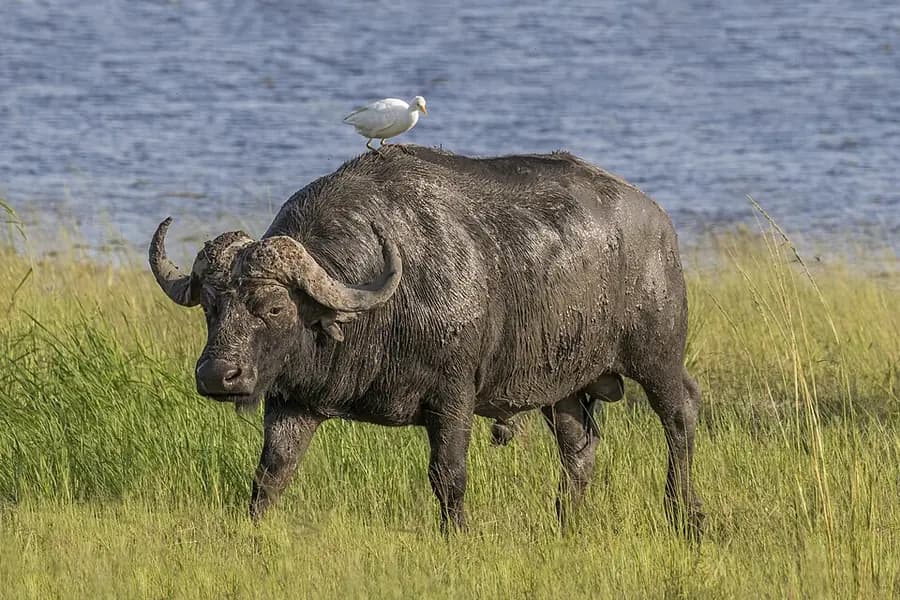
🐃Cape buffalo
Le Buffle d'Afrique, buffle noir des savanes ou grand buffle noir des savanes (Syncerus caffer) est une espèce de bovidés de la sous-tribu des Bubalina. Sa taille peut atteindre 1,7 m en hauteur et 3,4 m en longueur, avec des cornes de 1,5 m d'envergure et un poids de 900 kg. C'est la seule espèce du genre Syncerus. Il fait partie, avec le léopard d'Afrique, l'éléphant d'Afrique, le rhinocéros noir et le lion d'Afrique, du groupe dit « big five » des 5 mammifères autrefois craints et respectés par les chasseurs africains.
Text: Wikipedia, CC BY-SA 4.0.
IUCN Red List assessment, 2019.
- Body mass
- 646 kg
- Body length
- 2.96 m
- Shoulder height
- 1.35 m
- Top speed
- 55 km/h
- Bite force
- not recorded
- Maximum lifespan
- 30 years
Everything we know about the Cape buffalo
Typical adult figures. Where a value is an estimate rather than a measurement, it says so.
Body mass646 kgCOMBINEOther figures ↓Hide ↑
Source: COMBINE · v1 (Soria et al. 2021) · CC BY 4.0
Figures vary
- 700 kgAnAgeAnAge build 15, 2023-07-03 (HAGR)data quality: acceptable
Body length2.96 mCOMBINEDetails ↓Hide ↑
Source: COMBINE · v1 (Soria et al. 2021) · CC BY 4.0
Shoulder height1.35 m1–1.7 m · typical rangeDetails ↓Hide ↑
Range spans all subspecies, so it is wide; not specific to S. c. caffer.
Source: Kingdon 2015, The Kingdon Field Guide to African Mammals · see citation
Top speed55 km/hDetails ↓Hide ↑
Sprint over a short distance, not a sustained pace. Compilations give 55.44 and 57.02 km/h.
Source: Bejan & Marden 2006, J Exp Biol 209:238 and Christiansen 2002, Zool J Linn Soc 136:685; compiled in Hirt et al. 2017, Nat Ecol Evol 1:1116, Supplementary Data · see citation
Brain mass583 gCOMBINEDetails ↓Hide ↑
Source: COMBINE · v1 (Soria et al. 2021) · CC BY 4.0
Maximum lifespan30 yearsCOMBINEOther figures ↓Hide ↑
Source: COMBINE · v1 (Soria et al. 2021) · CC BY 4.0
Figures vary
- 33 yearsAnAgeAnAge build 15, 2023-07-03 (HAGR)data quality: acceptable
Generation length11 yearsCOMBINEDetails ↓Hide ↑
Source: COMBINE · v1 (Soria et al. 2021) · CC BY 4.0
Age at maturity4.6 yearsCOMBINEDetails ↓Hide ↑
Source: COMBINE · v1 (Soria et al. 2021) · CC BY 4.0
Gestation333 daysCOMBINEOther figures ↓Hide ↑
Source: COMBINE · v1 (Soria et al. 2021) · CC BY 4.0
Figures vary
- 331 daysAnAgeAnAge build 15, 2023-07-03 (HAGR)data quality: acceptable
Litter size1COMBINEOther figures ↓Hide ↑
Source: COMBINE · v1 (Soria et al. 2021) · CC BY 4.0
Figures vary
- 1AnAgeAnAge build 15, 2023-07-03 (HAGR)data quality: acceptable
Trophic levelHerbivoreCOMBINEDetails ↓Hide ↑
Source: COMBINE · v1 (Soria et al. 2021) · CC BY 4.0
Activity cycleCrepuscular / mixedCOMBINEDetails ↓Hide ↑
Source: COMBINE · v1 (Soria et al. 2021) · CC BY 4.0
Home range64 km²COMBINEDetails ↓Hide ↑
Source: COMBINE · v1 (Soria et al. 2021) · CC BY 4.0
Population density2.99 per km²COMBINEDetails ↓Hide ↑
Source: COMBINE · v1 (Soria et al. 2021) · CC BY 4.0
Volume l646 LaverageDetails ↓Hide ↑
Body mass at ~1.0 kg/L, the density of vertebrate tissue.
average = a mean across sexes or species in a group.
Not recorded for Cape buffalo yet: bite force.
Family tree
- kingdomAnimalia
- ›phylumChordata
- ›classMammalia
- ›orderArtiodactyla
- ›familyBovidae
- ›genusSyncerus
- ›speciesSyncerus caffer
- classMammals · Mammalia
- orderEven-toed hoofed animals · Artiodactyla
- subfamilyBovinae
- genusSyncerus
All 16 branches ↓Fewer branches ↑
- kingdomMetazoa
- phylumChordata
- subphylumCraniata
- subphylumVertebrata
- superclassGnathostomata
- superclassSarcopterygii
- superclassTetrapoda
- classMammals · Mammalia
- subclassTheria
- superorderLaurasiatheria
- orderEven-toed hoofed animals · Artiodactyla
- suborderRuminantia
- infraorderPecora
- familyBovidae
- subfamilyBovinae
- genusSyncerus
More about the Cape buffalo


Les animaux pris sur le vif
De vraies images des animaux de ce site — à la chasse, au combat, ou vaquant simplement à leurs occupations.
Compare the Cape buffalo
Pick a tool — the Cape buffalo is already selected.
Compare every stat with any other animal.
Stand them on the same floor and see who's bigger.
Does it punch above its weight? Its stats against what body size predicts.
See where it sits in the tree of life.