
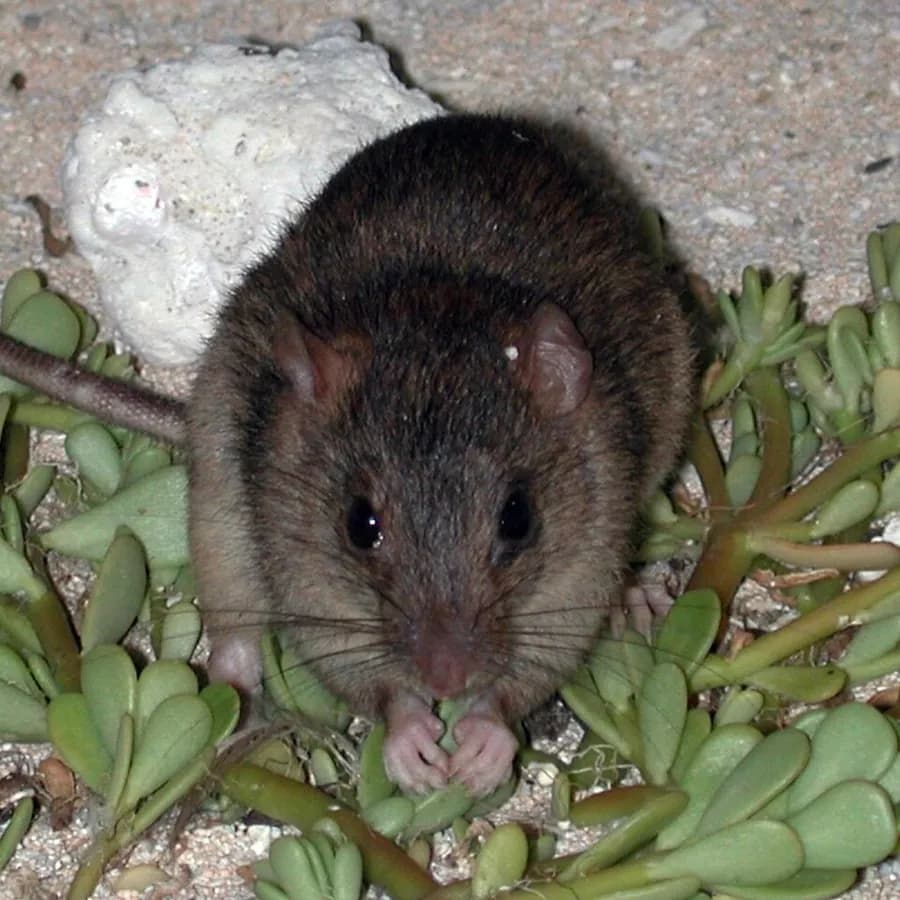
🐭Bramble Cay melomys
Melomys rubicola, le Mélomys de Bramble Cay, est un petit rongeur de la famille des muridés. Découvert en 1845, il est endémique de Bramble Cay, une petite langue de sable de 200 m de large située dans l'est du détroit de Torrès, entre l'Australie et la Papouasie-Nouvelle-Guinée. N'ayant plus été aperçu depuis 2009, il est considéré comme probablement éteint depuis le 14 juin 2016, et son extinction a été officialisée le 18 février 2019 par le gouvernement australien, puis par l'Union internationale pour la conservation de la nature. Il est considéré comme étant probablement la première espèce de mammifère ayant disparu à cause du réchauffement climatique. La cause de cette extinction est la destruction de son habitat après des tempêtes de forte intensité qui ont provoqué des inondations répétées.
Text: Wikipedia, CC BY-SA 4.0.
IUCN Red List assessment, 2025.
- Body mass
- 0.09 kg
- Body length
- 0.15 m
- Shoulder height
- not recorded
- Top speed
- not recorded
- Bite force
- not recorded
- Maximum lifespan
- 5.05 years
This animal is extinct
Assessed Extinct on the IUCN Red List, 2025. Everything on this page — the measurements, the photos, the videos — is a record of an animal that is gone.
Everything we know about the Bramble Cay melomys
Typical adult figures. Where a value is an estimate rather than a measurement, it says so.
Body mass0.09 kgCOMBINEDetails ↓Hide ↑
Source: COMBINE · v1 (Soria et al. 2021) · CC BY 4.0
Body length0.15 mCOMBINEDetails ↓Hide ↑
Source: COMBINE · v1 (Soria et al. 2021) · CC BY 4.0
Maximum lifespan5.05 yearsestimatedCOMBINEDetails ↓Hide ↑
Source: COMBINE · v1 (Soria et al. 2021) · CC BY 4.0
Generation length2.1 yearsestimatedCOMBINEDetails ↓Hide ↑
Source: COMBINE · v1 (Soria et al. 2021) · CC BY 4.0
Age at maturity172 daysCOMBINEDetails ↓Hide ↑
Source: COMBINE · v1 (Soria et al. 2021) · CC BY 4.0
Gestation38 daysCOMBINEDetails ↓Hide ↑
Source: COMBINE · v1 (Soria et al. 2021) · CC BY 4.0
Litter sizeabout 2COMBINEDetails ↓Hide ↑
Source: COMBINE · v1 (Soria et al. 2021) · CC BY 4.0
Trophic levelHerbivoreCOMBINEDetails ↓Hide ↑
Source: COMBINE · v1 (Soria et al. 2021) · CC BY 4.0
Activity cycleNocturnalCOMBINEDetails ↓Hide ↑
Source: COMBINE · v1 (Soria et al. 2021) · CC BY 4.0
Volume l0.1 LaverageDetails ↓Hide ↑
Body mass at ~1.0 kg/L, the density of vertebrate tissue.
estimated = a model's estimate for a species nobody has measured; average = a mean across sexes or species in a group.
Not recorded for Bramble Cay melomys yet: shoulder height, top speed, bite force.
Family tree
- kingdomAnimalia
- ›phylumChordata
- ›classMammalia
- ›orderRodentia
- ›familyMuridae
- ›genusMelomys
- ›speciesMelomys rubicola
- classMammals · Mammalia
- orderRodents · Rodentia
- suborderMyomorpha
- familyMuridae
All 13 branches ↓Fewer branches ↑
- kingdomMetazoa
- phylumChordata
- subphylumCraniata
- subphylumVertebrata
- superclassGnathostomata
- superclassSarcopterygii
- superclassTetrapoda
- classMammals · Mammalia
- subclassTheria
- superorderEuarchontoglires
- orderRodents · Rodentia
- suborderMyomorpha
- familyMuridae
More about the Bramble Cay melomys


No videos of the Bramble Cay melomys yet.
We have 44,653 videos so far, and none of them features this animal yet.
All videos →Compare the Bramble Cay melomys
Pick a tool — the Bramble Cay melomys is already selected.
Compare every stat with any other animal.
Stand them on the same floor and see who's bigger.
How speed, brain and bite scale with body size. This animal isn't in the sample yet.
See where it sits in the tree of life.