
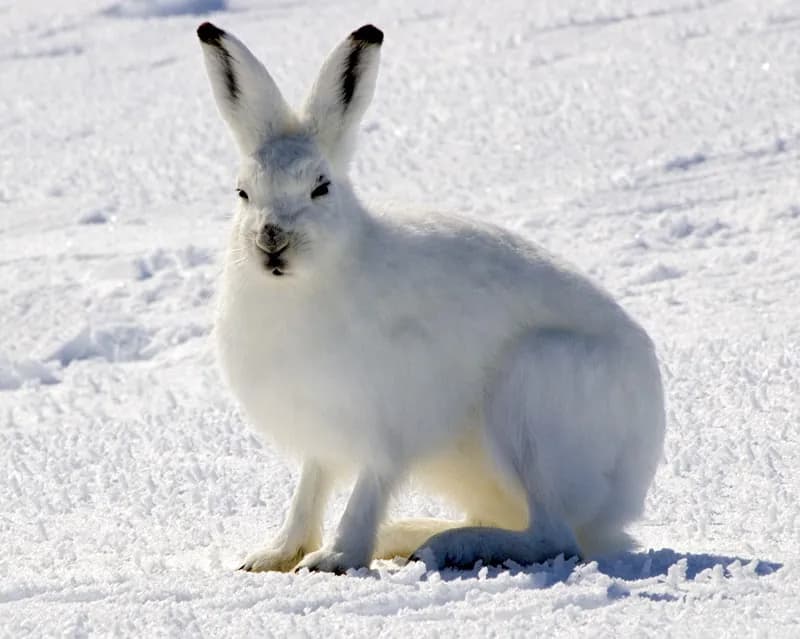
🐇Arctic hare
Le lièvre arctique (Lepus arcticus) est un petit mammifère recouvert de fourrure, adapté à un environnement froid (polaire ou de haute montagne) et à un rythme nycthéméral et annuel particulier. On l'a autrefois parfois considéré comme sous-espèce du lièvre variable, mais il est maintenant considéré comme une espèce distincte. Ce lièvre est adapté, tant par sa morphologie que par son épaisse fourrure blanche hivernale et son comportement, aux conditions climatiques du Grand Nord. Il est parfois surnommé « lièvre à raquettes » à cause de ses doigts de pattes écartés lui permettant de marcher sur des épaisseurs de neige différentes.
Text: Wikipedia, CC BY-SA 4.0.
IUCN Red List assessment, 2019.
- Body mass
- 3.03 kg
- Body length
- 0.57 m
- Shoulder height
- not recorded
- Top speed
- not recorded
- Bite force
- not recorded
- Maximum lifespan
- 18 years
Everything we know about the Arctic hare
Typical adult figures. Where a value is an estimate rather than a measurement, it says so.
Body mass3.03 kgCOMBINEDetails ↓Hide ↑
Source: COMBINE · v1 (Soria et al. 2021) · CC BY 4.0
Body length0.57 mCOMBINEDetails ↓Hide ↑
Source: COMBINE · v1 (Soria et al. 2021) · CC BY 4.0
Brain mass16 gCOMBINEDetails ↓Hide ↑
Source: COMBINE · v1 (Soria et al. 2021) · CC BY 4.0
Maximum lifespan18 yearsCOMBINEDetails ↓Hide ↑
Source: COMBINE · v1 (Soria et al. 2021) · CC BY 4.0
Generation length2.95 yearsCOMBINEDetails ↓Hide ↑
Source: COMBINE · v1 (Soria et al. 2021) · CC BY 4.0
Age at maturity1.0 yearsCOMBINEDetails ↓Hide ↑
Source: COMBINE · v1 (Soria et al. 2021) · CC BY 4.0
Gestation50 daysCOMBINEDetails ↓Hide ↑
Source: COMBINE · v1 (Soria et al. 2021) · CC BY 4.0
Litter sizeabout 4COMBINEDetails ↓Hide ↑
Source: COMBINE · v1 (Soria et al. 2021) · CC BY 4.0
Trophic levelOmnivoreCOMBINEDetails ↓Hide ↑
Source: COMBINE · v1 (Soria et al. 2021) · CC BY 4.0
Activity cycleNocturnalCOMBINEDetails ↓Hide ↑
Source: COMBINE · v1 (Soria et al. 2021) · CC BY 4.0
Home range2.26 km²COMBINEDetails ↓Hide ↑
Source: COMBINE · v1 (Soria et al. 2021) · CC BY 4.0
Volume l3 LaverageDetails ↓Hide ↑
Body mass at ~1.0 kg/L, the density of vertebrate tissue.
average = a mean across sexes or species in a group.
Not recorded for Arctic hare yet: shoulder height, top speed, bite force.
Family tree
- kingdomAnimalia
- ›phylumChordata
- ›classMammalia
- ›orderLagomorpha
- ›familyLeporidae
- ›genusLepus
- ›speciesLepus arcticus
- classMammals · Mammalia
- orderRabbits & hares · Lagomorpha
- familyLeporidae
- genusLepus
All 13 branches ↓Fewer branches ↑
- kingdomMetazoa
- phylumChordata
- subphylumCraniata
- subphylumVertebrata
- superclassGnathostomata
- superclassSarcopterygii
- superclassTetrapoda
- classMammals · Mammalia
- subclassTheria
- superorderEuarchontoglires
- orderRabbits & hares · Lagomorpha
- familyLeporidae
- genusLepus
More about the Arctic hare


No videos of the Arctic hare yet.
We have 44,653 videos so far, and none of them features this animal yet.
All videos →Compare the Arctic hare
Pick a tool — the Arctic hare is already selected.
Compare every stat with any other animal.
Stand them on the same floor and see who's bigger.
How speed, brain and bite scale with body size. This animal isn't in the sample yet.
See where it sits in the tree of life.