
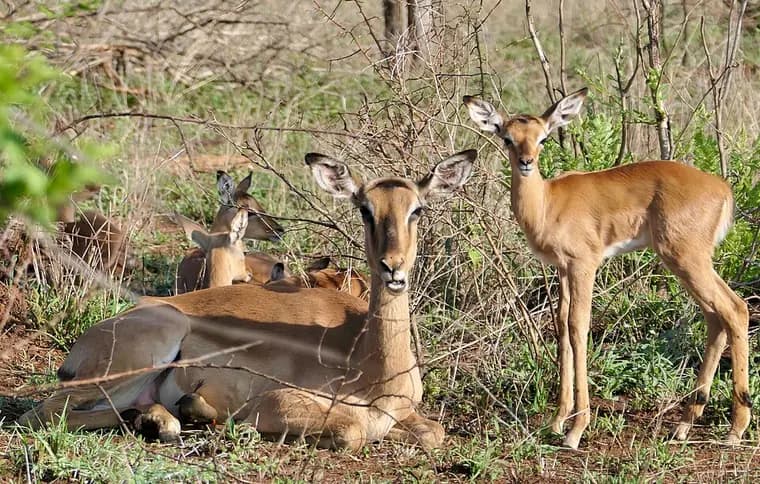
🐃Impala
Impala eli pala-antilooppi (Aepyceros melampus) on Afrikan yleisimpiä antilooppilajeja. Se elää yleisenä monin paikoin itäisessä ja eteläisessä Afrikassa. Lajin elinympäristöä ovat erilaiset reunaympäristöt, avoimet metsämaat, puu- ja pensassavannit. Se on antiloopiksi keskikokoinen ja painaa 40–76 kiloa. Väritys on selästä pähkinänruskea, kyljistä vaaleampi. Vatsa on valkoinen. Impalalaumoissa on 15–120 yksilöä ja laumojen rakenne vaihtelee vuodenaikojen ja lisääntymisajan mukaan. Ravinto koostuu sadekaudella lähinnä heinästä, kuivana kautena enimmäkseen puiden ja pensaiden lehdistä. Impala juo mieluiten päivittäin ja pysyttelee lähellä juomapaikkoja. Naaras synnyttää 194–200 päivän kantoajan jälkeen yleensä vain yhden vasan, jota se imettää 4–7 kuukautta.
Text: Wikipedia, CC BY-SA 4.0.
IUCN Red List assessment, 2016.
- Body mass
- 53 kg
- Body length
- 1.46 m
- Shoulder height
- not recorded
- Top speed
- not recorded
- Bite force
- not recorded
- Maximum lifespan
- 26 years
Everything we know about the Impala
Typical adult figures. Where a value is an estimate rather than a measurement, it says so.
Body mass53 kgCOMBINEOther figures ↓Hide ↑
Source: COMBINE · v1 (Soria et al. 2021) · CC BY 4.0
Figures vary
- 53 kgAnAgeAnAge build 15, 2023-07-03 (HAGR)data quality: high
Body length1.46 mCOMBINEDetails ↓Hide ↑
Source: COMBINE · v1 (Soria et al. 2021) · CC BY 4.0
Brain mass174 gCOMBINEDetails ↓Hide ↑
Source: COMBINE · v1 (Soria et al. 2021) · CC BY 4.0
Maximum lifespan26 yearsCOMBINEOther figures ↓Hide ↑
Source: COMBINE · v1 (Soria et al. 2021) · CC BY 4.0
Figures vary
- 26 yearsAnAgeAnAge build 15, 2023-07-03 (HAGR)data quality: high
Generation length7.32 yearsCOMBINEDetails ↓Hide ↑
Source: COMBINE · v1 (Soria et al. 2021) · CC BY 4.0
Age at maturity1.4 yearsCOMBINEDetails ↓Hide ↑
Source: COMBINE · v1 (Soria et al. 2021) · CC BY 4.0
Gestation197 daysCOMBINEOther figures ↓Hide ↑
Source: COMBINE · v1 (Soria et al. 2021) · CC BY 4.0
Figures vary
- 198 daysAnAgeAnAge build 15, 2023-07-03 (HAGR)data quality: high
Litter size1COMBINEOther figures ↓Hide ↑
Source: COMBINE · v1 (Soria et al. 2021) · CC BY 4.0
Figures vary
- 1AnAgeAnAge build 15, 2023-07-03 (HAGR)data quality: high
Trophic levelHerbivoreCOMBINEDetails ↓Hide ↑
Source: COMBINE · v1 (Soria et al. 2021) · CC BY 4.0
Activity cycleCrepuscular / mixedCOMBINEDetails ↓Hide ↑
Source: COMBINE · v1 (Soria et al. 2021) · CC BY 4.0
Home range1.97 km²COMBINEDetails ↓Hide ↑
Source: COMBINE · v1 (Soria et al. 2021) · CC BY 4.0
Population density9.94 per km²COMBINEDetails ↓Hide ↑
Source: COMBINE · v1 (Soria et al. 2021) · CC BY 4.0
Volume l53 LaverageDetails ↓Hide ↑
Body mass at ~1.0 kg/L, the density of vertebrate tissue.
average = a mean across sexes or species in a group.
Not recorded for Impala yet: shoulder height, top speed, bite force.
Family tree
- kingdomAnimalia
- ›phylumChordata
- ›classMammalia
- ›orderArtiodactyla
- ›familyBovidae
- ›genusAepyceros
- ›speciesAepyceros melampus
- classMammals · Mammalia
- orderEven-toed hoofed animals · Artiodactyla
- subfamilyAepycerotinae
- genusAepyceros
All 16 branches ↓Fewer branches ↑
- kingdomMetazoa
- phylumChordata
- subphylumCraniata
- subphylumVertebrata
- superclassGnathostomata
- superclassSarcopterygii
- superclassTetrapoda
- classMammals · Mammalia
- subclassTheria
- superorderLaurasiatheria
- orderEven-toed hoofed animals · Artiodactyla
- suborderRuminantia
- infraorderPecora
- familyBovidae
- subfamilyAepycerotinae
- genusAepyceros
More about the Impala


No videos of the Impala yet.
We have 44,653 videos so far, and none of them features this animal yet.
All videos →Compare the Impala
Pick a tool — the Impala is already selected.
Compare every stat with any other animal.
Stand them on the same floor and see who's bigger.
How speed, brain and bite scale with body size. This animal isn't in the sample yet.
See where it sits in the tree of life.