
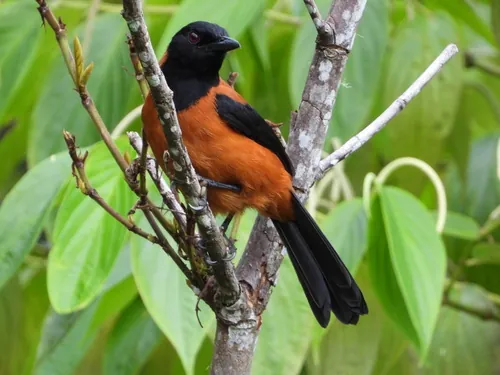
🐦Hooded pitohui
El pitohuí bicolor (Pitohui dichrous) es una especie de ave paseriforme de la familia Oriolidae endémica de Nueva Guinea. Debe su nombre a su plumaje negro y anaranjado. Esta especie y sus familiares, el pitohuí variable y el pitohuí marrón, son los primeros pájaros descubiertos que son tóxicos. Una neurotoxina, llamada homobatracotoxina, se encuentra en las plumas y en la piel de esta ave y es lo que les causa dolor a las personas que la tocan. El pitohuí con capucha adquiere su veneno de su dieta, la cual incluye el escarabajo Choresine de la familia Melyridae. Este escarabajo es probablemente el mismo que les da a las ranas tóxicas de Colombia sus venenos tan potentes. Su cabeza es negra brillante, azabache. Y el resto del cuerpo es de un vivo color. Es un pájaro cantor y mide poco más de 20 centímetros. El primero fue descubierto en 1989. Hay varias subespecies de distintos colores. Los más coloridos son los más venenosos. Las tribus locales lo llaman también "pájaro basura" porque no pueden comerlo.
Text: Wikipedia, CC BY-SA 4.0.
IUCN Red List assessment, 2018.
- Body mass
- 0.09 kg
- Body length
- not recorded
- Shoulder height
- not recorded
- Top speed
- not recorded
- Bite force
- not recorded
- Maximum lifespan
- not recorded
Everything we know about the Hooded pitohui
Typical adult figures. Where a value is an estimate rather than a measurement, it says so.
Body mass0.09 kgAVONETDetails ↓Hide ↑
Source: AVONET · v1.1 (Tobias et al. 2022) · CC BY 4.0
Tail length0.1 mAVONETDetails ↓Hide ↑
Source: AVONET · v1.1 (Tobias et al. 2022) · CC BY 4.0
Wing length0.11 mAVONETDetails ↓Hide ↑
Source: AVONET · v1.1 (Tobias et al. 2022) · CC BY 4.0
Beak length0.03 mAVONETDetails ↓Hide ↑
Source: AVONET · v1.1 (Tobias et al. 2022) · CC BY 4.0
Tarsus length0.03 mAVONETDetails ↓Hide ↑
Source: AVONET · v1.1 (Tobias et al. 2022) · CC BY 4.0
Trophic levelHerbivoreAVONETDetails ↓Hide ↑
Source: AVONET · v1.1 (Tobias et al. 2022) · CC BY 4.0
HabitatForestAVONETDetails ↓Hide ↑
Source: AVONET · v1.1 (Tobias et al. 2022) · CC BY 4.0
LifestyleInsessorialAVONETDetails ↓Hide ↑
Source: AVONET · v1.1 (Tobias et al. 2022) · CC BY 4.0
Volume l0.1 LaverageDetails ↓Hide ↑
Body mass at ~1.0 kg/L, the density of vertebrate tissue.
average = a mean across sexes or species in a group.
Not recorded for Hooded pitohui yet: body length, shoulder height, top speed, bite force, maximum lifespan.
Family tree
- kingdomAnimalia
- ›phylumChordata
- ›classAves
- ›orderPasseriformes
- ›familyOriolidae
- ›genusPitohui
- ›speciesPitohui dichrous
- superclassTetrapoda
- orderSauria
- classBirds · Aves
- orderPerching birds · Passeriformes
All 10 branches ↓Fewer branches ↑
- kingdomMetazoa
- phylumChordata
- subphylumCraniata
- subphylumVertebrata
- superclassGnathostomata
- superclassSarcopterygii
- superclassTetrapoda
- orderSauria
- classBirds · Aves
- orderPerching birds · Passeriformes
More about the Hooded pitohui
No videos of the Hooded pitohui yet.
We have 44,653 videos so far, and none of them features this animal yet.
All videos →Compare the Hooded pitohui
Pick a tool — the Hooded pitohui is already selected.
Compare every stat with any other animal.
Stand them on the same floor and see who's bigger.
How speed, brain and bite scale with body size. This animal isn't in the sample yet.
See where it sits in the tree of life.