
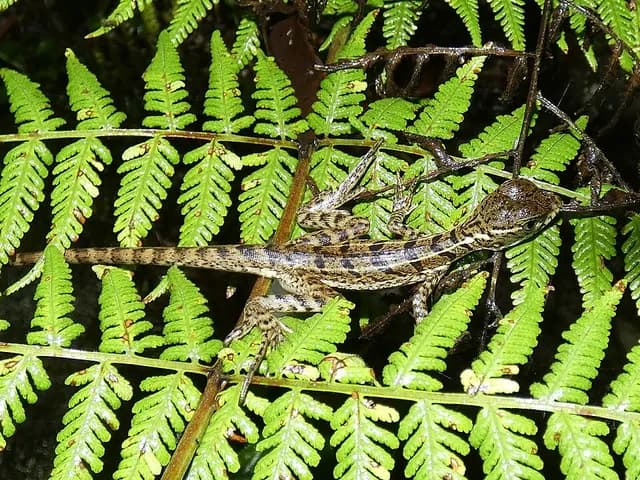
🦎Common basilisk
El basilisco común (Basiliscus basiliscus) es un lagarto nativo de América Central. Tiene la notable habilidad de ser capaz de caminar sobre la superficie del agua. Sus patas posteriores están provistas de unos lóbulos dérmicos que funcionan como aletas, los cuales aumentan la superficie de apoyo sobre el agua. Estos son enrollados cuando el animal camina por tierra. Si el animal afronta el peligro, comienza a correr muy rápidamente sobre la superficie de un río o un lago, entonces las aletas de sus pies traseros se abren permitiendo aumentar su superficie de apoyo y así correr sobre el agua. Sin embargo, al decrecer su velocidad, el basilisco se hunde y tiene que nadar del modo normal como cualquier otro lagarto. En algunos lugares de México es también llamado "teterete" o "toloque". En algunas zonas de Costa Rica se le conoce con el nombre de "cherepo" o "gallego". En El Salvador, se conoce como "tenguereche". En Panamá es llamado "moracho" o "meracho".
Text: Wikipedia, CC BY-SA 4.0.
IUCN Red List assessment, 2016.
- Body mass
- 0.55 kg
- Body length
- not recorded
- Shoulder height
- not recorded
- Top speed
- not recorded
- Bite force
- not recorded
- Maximum lifespan
- 9 years
Everything we know about the Common basilisk
Typical adult figures. Where a value is an estimate rather than a measurement, it says so.
Body mass0.55 kgmaximum recordedReptTraitsDetails ↓Hide ↑
Source: ReptTraits · v1.2 (Oskyrko et al. 2024) · CC BY 4.0
Maximum lifespan9 yearsmaximum recordedReptTraitsDetails ↓Hide ↑
Source: ReptTraits · v1.2 (Oskyrko et al. 2024) · CC BY 4.0
DietOmnivorousReptTraitsDetails ↓Hide ↑
Source: ReptTraits · v1.2 (Oskyrko et al. 2024) · CC BY 4.0
Activity cycleDiurnalReptTraitsDetails ↓Hide ↑
Source: ReptTraits · v1.2 (Oskyrko et al. 2024) · CC BY 4.0
Foraging modeAMBReptTraitsDetails ↓Hide ↑
Source: ReptTraits · v1.2 (Oskyrko et al. 2024) · CC BY 4.0
VenomousNoReptTraitsDetails ↓Hide ↑
Source: ReptTraits · v1.2 (Oskyrko et al. 2024) · CC BY 4.0
Snout–vent length0.25 mmaximum recordedReptTraitsOther figures ↓Hide ↑
Source: ReptTraits · v1.2 (Oskyrko et al. 2024) · CC BY 4.0
By sex
- Female0.16 mReptTraitsv1.2 (Oskyrko et al. 2024)
Volume l0.5 LaverageDetails ↓Hide ↑
Body mass at ~1.0 kg/L, the density of vertebrate tissue.
average = a mean across sexes or species in a group.
Not recorded for Common basilisk yet: body length, shoulder height, top speed, bite force.
Family tree
- kingdomAnimalia
- ›phylumChordata
- ›classSquamata
- ›familyCorytophanidae
- ›genusBasiliscus
- ›speciesBasiliscus basiliscus
- orderLizards & snakes · Squamata
- suborderIguania
- subfamilyCorytophaninae
- genusBasiliscus
All 13 branches ↓Fewer branches ↑
- kingdomMetazoa
- phylumChordata
- subphylumCraniata
- subphylumVertebrata
- superclassGnathostomata
- superclassSarcopterygii
- superclassTetrapoda
- orderSauria
- superorderLepidosauria
- orderLizards & snakes · Squamata
- suborderIguania
- subfamilyCorytophaninae
- genusBasiliscus
More about the Common basilisk
No videos of the Common basilisk yet.
We have 44,653 videos so far, and none of them features this animal yet.
All videos →Compare the Common basilisk
Pick a tool — the Common basilisk is already selected.
Compare every stat with any other animal.
Stand them on the same floor and see who's bigger.
How speed, brain and bite scale with body size. This animal isn't in the sample yet.
See where it sits in the tree of life.