
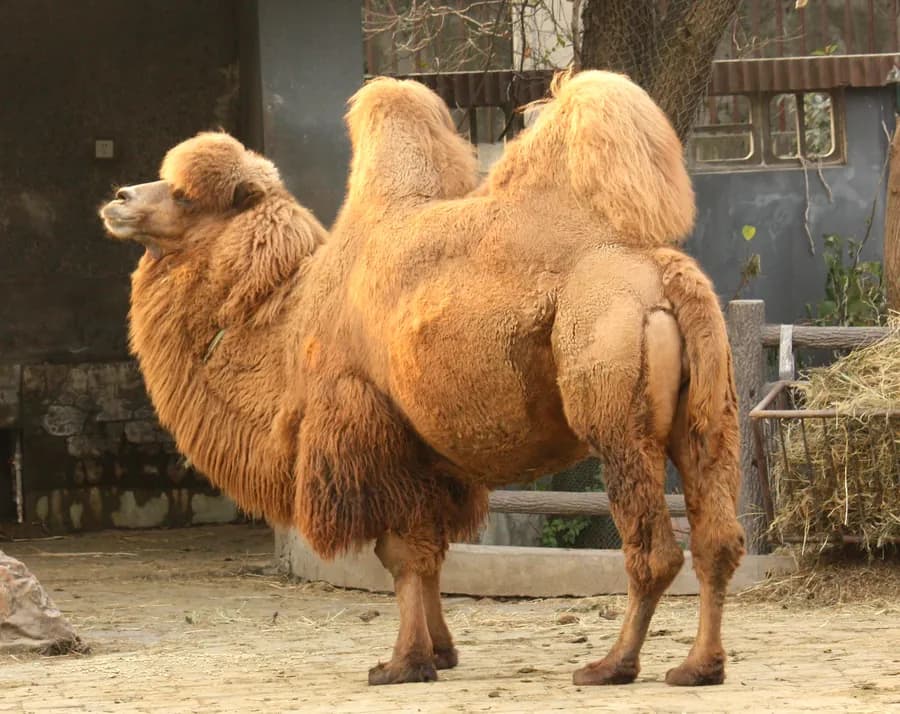
🐃Bactrian camel
El camello bactriano (Camelus bactrianus) es un gran ungulado doméstico nativo de las estepas de Asia Central. Tiene dos gibas en la espalda, tal y como sucede con el camello salvaje (Camelus ferus) en contraste con el dromedario (Camelus dromedarius) que cuenta con una sola giba. Su población de dos millones existe únicamente en la forma domesticada. Su nombre proviene de la antigua región histórica de Bactria. Los camellos bactrianos son camellos domesticados que han servido como animales de carga en el centro de Asia desde la antigüedad. Con su tolerancia al frío, la sequía y las grandes altitudes, permitió el viaje de caravanas en la Ruta de la Seda. Los camellos bactrianos, son una especie separada del camello salvaje, que es la única especie de camello verdaderamente salvaje (en oposición a la asilvestrada) en el mundo.
Text: Wikipedia, CC BY-SA 4.0.
The IUCN Red List has not assessed Camelus bactrianus yet.
- Body mass
- 475 kg
- Body length
- not recorded
- Shoulder height
- 1.7 m
- Top speed
- not recorded
- Bite force
- not recorded
- Maximum lifespan
- 35 years
Everything we know about the Bactrian camel
Typical adult figures. Where a value is an estimate rather than a measurement, it says so.
Body mass475 kgAnAgeDetails ↓Hide ↑
data quality: high
Source: AnAge · AnAge build 15, 2023-07-03 (HAGR) · CC BY 3.0
Shoulder height1.7 m1.6–1.8 m · typical rangenot statedDetails ↓Hide ↑
SDZWA factsheet body-measurements table, shoulder height: '160-180 cm (5.2-5.9 ft)', data attributed to Franklin (2011). Midpoint of the published range. Domestic Bactrian camel.
Source: Franklin 2011, Family Camelidae, in Wilson & Mittermeier (eds), Handbook of the Mammals of the World Vol 2, Lynx Edicions; as compiled in San Diego Zoo Wildlife Alliance Extant Camels factsheet, https://ielc.libguides.com/sdzg/factsheets/extantcamels/characteristics · see citation
Maximum lifespan35 yearsAnAgeDetails ↓Hide ↑
data quality: high
Source: AnAge · AnAge build 15, 2023-07-03 (HAGR) · CC BY 3.0
Gestation1.1 yearsAnAgeDetails ↓Hide ↑
data quality: high
Source: AnAge · AnAge build 15, 2023-07-03 (HAGR) · CC BY 3.0
Litter size1AnAgeDetails ↓Hide ↑
data quality: high
Source: AnAge · AnAge build 15, 2023-07-03 (HAGR) · CC BY 3.0
Volume l475 LaverageDetails ↓Hide ↑
Body mass at ~1.0 kg/L, the density of vertebrate tissue.
average = a mean across sexes or species in a group.
Not recorded for Bactrian camel yet: body length, top speed, bite force.
Family tree
- kingdomAnimalia
- ›phylumChordata
- ›classMammalia
- ›orderArtiodactyla
- ›familyCamelidae
- ›genusCamelus
- ›speciesCamelus bactrianus
- classMammals · Mammalia
- orderEven-toed hoofed animals · Artiodactyla
- familyCamelidae
- genusCamelus
All 14 branches ↓Fewer branches ↑
- kingdomMetazoa
- phylumChordata
- subphylumCraniata
- subphylumVertebrata
- superclassGnathostomata
- superclassSarcopterygii
- superclassTetrapoda
- classMammals · Mammalia
- subclassTheria
- superorderLaurasiatheria
- orderEven-toed hoofed animals · Artiodactyla
- suborderTylopoda
- familyCamelidae
- genusCamelus
More about the Bactrian camel


No videos of the Bactrian camel yet.
We have 44,653 videos so far, and none of them features this animal yet.
All videos →Compare the Bactrian camel
Pick a tool — the Bactrian camel is already selected.
Compare every stat with any other animal.
Stand them on the same floor and see who's bigger.
How speed, brain and bite scale with body size. This animal isn't in the sample yet.
See where it sits in the tree of life.