
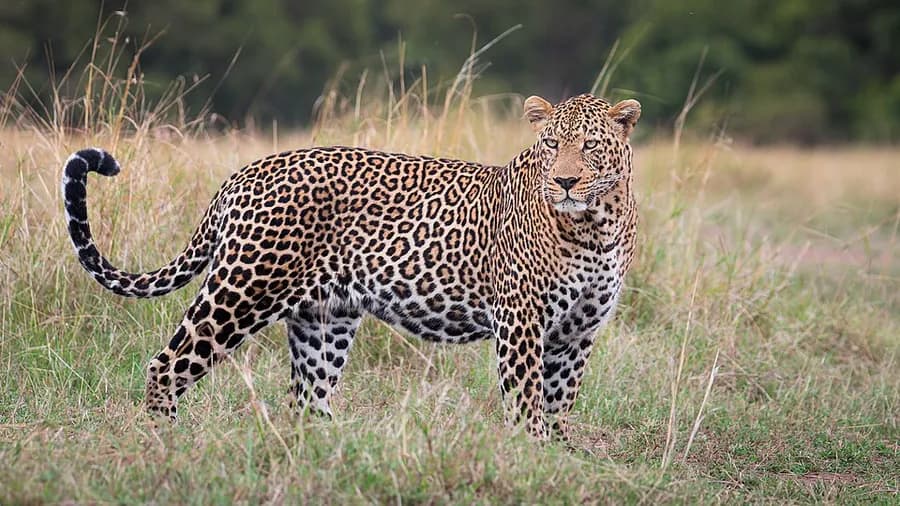
🐆Leopard
Der Leopard (Panthera pardus), auch Panther, ist eine Art aus der Familie der Katzen, die in Afrika und Asien verbreitet ist. Darüber hinaus kommt sie auch im Kaukasus vor. Der Leopard ist nach Tiger, Löwe, Jaguar und Puma die fünftgrößte Katzenart. Auf der Roten Liste gefährdeter Arten der IUCN sind Leoparden in der Vorwarnliste als Vulnerable ‚gefährdet‘ klassifiziert. Leoparden haben von allen sieben Großkatzen das größte Verbreitungsgebiet, sie leben in Afrika und Asien. Sie sind Raubtiere und Einzelgänger. Die Fellzeichnung ist je nach Unterart oft sehr verschieden, aber auch innerhalb eines Gebietes treten individuelle Unterschiede auf. Fast immer zeigt das Fell Rosetten. In großen Höhenlagen und im tropischen Regenwald findet man manchmal Schwärzlinge, die auch Schwarzer Panther genannt werden. Die Ausprägung des schwarzen Fells ist erblich und wird über ein einziges Gen (monogenetisch) rezessiv vererbt.
Text: Wikipedia, CC BY-SA 4.0.
IUCN Red List assessment, 2025.
- Body mass
- 53 kg
- Body length
- 1.64 m
- Shoulder height
- 0.72 m
- Top speed
- 58 km/h
- Bite force
- 467 N
- Maximum lifespan
- 27 years
Everything we know about the Leopard
Typical adult figures. Where a value is an estimate rather than a measurement, it says so.
Body mass53 kgCOMBINEOther figures ↓Hide ↑
Source: COMBINE · v1 (Soria et al. 2021) · CC BY 4.0
Figures vary
- 54 kgAnAgeAnAge build 15, 2023-07-03 (HAGR)data quality: high
Body length1.64 mCOMBINEDetails ↓Hide ↑
Source: COMBINE · v1 (Soria et al. 2021) · CC BY 4.0
Shoulder height0.72 maverageOther figures ↓Hide ↑
Species-level value synthesised as the mean of: male.
By sex
- Male0.72 mStein & Hayssen 2013, Mammalian Species 45(900), pp.33-34n=6. Not verified for African leopard specifically.
Top speed58 km/hDetails ↓Hide ↑
Sprint over a short distance, not a sustained pace. Compilations give 58.32 and 59.98 km/h.
Source: Iriarte-Diaz 2002, J Exp Biol 205:2897 and Christiansen 2002, Zool J Linn Soc 136:685; compiled in Hirt et al. 2017, Nat Ecol Evol 1:1116, Supplementary Data · see citation
Bite force467 NDetails ↓Hide ↑
Canine bite modelled by the dry-skull method (Thomason 1991) from a prepared skull; static bite at the canines, gape not stated. Not a live measurement. The skull's estimated body mass was 43.1 kg.
Source: Wroe, McHenry & Thomason 2005, Proc R Soc B 272:619, Table 1 · see citation
Bite force for its size94Details ↓Hide ↑
Bite force normalised for body mass: the residual of canine bite force regressed on body mass, average across the sample set to 100. Above 100 means the animal bites harder than its size predicts. Do not cross-check against Wikipedia's BFQ table, which silently mixes this paper with Christiansen & Wroe 2007 and cites a popular-science book.
Source: Wroe, McHenry & Thomason 2005, Proc R Soc B 272:619, Table 1 · see citation
Brain mass134 gCOMBINEDetails ↓Hide ↑
Source: COMBINE · v1 (Soria et al. 2021) · CC BY 4.0
Maximum lifespan27 yearsCOMBINEOther figures ↓Hide ↑
Source: COMBINE · v1 (Soria et al. 2021) · CC BY 4.0
Figures vary
- 27 yearsAnAgeAnAge build 15, 2023-07-03 (HAGR)data quality: high
Generation length9.31 yearsCOMBINEDetails ↓Hide ↑
Source: COMBINE · v1 (Soria et al. 2021) · CC BY 4.0
Age at maturity2.2 yearsCOMBINEDetails ↓Hide ↑
Source: COMBINE · v1 (Soria et al. 2021) · CC BY 4.0
Gestation97 daysCOMBINEOther figures ↓Hide ↑
Source: COMBINE · v1 (Soria et al. 2021) · CC BY 4.0
Figures vary
- 97 daysAnAgeAnAge build 15, 2023-07-03 (HAGR)data quality: high
Litter sizeabout 2COMBINEOther figures ↓Hide ↑
Source: COMBINE · v1 (Soria et al. 2021) · CC BY 4.0
Figures vary
- 2AnAgeAnAge build 15, 2023-07-03 (HAGR)data quality: high
Trophic levelCarnivoreCOMBINEDetails ↓Hide ↑
Source: COMBINE · v1 (Soria et al. 2021) · CC BY 4.0
Activity cycleNocturnalCOMBINEDetails ↓Hide ↑
Source: COMBINE · v1 (Soria et al. 2021) · CC BY 4.0
Home range19 km²COMBINEDetails ↓Hide ↑
Source: COMBINE · v1 (Soria et al. 2021) · CC BY 4.0
Population density0.07 per km²COMBINEDetails ↓Hide ↑
Source: COMBINE · v1 (Soria et al. 2021) · CC BY 4.0
Volume l53 LaverageDetails ↓Hide ↑
Body mass at ~1.0 kg/L, the density of vertebrate tissue.
average = a mean across sexes or species in a group.
Family tree
- kingdomAnimalia
- ›phylumChordata
- ›classMammalia
- ›orderCarnivora
- ›familyFelidae
- ›genusPanthera
- ›speciesPanthera pardus
- classMammals · Mammalia
- orderCarnivorans · Carnivora
- familyFelidae
- genusPanthera
All 14 branches ↓Fewer branches ↑
- kingdomMetazoa
- phylumChordata
- subphylumCraniata
- subphylumVertebrata
- superclassGnathostomata
- superclassSarcopterygii
- superclassTetrapoda
- classMammals · Mammalia
- subclassTheria
- superorderLaurasiatheria
- orderCarnivorans · Carnivora
- suborderFeliformia
- familyFelidae
- genusPanthera
More about the Leopard


Tiere vor der Kamera
Echtes Filmmaterial von den Tieren dieser Website – beim Jagen, beim Kämpfen und beim ganz normalen Alltag.
Compare the Leopard
Pick a tool — the Leopard is already selected.
Compare every stat with any other animal.
Stand them on the same floor and see who's bigger.
How speed, brain and bite scale with body size. This animal isn't in the sample yet.
See where it sits in the tree of life.