
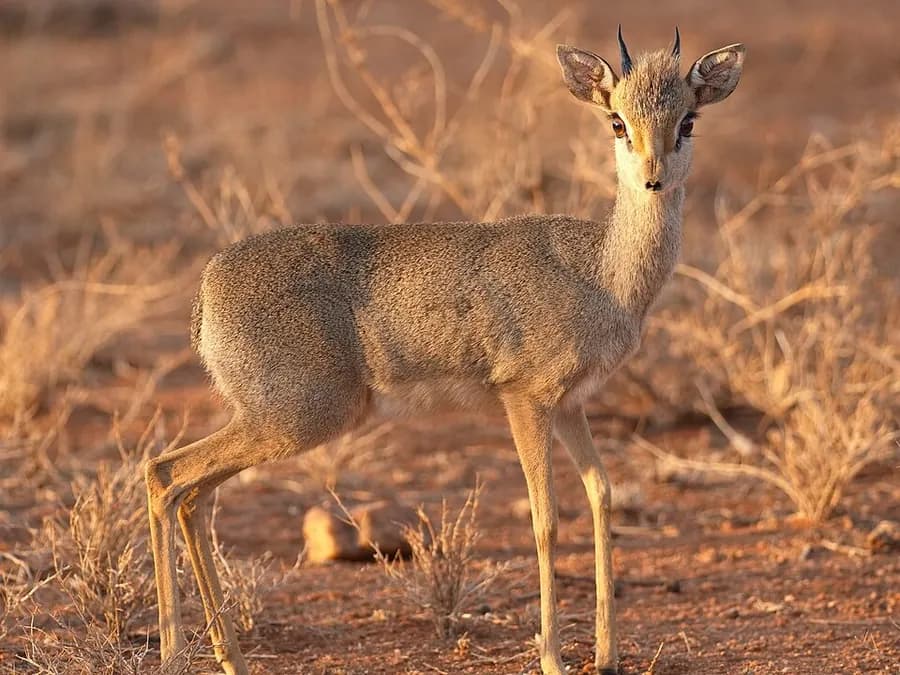
🐃Kirk's dik-dik
Das Kirk-Dikdik (Madoqua kirkii), auch bekannt als Zwergrüssel, ist eine Art der Dikdiks aus der Gruppe der Gazellenartigen. Es handelt sich um eine kleine Antilope, die im Osten von Afrika entlang der Küste von Somalia und Kenia verbreitet ist. Die Tiere bewohnen trockenere Landschaften. Sie zeichnen sich durch eine blasse, gelblich-olivefarbene Felltönung aus mit schwärzlicher, allerdings teils ausgebleichter Sprenkelung auf dem Rücken. Ansonsten ähneln sie mit ihrem kleinen Kopf, langen Hals, kurzen Schwanz und langen Gliedmaßen anderen Dikdiks. Ebenso wie bei diesen sind die Hörner kurz und spießartig. Die Lebensweise ist nur wenig erforscht. Männchen und Weibchen leben monogam und ernähren sich von weicher Pflanzenkost. Die wissenschaftliche Benennung des Kirk-Dikdiks datiert in das Jahr 1880. Vor allem in der zweiten Hälfte des 20. Jahrhunderts wurden ihm zahlreiche verwandte Formen zugewiesen, so dass die Art als Metapopulation im östlichen und südlichen Afrika verbreitet war. Untersuchungen an den Chromosomen in den 1980er und 1990er Jahren erbrachtet jedoch eine hohe Variabilität. In Konsequenz daraus wurden Anfang des 21. Jahrhunderts wieder mehrere Formen als eigenständig anerkannt. Zur Bestandsgefährdung liegen keine Informationen vor.
Text: Wikipedia, CC BY-SA 4.0.
IUCN Red List assessment, 2016.
- Body mass
- 4.83 kg
- Body length
- 0.69 m
- Shoulder height
- not recorded
- Top speed
- not recorded
- Bite force
- not recorded
- Maximum lifespan
- 17 years
Everything we know about the Kirk's dik-dik
Typical adult figures. Where a value is an estimate rather than a measurement, it says so.
Body mass4.83 kgCOMBINEOther figures ↓Hide ↑
Source: COMBINE · v1 (Soria et al. 2021) · CC BY 4.0
By sex
- Female5.13 kgWikidataQ833607
- Male4.59 kgWikidataQ833607
Figures vary
- 5 kgAnAgeAnAge build 15, 2023-07-03 (HAGR)data quality: acceptable
Body length0.69 mCOMBINEDetails ↓Hide ↑
Source: COMBINE · v1 (Soria et al. 2021) · CC BY 4.0
Brain mass35 gCOMBINEDetails ↓Hide ↑
Source: COMBINE · v1 (Soria et al. 2021) · CC BY 4.0
Maximum lifespan17 yearsCOMBINEOther figures ↓Hide ↑
Source: COMBINE · v1 (Soria et al. 2021) · CC BY 4.0
Figures vary
- 17 yearsAnAgeAnAge build 15, 2023-07-03 (HAGR)data quality: acceptable
Generation length5.83 yearsCOMBINEDetails ↓Hide ↑
Source: COMBINE · v1 (Soria et al. 2021) · CC BY 4.0
Age at maturity233 daysCOMBINEDetails ↓Hide ↑
Source: COMBINE · v1 (Soria et al. 2021) · CC BY 4.0
Gestation172 daysCOMBINEOther figures ↓Hide ↑
Source: COMBINE · v1 (Soria et al. 2021) · CC BY 4.0
Figures vary
- 172 daysAnAgeAnAge build 15, 2023-07-03 (HAGR)data quality: acceptable
Litter size1COMBINEOther figures ↓Hide ↑
Source: COMBINE · v1 (Soria et al. 2021) · CC BY 4.0
Figures vary
- 1AnAgeAnAge build 15, 2023-07-03 (HAGR)data quality: acceptable
Trophic levelHerbivoreCOMBINEDetails ↓Hide ↑
Source: COMBINE · v1 (Soria et al. 2021) · CC BY 4.0
Activity cycleCrepuscular / mixedCOMBINEDetails ↓Hide ↑
Source: COMBINE · v1 (Soria et al. 2021) · CC BY 4.0
Population density1.96 per km²COMBINEDetails ↓Hide ↑
Source: COMBINE · v1 (Soria et al. 2021) · CC BY 4.0
Volume l4.8 LaverageDetails ↓Hide ↑
Body mass at ~1.0 kg/L, the density of vertebrate tissue.
average = a mean across sexes or species in a group.
Not recorded for Kirk's dik-dik yet: shoulder height, top speed, bite force.
Family tree
- kingdomAnimalia
- ›phylumChordata
- ›classMammalia
- ›orderArtiodactyla
- ›familyBovidae
- ›genusMadoqua
- ›speciesMadoqua kirkii
- classMammals · Mammalia
- orderEven-toed hoofed animals · Artiodactyla
- familyBovidae
- genusMadoqua
All 15 branches ↓Fewer branches ↑
- kingdomMetazoa
- phylumChordata
- subphylumCraniata
- subphylumVertebrata
- superclassGnathostomata
- superclassSarcopterygii
- superclassTetrapoda
- classMammals · Mammalia
- subclassTheria
- superorderLaurasiatheria
- orderEven-toed hoofed animals · Artiodactyla
- suborderRuminantia
- infraorderPecora
- familyBovidae
- genusMadoqua
More about the Kirk's dik-dik


No videos of the Kirk's dik-dik yet.
We have 44,653 videos so far, and none of them features this animal yet.
All videos →Compare the Kirk's dik-dik
Pick a tool — the Kirk's dik-dik is already selected.
Compare every stat with any other animal.
Stand them on the same floor and see who's bigger.
How speed, brain and bite scale with body size. This animal isn't in the sample yet.
See where it sits in the tree of life.