
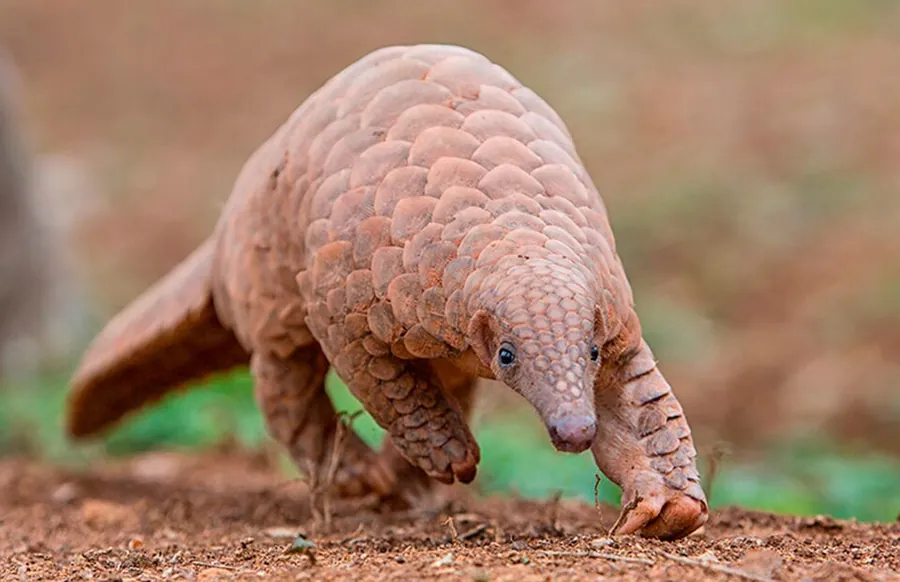
🐾Indian pangolin
Das Vorderindische Schuppentier oder Indien-Schuppentier (Manis crassicaudata) ist eine Säugetierart aus der Familie der Schuppentiere (Manidae). Es stellt einen großen Vertreter der Schuppentiere dar, dessen Verbreitungsgebiet Südasien („Vorderindien“) umfasst. Dort bewohnt die Schuppentierart dichte Wälder, offene Landschaften und auch teils wüstenartige Gebiete. Sie ist nachtaktiv, einzelgängerisch und bodenlebend, kann aber auch gut in Bäumen klettern. Die Hauptnahrung stellen Ameisen und Termiten dar, über die genaue Lebensweise gibt es aber nur wenige Informationen. Allgemein gilt das Vorderindische Schuppentier als selten und sein Bestand ist durch zunehmende Jagd stark bedroht. Hauptsächlich die Schuppen, aber auch andere Körperteile dienen in lokalen medizinischen Bräuchen als Heilmittel, ebenso gelangen sie häufiger auch auf den internationalen Schwarzmarkt. Ein weiterer Gefährdungsfaktor ist die hohe menschliche Bevölkerungsdichte im Verbreitungsgebiet. Erstmals erwähnt wurde diese Schuppentierart im Jahr 1803.
Text: Wikipedia, CC BY-SA 4.0.
IUCN Red List assessment, 2019.
- Body mass
- 12 kg
- Body length
- 0.54 m
- Shoulder height
- not recorded
- Top speed
- not recorded
- Bite force
- not recorded
- Maximum lifespan
- 20 years
Everything we know about the Indian pangolin
Typical adult figures. Where a value is an estimate rather than a measurement, it says so.
Body mass12 kgCOMBINEOther figures ↓Hide ↑
Source: COMBINE · v1 (Soria et al. 2021) · CC BY 4.0
Figures vary
- 13 kgAnAgeAnAge build 15, 2023-07-03 (HAGR)data quality: low
Body length0.54 mCOMBINEDetails ↓Hide ↑
Source: COMBINE · v1 (Soria et al. 2021) · CC BY 4.0
Maximum lifespan20 yearsCOMBINEDetails ↓Hide ↑
Source: COMBINE · v1 (Soria et al. 2021) · CC BY 4.0
Generation length5.62 yearsCOMBINEDetails ↓Hide ↑
Source: COMBINE · v1 (Soria et al. 2021) · CC BY 4.0
Age at maturity2.1 yearsCOMBINEDetails ↓Hide ↑
Source: COMBINE · v1 (Soria et al. 2021) · CC BY 4.0
Gestation68 daysCOMBINEOther figures ↓Hide ↑
Source: COMBINE · v1 (Soria et al. 2021) · CC BY 4.0
Figures vary
- 67 daysAnAgeAnAge build 15, 2023-07-03 (HAGR)data quality: low
Litter size1COMBINEOther figures ↓Hide ↑
Source: COMBINE · v1 (Soria et al. 2021) · CC BY 4.0
Figures vary
- 1AnAgeAnAge build 15, 2023-07-03 (HAGR)data quality: low
Trophic levelCarnivoreCOMBINEDetails ↓Hide ↑
Source: COMBINE · v1 (Soria et al. 2021) · CC BY 4.0
Activity cycleNocturnalCOMBINEDetails ↓Hide ↑
Source: COMBINE · v1 (Soria et al. 2021) · CC BY 4.0
Volume l12 LaverageDetails ↓Hide ↑
Body mass at ~1.0 kg/L, the density of vertebrate tissue.
average = a mean across sexes or species in a group.
Not recorded for Indian pangolin yet: shoulder height, top speed, bite force.
Family tree
- kingdomAnimalia
- ›phylumChordata
- ›classMammalia
- ›orderPholidota
- ›familyManidae
- ›genusManis
- ›speciesManis crassicaudata
- classMammals · Mammalia
- orderPholidota
- familyManidae
- genusManis
All 13 branches ↓Fewer branches ↑
- kingdomMetazoa
- phylumChordata
- subphylumCraniata
- subphylumVertebrata
- superclassGnathostomata
- superclassSarcopterygii
- superclassTetrapoda
- classMammals · Mammalia
- subclassTheria
- superorderLaurasiatheria
- orderPholidota
- familyManidae
- genusManis
More about the Indian pangolin


No videos of the Indian pangolin yet.
We have 44,653 videos so far, and none of them features this animal yet.
All videos →Compare the Indian pangolin
Pick a tool — the Indian pangolin is already selected.
Compare every stat with any other animal.
Stand them on the same floor and see who's bigger.
How speed, brain and bite scale with body size. This animal isn't in the sample yet.
See where it sits in the tree of life.