
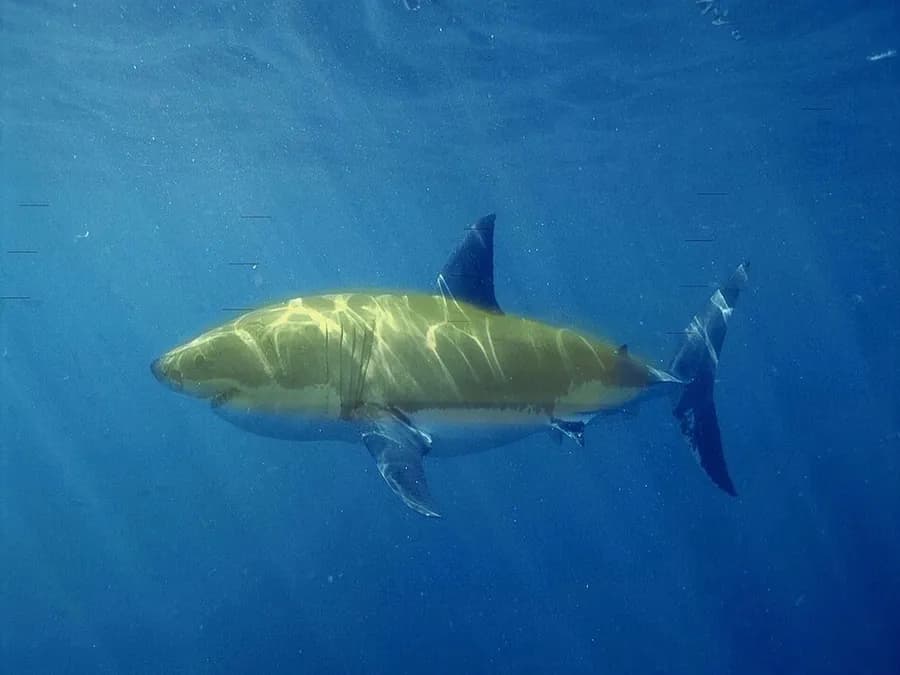
🦈Great white shark
Der Weiße Hai (Carcharodon carcharias), seltener auch als Weißhai oder Menschenhai bezeichnet, ist die einzige Art der Gattung Carcharodon aus der Familie der Makrelenhaie (Lamnidae). Der Trivialname bezieht sich auf die auffällig helle Bauchfärbung der Tiere. Die Art kommt fast weltweit vor und besiedelt bevorzugt gemäßigte Küstengewässer. Als die größte Haiart, die sich nicht von Plankton ernährt, ist der Weiße Hai der größte Raubfisch; er kann auch Menschen gefährlich werden. Er ist im gesamten Verbreitungsgebiet selten; heute gilt er durch Beifang in der kommerziellen Fischerei sowie gezielte Bejagung zum Gewinn von Trophäen als im Bestand bedroht.
Text: Wikipedia, CC BY-SA 4.0.
IUCN Red List assessment, 2022.
- Body mass
- 1,870 kg
- Body length
- 6.4 m
- Shoulder height
- not recorded
- Top speed
- 24 km/h
- Bite force
- 1,602 N
- Maximum lifespan
- 50 years
Everything we know about the Great white shark
Typical adult figures. Where a value is an estimate rather than a measurement, it says so.
Body mass1,870 kgAnAgeOther figures ↓Hide ↑
data quality: acceptable
Source: AnAge · AnAge build 15, 2023-07-03 (HAGR) · CC BY 3.0
By sex
- Female3,230 kgFishBasev25.04
Body length6.4 mmaximum recordedFishBaseDetails ↓Hide ↑
Source: FishBase · v25.04 · CC BY-NC 4.0
Top speed24 km/hDetails ↓Hide ↑
MEASURED burst of 6.54 m/s by dorsal-fin accelerometer and camera tag; bursts last roughly 6-8 s. Cruising is far slower, around 0.6-0.9 m/s. This contradicts the popular 40-56 km/h figures, which enter the literature through Hirt's reference 101, speedofanimals.com.
Source: Gooden, Clarke, Meyer, Watanabe & Huveneers 2025, Wildlife Research 52:WR24112 · see citation
Bite force1,602 NDetails ↓Hide ↑
MODELLED by 3D finite-element analysis at 35 degrees gape: anterior bite of the scanned 2.5 m, 240 kg specimen. Posterior bite of the same animal is 3131 N. Scaling isometrically to the largest verified great white (6.4 m, 3324 kg) gives 9320 N anterior and 18216 N posterior. An independent model of a same-sized shark gives 1053-1329 N (Ferrara et al. 2011, J Biomech 44:430). The 55000-182000 N figures quoted from this paper belong to megalodon.
Source: Wroe et al. 2008, J Zool 276:336, Table 2 · see citation
Maximum lifespan50 yearsrecord 36 years · FishBaseAnAgeDetails ↓Hide ↑
data quality: acceptable
Record: largest individual on record
Source: AnAge · AnAge build 15, 2023-07-03 (HAGR) · CC BY 3.0
Litter sizeabout 6AnAgeDetails ↓Hide ↑
data quality: acceptable
Source: AnAge · AnAge build 15, 2023-07-03 (HAGR) · CC BY 3.0
Trophic level4.53FishBaseDetails ↓Hide ↑
Source: FishBase · v25.04, estimate table · CC BY-NC 4.0
DietcarnivoreaverageDetails ↓Hide ↑
From trophic level 4.53 (FishBase): <2.2 herbivore, 2.2–2.8 omnivore, >2.8 carnivore.
Danger to humanstraumatogenicFishBaseDetails ↓Hide ↑
Source: FishBase · v25.04 · CC BY-NC 4.0
Volume l1,870 LaverageDetails ↓Hide ↑
Body mass at ~1.0 kg/L, the density of vertebrate tissue.
average = a mean across sexes or species in a group.
Not recorded for Great white shark yet: shoulder height.
Family tree
- kingdomAnimalia
- ›phylumChordata
- ›classElasmobranchii
- ›orderLamniformes
- ›familyLamnidae
- ›genusCarcharodon
- ›speciesCarcharodon carcharias
- classSharks & rays · Chondrichthyes
- orderLamniformes
- subfamilyLamninae
- genusCarcharodon
All 10 branches ↓Fewer branches ↑
- kingdomMetazoa
- phylumChordata
- subphylumCraniata
- subphylumVertebrata
- superclassGnathostomata
- classSharks & rays · Chondrichthyes
- subclassElasmobranchii
- orderLamniformes
- subfamilyLamninae
- genusCarcharodon
More about the Great white shark


No videos of the Great white shark yet.
We have 44,653 videos so far, and none of them features this animal yet.
All videos →Compare the Great white shark
Pick a tool — the Great white shark is already selected.
Compare every stat with any other animal.
Stand them on the same floor and see who's bigger.
Does it punch above its weight? Its stats against what body size predicts.
See where it sits in the tree of life.