
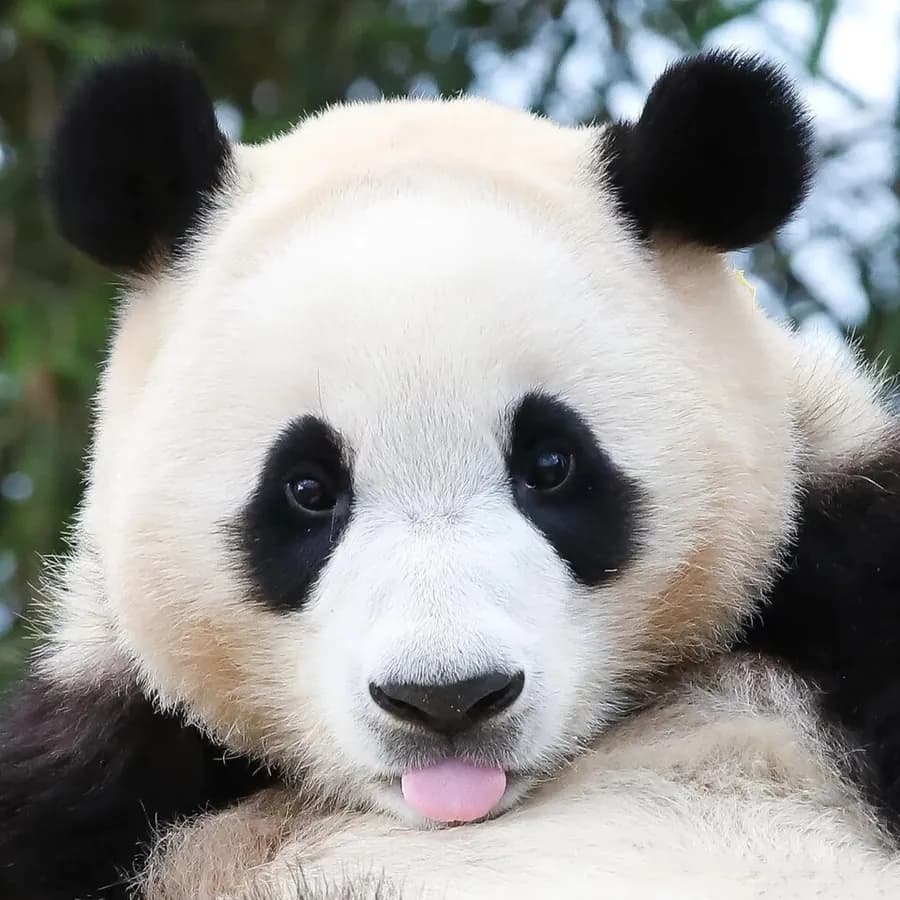
🐼Giant panda
Der Große Panda (Ailuropoda melanoleuca), auch Riesenpanda oder Pandabär, ist eine Säugetierart aus der Familie der Bären (Ursidae). Als Symbol des WWF und manchmal auch des Artenschutzes allgemein hat er trotz seines sehr beschränkten Verbreitungsgebiets weltweite Bekanntheit erlangt. In älterer deutscher Literatur wird der Große Panda auch Bambusbär oder Prankenbär genannt. Der Gefährdungsstatus der Bärenart wurde 2016 vom IUCN von stark gefährdet (endangered) auf gefährdet (vulnerable) abgesenkt, da die Bestände sich etwas erholt hatten. Nach Schätzungen, die auf der letzten offiziellen Zählung basieren, gibt es über 2000 wild lebende Tiere, da von 2011 bis 2014 insgesamt 1864 Pandas in freier Wildbahn gezählt werden konnten.
Text: Wikipedia, CC BY-SA 4.0.
IUCN Red List assessment, 2016.
- Body mass
- 118 kg
- Body length
- 1.42 m
- Shoulder height
- 0.68 m
- Top speed
- not recorded
- Bite force
- not recorded
- Maximum lifespan
- 37 years
Everything we know about the Giant panda
Typical adult figures. Where a value is an estimate rather than a measurement, it says so.
Body mass118 kgCOMBINEOther figures ↓Hide ↑
Source: COMBINE · v1 (Soria et al. 2021) · CC BY 4.0
Figures vary
- 118 kgAnAgeAnAge build 15, 2023-07-03 (HAGR)data quality: acceptable
Body length1.42 mCOMBINEDetails ↓Hide ↑
Source: COMBINE · v1 (Soria et al. 2021) · CC BY 4.0
Shoulder height0.68 m0.65–0.7 m · typical rangeat the shoulderDetails ↓Hide ↑
"The shoulder height is 65-70 cm." Value is the midpoint of the stated range; measurement method beyond "shoulder height" not stated.
Source: Animal Diversity Web (Univ. Michigan), Ailuropoda melanoleuca account, https://animaldiversity.org/accounts/Ailuropoda_melanoleuca/ · see citation
Brain mass243 gCOMBINEDetails ↓Hide ↑
Source: COMBINE · v1 (Soria et al. 2021) · CC BY 4.0
Maximum lifespan37 yearsCOMBINEOther figures ↓Hide ↑
Source: COMBINE · v1 (Soria et al. 2021) · CC BY 4.0
Figures vary
- 37 yearsAnAgeAnAge build 15, 2023-07-03 (HAGR)data quality: acceptable
Generation length14 yearsCOMBINEDetails ↓Hide ↑
Source: COMBINE · v1 (Soria et al. 2021) · CC BY 4.0
Age at maturity6.6 yearsCOMBINEDetails ↓Hide ↑
Source: COMBINE · v1 (Soria et al. 2021) · CC BY 4.0
Gestation131 daysCOMBINEOther figures ↓Hide ↑
Source: COMBINE · v1 (Soria et al. 2021) · CC BY 4.0
Figures vary
- 48 daysAnAgeAnAge build 15, 2023-07-03 (HAGR)data quality: acceptable
Litter sizeabout 2COMBINEOther figures ↓Hide ↑
Source: COMBINE · v1 (Soria et al. 2021) · CC BY 4.0
Figures vary
- 1.5AnAgeAnAge build 15, 2023-07-03 (HAGR)data quality: acceptable
Trophic levelHerbivoreCOMBINEDetails ↓Hide ↑
Source: COMBINE · v1 (Soria et al. 2021) · CC BY 4.0
Activity cycleCrepuscular / mixedCOMBINEDetails ↓Hide ↑
Source: COMBINE · v1 (Soria et al. 2021) · CC BY 4.0
Home range3.55 km²COMBINEDetails ↓Hide ↑
Source: COMBINE · v1 (Soria et al. 2021) · CC BY 4.0
Population density0.18 per km²COMBINEDetails ↓Hide ↑
Source: COMBINE · v1 (Soria et al. 2021) · CC BY 4.0
Volume l118 LaverageDetails ↓Hide ↑
Body mass at ~1.0 kg/L, the density of vertebrate tissue.
average = a mean across sexes or species in a group.
Not recorded for Giant panda yet: top speed, bite force.
Family tree
- kingdomAnimalia
- ›phylumChordata
- ›classMammalia
- ›orderCarnivora
- ›familyUrsidae
- ›genusAiluropoda
- ›speciesAiluropoda melanoleuca
- classMammals · Mammalia
- orderCarnivorans · Carnivora
- familyUrsidae
- genusAiluropoda
All 14 branches ↓Fewer branches ↑
- kingdomMetazoa
- phylumChordata
- subphylumCraniata
- subphylumVertebrata
- superclassGnathostomata
- superclassSarcopterygii
- superclassTetrapoda
- classMammals · Mammalia
- subclassTheria
- superorderLaurasiatheria
- orderCarnivorans · Carnivora
- suborderCaniformia
- familyUrsidae
- genusAiluropoda
More about the Giant panda


Tiere vor der Kamera
Echtes Filmmaterial von den Tieren dieser Website – beim Jagen, beim Kämpfen und beim ganz normalen Alltag.
Compare the Giant panda
Pick a tool — the Giant panda is already selected.
Compare every stat with any other animal.
Stand them on the same floor and see who's bigger.
How speed, brain and bite scale with body size. This animal isn't in the sample yet.
See where it sits in the tree of life.