
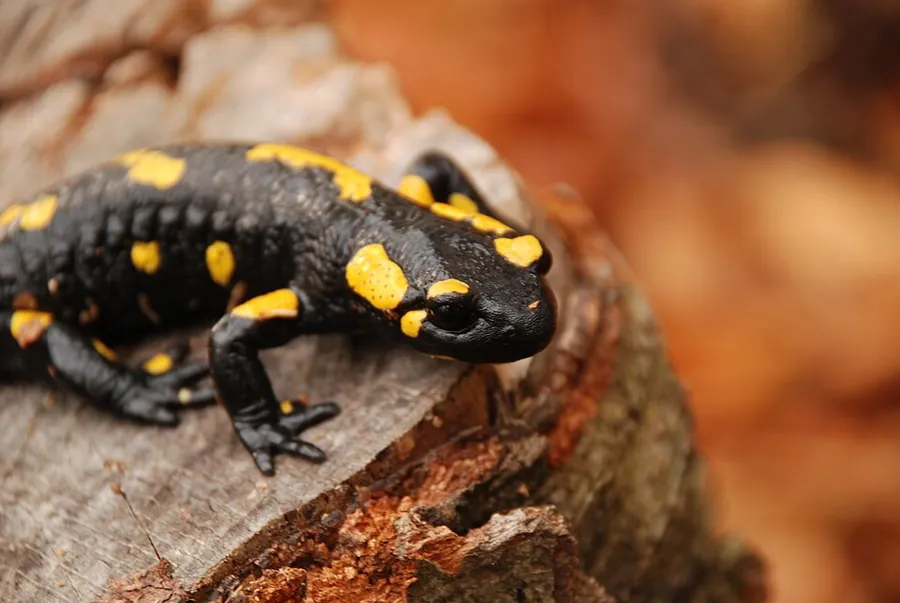
🦎Fire salamander
Der Feuersalamander (Salamandra salamandra) ist eine europäische Amphibienart aus der Familie der Echten Salamander. Die Spezies wurde erstmals 1758 von dem schwedischen Naturforscher Carl von Linné beschrieben. Je nach regionaler Mundart wird sie unter anderem auch als Feuermolch, Erdmolch, Erdsalamander, Regenmolch, Regenmännchen, Gelber Schneider, Bergnarr, Wegnarr, Regenmolli oder Tattermandl (bayerisch) bezeichnet. Diese volkstümlichen Namen unterscheiden allerdings nicht immer eindeutig zwischen Feuer- und Alpensalamander. Die Schwanzlurche leben in größeren Laub- und Mischwaldgebieten mit naturnahen Bachläufen. Sie sind überwiegend nachtaktiv. Anders als bei vielen anderen mitteleuropäischen Lurchen werden keine Eier, sondern in der Regel weit entwickelte, kiementragende Larven ins Wasser abgesetzt (Larviparie). Die Hauptlaichzeit erstreckt sich witterungsbedingt von Anfang März bis in den Mai. Wie andere Salamander sind sie seit den 1980er Jahren bedroht durch den Chytridpilz und seit 2015 auch durch die verwandte Salamanderpest (Bsal). Der Feuersalamander war Lurch des Jahres 2016. Aufgrund seiner Vorliebe für unterirdische Verstecke wurde er für das Jahr 2023 zum Höhlentier des Jahres in Deutschland und der Schweiz ernannt.
Text: Wikipedia, CC BY-SA 4.0.
IUCN Red List assessment, 2023.
- Body mass
- 0.02 kg
- Body length
- 0.28 m
- Shoulder height
- not recorded
- Top speed
- not recorded
- Bite force
- not recorded
- Maximum lifespan
- 24 years
Everything we know about the Fire salamander
Typical adult figures. Where a value is an estimate rather than a measurement, it says so.
Body mass0.02 kgAnAgeOther figures ↓Hide ↑
data quality: acceptable
Source: AnAge · AnAge build 15, 2023-07-03 (HAGR) · CC BY 3.0
Figures vary
- 0.04 kgAmphiBIOv1 (Oliveira et al. 2017)
Body length0.28 mAmphiBIODetails ↓Hide ↑
Source: AmphiBIO · v1 (Oliveira et al. 2017) · CC BY 4.0
Maximum lifespan24 yearsrecord 24 years · AmphiBIOAnAgeDetails ↓Hide ↑
data quality: acceptable
Record: largest individual on record
Source: AnAge · AnAge build 15, 2023-07-03 (HAGR) · CC BY 3.0
DietarthropodsAmphiBIODetails ↓Hide ↑
Source: AmphiBIO · v1 (Oliveira et al. 2017) · CC BY 4.0
Volume l0 LaverageDetails ↓Hide ↑
Body mass at ~1.0 kg/L, the density of vertebrate tissue.
average = a mean across sexes or species in a group.
Not recorded for Fire salamander yet: shoulder height, top speed, bite force.
Family tree
- kingdomAnimalia
- ›phylumChordata
- ›classAmphibia
- ›orderCaudata
- ›familySalamandridae
- ›genusSalamandra
- ›speciesSalamandra salamandra
- classAmphibians · Amphibia
- orderSalamanders & newts · Caudata
- subfamilySalamandrinae
- genusSalamandra
All 14 branches ↓Fewer branches ↑
- kingdomMetazoa
- phylumChordata
- subphylumCraniata
- subphylumVertebrata
- superclassGnathostomata
- superclassSarcopterygii
- superclassTetrapoda
- classAmphibians · Amphibia
- superorderBatrachia
- orderSalamanders & newts · Caudata
- superfamilySalamandroidea
- familySalamandridae
- subfamilySalamandrinae
- genusSalamandra
More about the Fire salamander
No videos of the Fire salamander yet.
We have 44,653 videos so far, and none of them features this animal yet.
All videos →Compare the Fire salamander
Pick a tool — the Fire salamander is already selected.
Compare every stat with any other animal.
Stand them on the same floor and see who's bigger.
How speed, brain and bite scale with body size. This animal isn't in the sample yet.
See where it sits in the tree of life.