
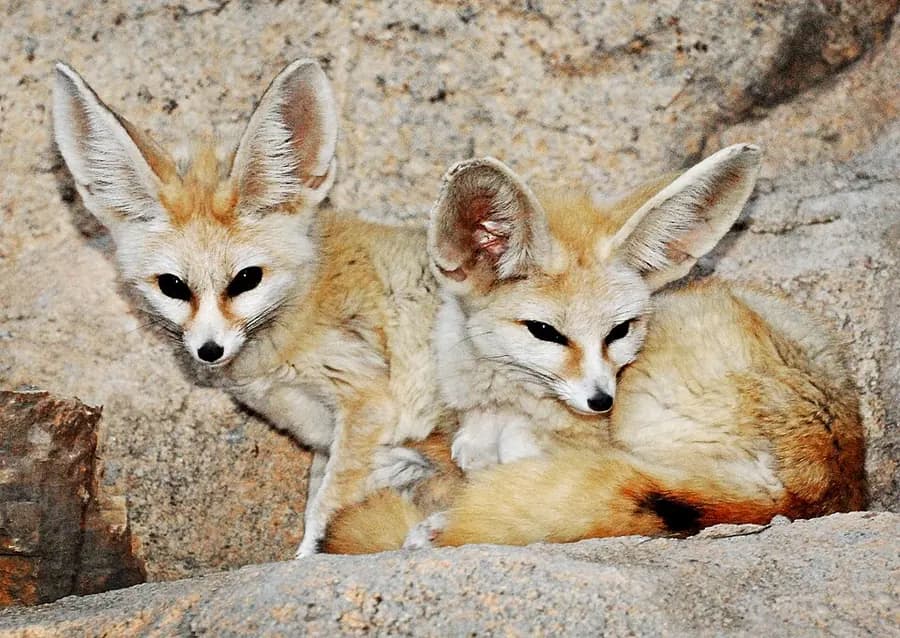
🦊Fennec fox
Der Fennek oder Wüstenfuchs (Vulpes zerda) ist eine Fuchsart aus der Gattung Vulpes. Er ist der kleinste aller Wildhunde und bewohnt die Sandwüsten Nordafrikas. Die Art zeigt zahlreiche Anpassungen an das Wüstenklima, etwa die geringe Körpergröße, behaarte Sohlen und große Ohren, die der Wärmeregulation dienen. Der Fennek ist nacht- und dämmerungsaktiv und frisst als Allesfresser sowohl Wirbellose und kleine Wirbeltiere als auch Früchte und Knollen. Fenneks leben für gewöhnlich in Paaren; die meist zwei bis fünf Jungen pro Wurf kommen im März und April zur Welt. Während der Trage- und Säugezeit versorgt und beschützt das Männchen das Weibchen und den Wurf. Der Erdbau des Fenneks ist im Regelfall einfach und wird meist in lockeren Sand gegraben, nur in festerem Untergrund nimmt er komplexere Formen an. Der nächste Verwandte des Fenneks ist der Afghanfuchs (Vulpes cana), der auf der Arabischen Halbinsel, im Iran und in Afghanistan lebt. Obwohl Fenneks regelmäßig wegen ihres Fells oder für touristische Schauvorführungen gefangen werden, gilt der Bestand nicht als bedroht. Die IUCN klassifiziert die Art als Least Concern (nicht gefährdet). Der Fennek wird seit der Jungsteinzeit von den Menschen Nordafrikas als Nahrungs- und Felllieferant genutzt und seit dem 20. Jahrhundert vor allem in Nordamerika auch als Haustier gehalten.
Text: Wikipedia, CC BY-SA 4.0.
IUCN Red List assessment, 2015.
- Body mass
- 1.21 kg
- Body length
- 0.39 m
- Shoulder height
- 0.2 m
- Top speed
- not recorded
- Bite force
- not recorded
- Maximum lifespan
- 16 years
Everything we know about the Fennec fox
Typical adult figures. Where a value is an estimate rather than a measurement, it says so.
Body mass1.21 kgCOMBINEOther figures ↓Hide ↑
Source: COMBINE · v1 (Soria et al. 2021) · CC BY 4.0
Figures vary
- 1.25 kgAnAgeAnAge build 15, 2023-07-03 (HAGR)data quality: acceptable
Body length0.39 mCOMBINEDetails ↓Hide ↑
Source: COMBINE · v1 (Soria et al. 2021) · CC BY 4.0
Shoulder height0.2 m0.18–0.22 m · typical rangenot statedDetails ↓Hide ↑
"Standing 18 to 22 cm at the shoulder, fennecs are significantly shorter than other African foxes, which average a shoulder height of 30 cm." Range-only; value is the midpoint.
Source: Adams 2004, Animal Diversity Web account: Vulpes zerda, https://animaldiversity.org/accounts/Vulpes_zerda/ · see citation
Brain mass18 gCOMBINEDetails ↓Hide ↑
Source: COMBINE · v1 (Soria et al. 2021) · CC BY 4.0
Maximum lifespan16 yearsCOMBINEOther figures ↓Hide ↑
Source: COMBINE · v1 (Soria et al. 2021) · CC BY 4.0
Figures vary
- 16 yearsAnAgeAnAge build 15, 2023-07-03 (HAGR)data quality: acceptable
Generation length5.14 yearsCOMBINEDetails ↓Hide ↑
Source: COMBINE · v1 (Soria et al. 2021) · CC BY 4.0
Age at maturity294 daysCOMBINEDetails ↓Hide ↑
Source: COMBINE · v1 (Soria et al. 2021) · CC BY 4.0
Gestation51 daysCOMBINEOther figures ↓Hide ↑
Source: COMBINE · v1 (Soria et al. 2021) · CC BY 4.0
Figures vary
- 51 daysAnAgeAnAge build 15, 2023-07-03 (HAGR)data quality: acceptable
Litter sizeabout 2COMBINEOther figures ↓Hide ↑
Source: COMBINE · v1 (Soria et al. 2021) · CC BY 4.0
Figures vary
- 2.2AnAgeAnAge build 15, 2023-07-03 (HAGR)data quality: acceptable
Trophic levelOmnivoreCOMBINEDetails ↓Hide ↑
Source: COMBINE · v1 (Soria et al. 2021) · CC BY 4.0
Activity cycleNocturnalCOMBINEDetails ↓Hide ↑
Source: COMBINE · v1 (Soria et al. 2021) · CC BY 4.0
Volume l1.2 LaverageDetails ↓Hide ↑
Body mass at ~1.0 kg/L, the density of vertebrate tissue.
average = a mean across sexes or species in a group.
Not recorded for Fennec fox yet: top speed, bite force.
Family tree
- kingdomAnimalia
- ›phylumChordata
- ›classMammalia
- ›orderCarnivora
- ›familyCanidae
- ›genusVulpes
- ›speciesVulpes zerda
- classMammals · Mammalia
- orderCarnivorans · Carnivora
- suborderCaniformia
- familyCanidae
All 13 branches ↓Fewer branches ↑
- kingdomMetazoa
- phylumChordata
- subphylumCraniata
- subphylumVertebrata
- superclassGnathostomata
- superclassSarcopterygii
- superclassTetrapoda
- classMammals · Mammalia
- subclassTheria
- superorderLaurasiatheria
- orderCarnivorans · Carnivora
- suborderCaniformia
- familyCanidae
More about the Fennec fox


Tiere vor der Kamera
Echtes Filmmaterial von den Tieren dieser Website – beim Jagen, beim Kämpfen und beim ganz normalen Alltag.
Compare the Fennec fox
Pick a tool — the Fennec fox is already selected.
Compare every stat with any other animal.
Stand them on the same floor and see who's bigger.
How speed, brain and bite scale with body size. This animal isn't in the sample yet.
See where it sits in the tree of life.