
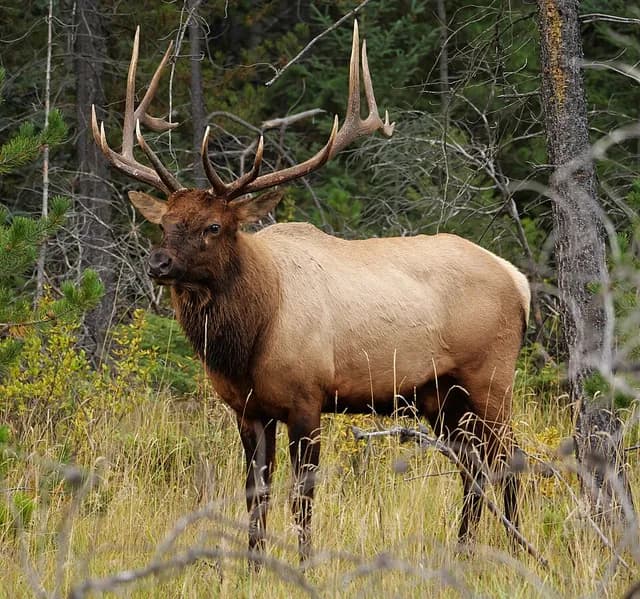
🦌Elk
Der Wapiti, auch Wapiti-Hirsch, (Cervus canadensis) ist eine Säugetierart aus der Familie der Hirsche (Cervidae). Unter der Bezeichnung werden die in Nordamerika lebenden Tiere samt einigen ostasiatischen Unterarten zusammengefasst, die früher allesamt als Unterart des Rothirschs galten. Viele Wapitis sind deutlich größer als europäische Rothirsche. In der Familie der Hirsche ist lediglich der Elch größer. In Nordamerika wird die Art meist elk genannt, während dies im britischen Englisch die Bezeichnung für den Elch ist, welcher in Nordamerika wiederum moose heißt. Die Bezeichnung Wapiti („weißes Hinterteil“) stammt von den Shawnee-Indianern. Wapitis haben eine Schulterhöhe von 0,75 bis 1,50 Metern und wiegen 230 bis 450 Kilogramm. Die Männchen sind meist etwa doppelt so schwer wie die Weibchen. Die Geweihe der Tiere messen 1,0 bis 1,5 Meter von Spitze zu Spitze. Wapitis sind bekannt für ihre lauten trompetenden Rufe während der Brunftzeit.
Text: Wikipedia, CC BY-SA 4.0.
IUCN Red List assessment, 2018.
- Body mass
- 131 kg
- Body length
- 2.14 m
- Shoulder height
- 1.13 m
- Top speed
- not recorded
- Bite force
- not recorded
- Maximum lifespan
- 31 years
Everything we know about the Elk
Typical adult figures. Where a value is an estimate rather than a measurement, it says so.
Body mass131 kgCOMBINEDetails ↓Hide ↑
Source: COMBINE · v1 (Soria et al. 2021) · CC BY 4.0
Body length2.14 mCOMBINEDetails ↓Hide ↑
Source: COMBINE · v1 (Soria et al. 2021) · CC BY 4.0
Shoulder height1.13 m0.75–1.5 m · typical rangeat the shoulderDetails ↓Hide ↑
ADW: "most elk stand approximately 0.75 to 1.5 m high at the shoulder". Range only; value is the midpoint. ADW treats elk under Cervus elaphus (older classification; North American elk is now Cervus canadensis).
Source: Senseman 2002, 'Cervus elaphus', Animal Diversity Web (account covers North American elk), https://animaldiversity.org/accounts/Cervus_elaphus/ · see citation
Brain mass354 gCOMBINEDetails ↓Hide ↑
Source: COMBINE · v1 (Soria et al. 2021) · CC BY 4.0
Maximum lifespan31 yearsCOMBINEDetails ↓Hide ↑
Source: COMBINE · v1 (Soria et al. 2021) · CC BY 4.0
Generation length14 yearsCOMBINEDetails ↓Hide ↑
Source: COMBINE · v1 (Soria et al. 2021) · CC BY 4.0
Age at maturity1.8 yearsCOMBINEDetails ↓Hide ↑
Source: COMBINE · v1 (Soria et al. 2021) · CC BY 4.0
Gestation244 daysCOMBINEDetails ↓Hide ↑
Source: COMBINE · v1 (Soria et al. 2021) · CC BY 4.0
Litter size1COMBINEDetails ↓Hide ↑
Source: COMBINE · v1 (Soria et al. 2021) · CC BY 4.0
Trophic levelHerbivoreCOMBINEDetails ↓Hide ↑
Source: COMBINE · v1 (Soria et al. 2021) · CC BY 4.0
Activity cycleCrepuscular / mixedCOMBINEDetails ↓Hide ↑
Source: COMBINE · v1 (Soria et al. 2021) · CC BY 4.0
Home range58 km²COMBINEDetails ↓Hide ↑
Source: COMBINE · v1 (Soria et al. 2021) · CC BY 4.0
Population density3.62 per km²COMBINEDetails ↓Hide ↑
Source: COMBINE · v1 (Soria et al. 2021) · CC BY 4.0
Volume l131 LaverageDetails ↓Hide ↑
Body mass at ~1.0 kg/L, the density of vertebrate tissue.
average = a mean across sexes or species in a group.
Not recorded for Elk yet: top speed, bite force.
Family tree
- kingdomAnimalia
- ›phylumChordata
- ›classMammalia
- ›orderArtiodactyla
- ›familyCervidae
- ›genusCervus
- ›speciesCervus elaphus
- classMammals · Mammalia
- orderEven-toed hoofed animals · Artiodactyla
- familyCervidae
- subfamilyCervinae
All 15 branches ↓Fewer branches ↑
- kingdomMetazoa
- phylumChordata
- subphylumCraniata
- subphylumVertebrata
- superclassGnathostomata
- superclassSarcopterygii
- superclassTetrapoda
- classMammals · Mammalia
- subclassTheria
- superorderLaurasiatheria
- orderEven-toed hoofed animals · Artiodactyla
- suborderRuminantia
- infraorderPecora
- familyCervidae
- subfamilyCervinae
More about the Elk


No videos of the Elk yet.
We have 44,653 videos so far, and none of them features this animal yet.
All videos →Compare the Elk
Pick a tool — the Elk is already selected.
Compare every stat with any other animal.
Stand them on the same floor and see who's bigger.
How speed, brain and bite scale with body size. This animal isn't in the sample yet.
See where it sits in the tree of life.