
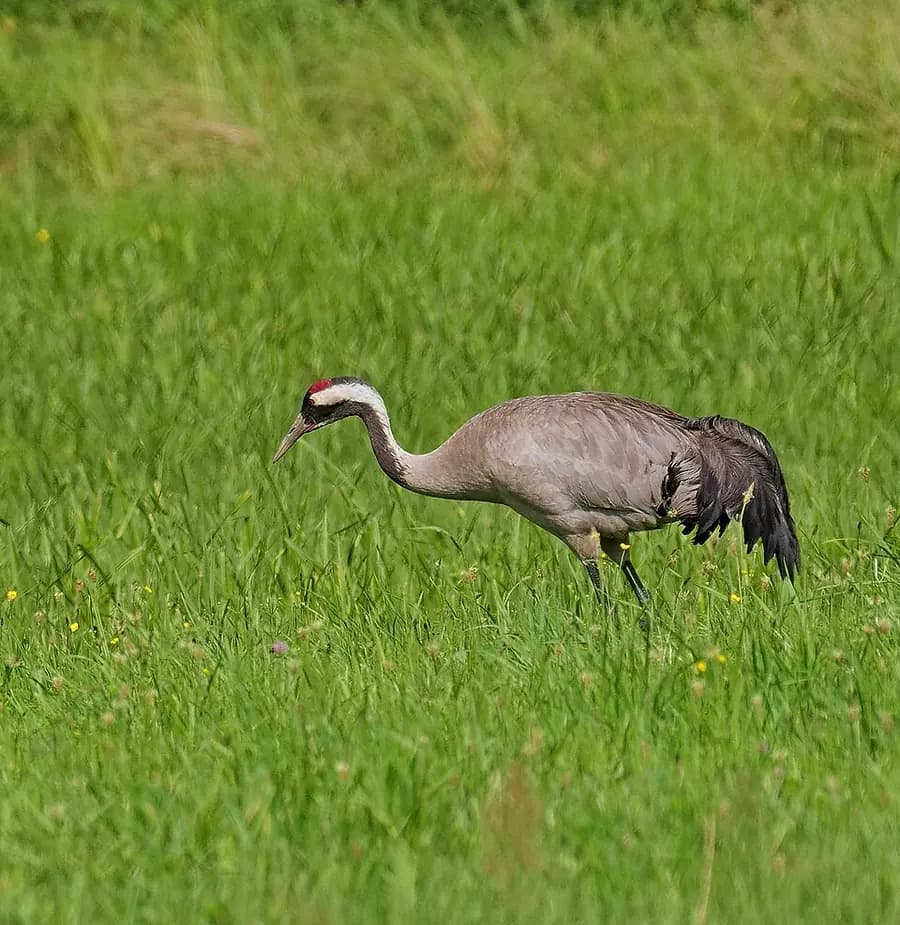
🐦Common Crane
Der Kranich (Grus grus), auch Grauer Kranich oder Eurasischer Kranich, ist ein Vertreter der Familie der Kraniche (Gruidae). In Europa kommt er weitgehend als einzige Kranichart vor; erst ab der Schwarzmeerregion beginnt das Verbreitungsgebiet des Jungfernkranichs. Kraniche bewohnen Sumpf- und Moorlandschaften in weiten Teilen des nördlichen und östlichen Europas, aber auch einige Gebiete im Norden Asiens. Sie nehmen das ganze Jahr über sowohl tierische als auch pflanzliche Nahrung auf. Der Bestand hat in den letzten Jahrzehnten stark zugenommen, so dass die Art nicht gefährdet ist. Die Schönheit der Kraniche, ihre spektakulären Balztänze und ihr gut zu beobachtender Zug haben schon in früher Zeit die Menschen fasziniert. In der griechischen Mythologie war der Kranich Apollon, Demeter und Hermes zugeordnet. Er war ein Symbol der Wachsamkeit und Klugheit und galt als Vogel des Glücks. In der Heraldik ist der Kranich das Symbol der Vorsicht und der schlaflosen Wachsamkeit. In der Dichtung steht der Kranich symbolisch für das Erhabene in der Natur.
Text: Wikipedia, CC BY-SA 4.0.
IUCN Red List assessment, 2025.
- Body mass
- 5.5 kg
- Body length
- not recorded
- Shoulder height
- not recorded
- Top speed
- not recorded
- Bite force
- not recorded
- Maximum lifespan
- 43 years
Everything we know about the Common Crane
Typical adult figures. Where a value is an estimate rather than a measurement, it says so.
Body mass5.5 kgAVONETOther figures ↓Hide ↑
Source: AVONET · v1.1 (Tobias et al. 2022) · CC BY 4.0
Figures vary
- 5.5 kgAnAgeAnAge build 15, 2023-07-03 (HAGR)data quality: acceptable
Tail length0.19 mAVONETDetails ↓Hide ↑
Source: AVONET · v1.1 (Tobias et al. 2022) · CC BY 4.0
Wing length0.54 mAVONETDetails ↓Hide ↑
Source: AVONET · v1.1 (Tobias et al. 2022) · CC BY 4.0
Beak length0.11 mAVONETDetails ↓Hide ↑
Source: AVONET · v1.1 (Tobias et al. 2022) · CC BY 4.0
Tarsus length0.23 mAVONETDetails ↓Hide ↑
Source: AVONET · v1.1 (Tobias et al. 2022) · CC BY 4.0
Maximum lifespan43 yearsAnAgeDetails ↓Hide ↑
data quality: acceptable
Source: AnAge · AnAge build 15, 2023-07-03 (HAGR) · CC BY 3.0
Trophic levelHerbivoreAVONETDetails ↓Hide ↑
Source: AVONET · v1.1 (Tobias et al. 2022) · CC BY 4.0
HabitatWetlandAVONETDetails ↓Hide ↑
Source: AVONET · v1.1 (Tobias et al. 2022) · CC BY 4.0
LifestyleTerrestrialAVONETDetails ↓Hide ↑
Source: AVONET · v1.1 (Tobias et al. 2022) · CC BY 4.0
Volume l5.5 LaverageDetails ↓Hide ↑
Body mass at ~1.0 kg/L, the density of vertebrate tissue.
average = a mean across sexes or species in a group.
Not recorded for Common Crane yet: body length, shoulder height, top speed, bite force.
Family tree
- superclassTetrapoda
- orderSauria
- classBirds · Aves
- familyGruidae
All 10 branches ↓Fewer branches ↑
- kingdomMetazoa
- phylumChordata
- subphylumCraniata
- subphylumVertebrata
- superclassGnathostomata
- superclassSarcopterygii
- superclassTetrapoda
- orderSauria
- classBirds · Aves
- familyGruidae
More about the Common Crane
No videos of the Common Crane yet.
We have 44,653 videos so far, and none of them features this animal yet.
All videos →Compare the Common Crane
Pick a tool — the Common Crane is already selected.
Compare every stat with any other animal.
Stand them on the same floor and see who's bigger.
How speed, brain and bite scale with body size. This animal isn't in the sample yet.
See where it sits in the tree of life.