
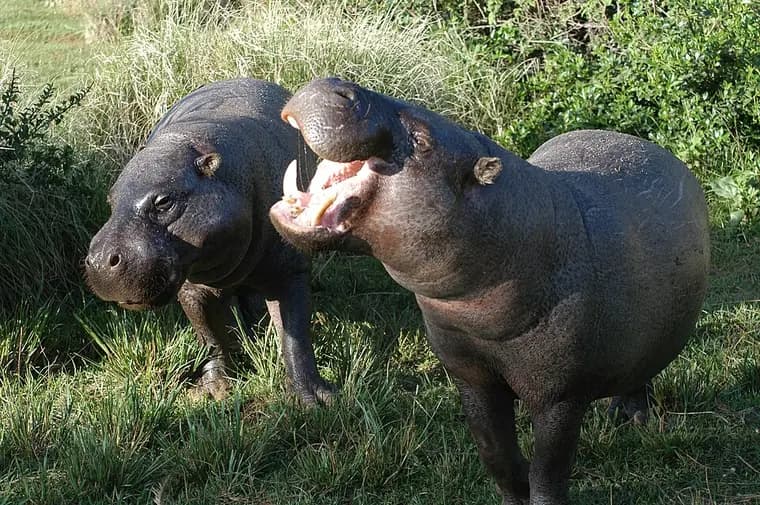
🦛Pygmy hippopotamus
Das Zwergflusspferd (Choeropsis liberiensis oder Hexaprotodon liberiensis) ist eine der zwei heute noch vorkommenden Arten aus der Familie der Flusspferde. Das nachtaktive und seltene Zwergflusspferd ist in den Wäldern und Sümpfen des westlichen Afrika heimisch. Die Artbezeichnung liberiensis für „aus Liberia stammend“ spiegelt dies wider. Das Zwergflusspferd weist eine Reihe von Anpassungen an das Leben an Land auf. Ähnlich wie das (Groß-)Flusspferd ist es jedoch darauf angewiesen, sich in der Nähe von Gewässern aufzuhalten: Zwergflusspferde halten sich über Stunden im Wasser auf, halten darüber unter anderem die Haut elastisch und ihre Körpertemperatur niedrig. Sowohl die Paarung der Elterntiere als auch die Geburt der Jungen kann sich an Land oder im Wasser abspielen. Das Zwergflusspferd ist ein Pflanzenfresser, zu dessen Nahrungsspektrum unter anderem Farne, Laubbäume und Sträucher sowie Gräser und Früchte zählen. Es lebt überwiegend einzelgängerisch und wird nur gelegentlich auch in Gruppen zu drei Tieren beobachtet.
Text: Wikipedia, CC BY-SA 4.0.
IUCN Red List assessment, 2015.
- Body mass
- 215 kg
- Body length
- 1.68 m
- Shoulder height
- not recorded
- Top speed
- not recorded
- Bite force
- not recorded
- Maximum lifespan
- 44 years
Everything we know about the Pygmy hippopotamus
Typical adult figures. Where a value is an estimate rather than a measurement, it says so.
Body mass215 kgCOMBINEDetails ↓Hide ↑
Source: COMBINE · v1 (Soria et al. 2021) · CC BY 4.0
Body length1.68 mCOMBINEDetails ↓Hide ↑
Source: COMBINE · v1 (Soria et al. 2021) · CC BY 4.0
Brain mass260 gCOMBINEDetails ↓Hide ↑
Source: COMBINE · v1 (Soria et al. 2021) · CC BY 4.0
Maximum lifespan44 yearsCOMBINEDetails ↓Hide ↑
Source: COMBINE · v1 (Soria et al. 2021) · CC BY 4.0
Generation length14 yearsCOMBINEDetails ↓Hide ↑
Source: COMBINE · v1 (Soria et al. 2021) · CC BY 4.0
Age at maturity4.1 yearsCOMBINEDetails ↓Hide ↑
Source: COMBINE · v1 (Soria et al. 2021) · CC BY 4.0
Gestation200 daysCOMBINEDetails ↓Hide ↑
Source: COMBINE · v1 (Soria et al. 2021) · CC BY 4.0
Litter size1COMBINEDetails ↓Hide ↑
Source: COMBINE · v1 (Soria et al. 2021) · CC BY 4.0
Trophic levelHerbivoreCOMBINEDetails ↓Hide ↑
Source: COMBINE · v1 (Soria et al. 2021) · CC BY 4.0
Activity cycleCrepuscular / mixedCOMBINEDetails ↓Hide ↑
Source: COMBINE · v1 (Soria et al. 2021) · CC BY 4.0
Home range0.72 km²COMBINEDetails ↓Hide ↑
Source: COMBINE · v1 (Soria et al. 2021) · CC BY 4.0
Volume l215 LaverageDetails ↓Hide ↑
Body mass at ~1.0 kg/L, the density of vertebrate tissue.
average = a mean across sexes or species in a group.
Not recorded for Pygmy hippopotamus yet: shoulder height, top speed, bite force.
Family tree
- kingdomAnimalia
- ›phylumChordata
- ›classMammalia
- ›orderArtiodactyla
- ›familyHippopotamidae
- ›genusHexaprotodon
- ›speciesHexaprotodon liberiensis
- classMammals · Mammalia
- orderEven-toed hoofed animals · Artiodactyla
- familyHippopotamidae
- genusHexaprotodon
All 15 branches ↓Fewer branches ↑
- kingdomMetazoa
- phylumChordata
- subphylumCraniata
- subphylumVertebrata
- superclassGnathostomata
- superclassSarcopterygii
- superclassTetrapoda
- classMammals · Mammalia
- subclassTheria
- superorderLaurasiatheria
- orderEven-toed hoofed animals · Artiodactyla
- suborderWhippomorpha
- infraorderAncodonta
- familyHippopotamidae
- genusHexaprotodon
More about the Pygmy hippopotamus


Tiere vor der Kamera
Echtes Filmmaterial von den Tieren dieser Website – beim Jagen, beim Kämpfen und beim ganz normalen Alltag.
Compare the Pygmy hippopotamus
Pick a tool — the Pygmy hippopotamus is already selected.
Compare every stat with any other animal.
Stand them on the same floor and see who's bigger.
How speed, brain and bite scale with body size. This animal isn't in the sample yet.
See where it sits in the tree of life.