
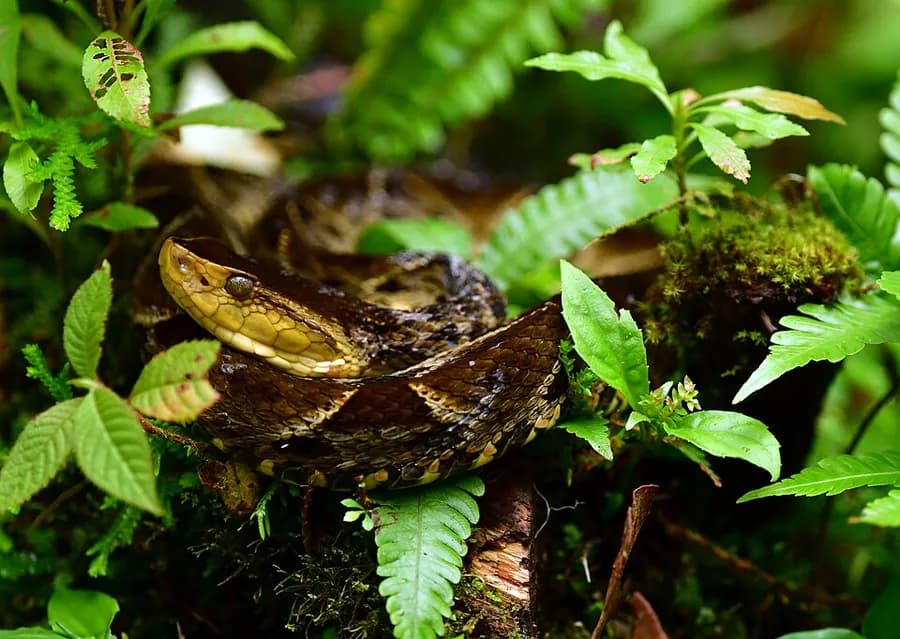
🐍Bothrops asper
Die Terciopelo-Lanzenotter (Bothrops asper) ist eine in Mittelamerika und im Nordwesten Südamerikas weit verbreitete Schlangenart. Sie gehört zur Unterfamilie der Grubenottern. Weitere gelegentlich im deutschen Sprachraum genutzte Namen für die Art sind Amerikanische Lanzenotter, Rauschuppige Lanzenotter, Fer de lance oder Barba amarilla. Die Art bewohnt tropische Laub- und Regenwälder. Sie lebt dort überwiegend auf dem Boden, klettert jedoch auch zumindest einige Meter hoch auf Bäume oder Sträucher. Jungtiere von Bothrops asper ernähren sich überwiegend von kleinen Amphibien, Reptilien und Wirbellosen, ausgewachsene Tiere überwiegend von kleinen Säugetieren. Die Terciopelo-Lanzenotter wird mit bis über zwei Meter Körperlänge sehr groß, ist leicht erregbar, bewegt sich sehr schnell und ist extrem giftig. Sie ist innerhalb ihres Areals für den Großteil der Vergiftungen durch Schlangenbisse und jährlich für zahlreiche Todesfälle verantwortlich. Viele Patienten, die den Biss überleben, bleiben durch schwerste Gewebezerstörungen und Gliedmaßenverluste lebenslang behindert.
Text: Wikipedia, CC BY-SA 4.0.
IUCN Red List assessment, 2021.
- Body mass
- 1.04 kg
- Body length
- 2.5 m
- Shoulder height
- not recorded
- Top speed
- not recorded
- Bite force
- not recorded
- Maximum lifespan
- 20 years
Everything we know about the Bothrops asper
Typical adult figures. Where a value is an estimate rather than a measurement, it says so.
Body mass1.04 kgrecord 7.5 kg · ReptTraitsAnAgeDetails ↓Hide ↑
data quality: acceptable
Record: largest individual on record
Source: AnAge · AnAge build 15, 2023-07-03 (HAGR) · CC BY 3.0
Body length2.5 mmaximum recordedReptTraitsDetails ↓Hide ↑
Source: ReptTraits · v1.2 (Oskyrko et al. 2024) · CC BY 4.0
Maximum lifespan20 yearsrecord 21 years · ReptTraitsAnAgeDetails ↓Hide ↑
data quality: acceptable
Record: largest individual on record
Source: AnAge · AnAge build 15, 2023-07-03 (HAGR) · CC BY 3.0
Activity cycleNocturnalReptTraitsDetails ↓Hide ↑
Source: ReptTraits · v1.2 (Oskyrko et al. 2024) · CC BY 4.0
VenomousYesReptTraitsDetails ↓Hide ↑
Source: ReptTraits · v1.2 (Oskyrko et al. 2024) · CC BY 4.0
Volume l1 LaverageDetails ↓Hide ↑
Body mass at ~1.0 kg/L, the density of vertebrate tissue.
average = a mean across sexes or species in a group.
Not recorded for Bothrops asper yet: shoulder height, top speed, bite force.
Family tree
- orderLizards & snakes · Squamata
- infraorderSnakes · Serpentes
- familyViperidae
- subfamilyCrotalinae
All 13 branches ↓Fewer branches ↑
- kingdomMetazoa
- phylumChordata
- subphylumCraniata
- subphylumVertebrata
- superclassGnathostomata
- superclassSarcopterygii
- superclassTetrapoda
- orderSauria
- superorderLepidosauria
- orderLizards & snakes · Squamata
- infraorderSnakes · Serpentes
- familyViperidae
- subfamilyCrotalinae
More about the Bothrops asper


No videos of the Bothrops asper yet.
We have 44,653 videos so far, and none of them features this animal yet.
All videos →Compare the Bothrops asper
Pick a tool — the Bothrops asper is already selected.
Compare every stat with any other animal.
Stand them on the same floor and see who's bigger.
How speed, brain and bite scale with body size. This animal isn't in the sample yet.
See where it sits in the tree of life.