
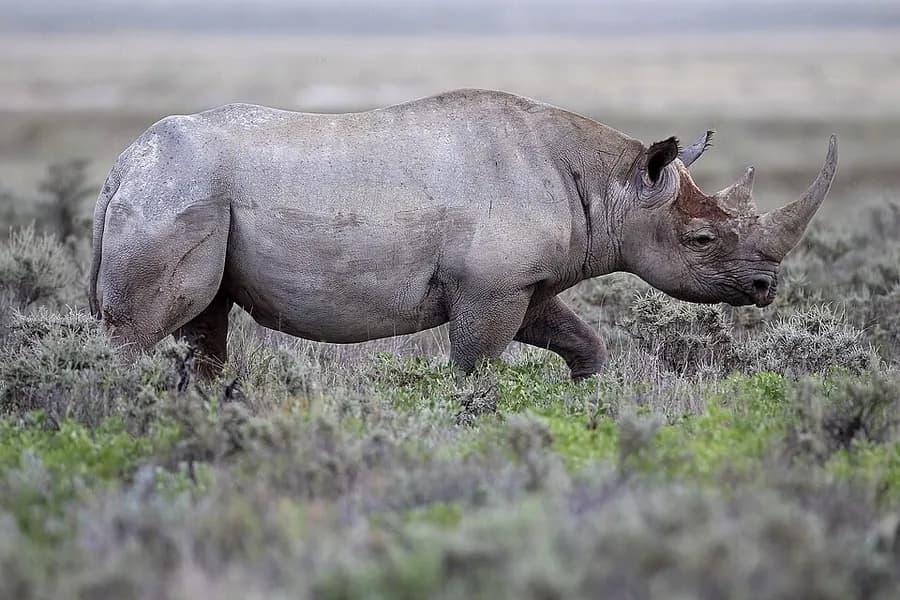
🦏Black rhinoceros
Das Spitzmaulnashorn (Diceros bicornis), auch Spitzlippennashorn oder seltener Schwarzes Nashorn genannt, ist eine Säugetierart aus der Familie der Nashörner (Rhinocerotidae). Es ist neben dem etwas größeren Breitmaulnashorn (Ceratotherium simum) eine der beiden Nashornarten des afrikanischen Kontinents. Die bis zu 1.400 Kilogramm schweren Tiere sind Bewohner der Savannen und offenen Landschaften und heute unter anderem in Ost- und Südafrika zu finden. Dort ernähren sie sich überwiegend von weicher Pflanzenkost, dabei meist von verschiedenen Akazienarten. Als Einzelgänger leben sie in bis zu 40 km² großen Territorien. Ein weibliches Tier bringt, wie bei allen Nashörnern üblich, pro Wurf nur ein Junges zur Welt, das bis zu zwei Jahre gesäugt wird. Der Ursprung des Spitzmaulnashorns liegt in Afrika und reicht bis zu 17 Millionen Jahre zurück; nahe Verwandte der Nashornart kamen während ihrer Stammesgeschichte auch in Ostasien vor. Die Hörner dieser Nashornart sind so begehrt, dass sie durch Wilderei und illegalen Handel vom Aussterben bedroht ist.
Text: Wikipedia, CC BY-SA 4.0.
IUCN Red List assessment, 2020.
- Body mass
- 996 kg
- Body length
- 3.3 m
- Shoulder height
- not recorded
- Top speed
- not recorded
- Bite force
- not recorded
- Maximum lifespan
- 49 years
Everything we know about the Black rhinoceros
Typical adult figures. Where a value is an estimate rather than a measurement, it says so.
Body mass996 kgCOMBINEOther figures ↓Hide ↑
Source: COMBINE · v1 (Soria et al. 2021) · CC BY 4.0
Figures vary
- 1,100 kgAnAgeAnAge build 15, 2023-07-03 (HAGR)data quality: acceptable
Body length3.3 mCOMBINEDetails ↓Hide ↑
Source: COMBINE · v1 (Soria et al. 2021) · CC BY 4.0
Brain mass791 gCOMBINEDetails ↓Hide ↑
Source: COMBINE · v1 (Soria et al. 2021) · CC BY 4.0
Maximum lifespan49 yearsCOMBINEOther figures ↓Hide ↑
Source: COMBINE · v1 (Soria et al. 2021) · CC BY 4.0
Figures vary
- 57 yearsAnAgeAnAge build 15, 2023-07-03 (HAGR)data quality: acceptable
Generation length17 yearsCOMBINEDetails ↓Hide ↑
Source: COMBINE · v1 (Soria et al. 2021) · CC BY 4.0
Age at maturity6.0 yearsCOMBINEDetails ↓Hide ↑
Source: COMBINE · v1 (Soria et al. 2021) · CC BY 4.0
Gestation1.3 yearsCOMBINEOther figures ↓Hide ↑
Source: COMBINE · v1 (Soria et al. 2021) · CC BY 4.0
Figures vary
- 1.3 yearsAnAgeAnAge build 15, 2023-07-03 (HAGR)data quality: acceptable
Litter size1COMBINEOther figures ↓Hide ↑
Source: COMBINE · v1 (Soria et al. 2021) · CC BY 4.0
Figures vary
- 1AnAgeAnAge build 15, 2023-07-03 (HAGR)data quality: acceptable
Trophic levelHerbivoreCOMBINEDetails ↓Hide ↑
Source: COMBINE · v1 (Soria et al. 2021) · CC BY 4.0
Activity cycleCrepuscular / mixedCOMBINEDetails ↓Hide ↑
Source: COMBINE · v1 (Soria et al. 2021) · CC BY 4.0
Home range11 km²COMBINEDetails ↓Hide ↑
Source: COMBINE · v1 (Soria et al. 2021) · CC BY 4.0
Population density0.14 per km²COMBINEDetails ↓Hide ↑
Source: COMBINE · v1 (Soria et al. 2021) · CC BY 4.0
Volume l996 LaverageDetails ↓Hide ↑
Body mass at ~1.0 kg/L, the density of vertebrate tissue.
average = a mean across sexes or species in a group.
Not recorded for Black rhinoceros yet: shoulder height, top speed, bite force.
Family tree
- kingdomAnimalia
- ›phylumChordata
- ›classMammalia
- ›orderPerissodactyla
- ›familyRhinocerotidae
- ›genusDiceros
- ›speciesDiceros bicornis
- classMammals · Mammalia
- orderOdd-toed hoofed animals · Perissodactyla
- familyRhinocerotidae
- genusDiceros
All 13 branches ↓Fewer branches ↑
- kingdomMetazoa
- phylumChordata
- subphylumCraniata
- subphylumVertebrata
- superclassGnathostomata
- superclassSarcopterygii
- superclassTetrapoda
- classMammals · Mammalia
- subclassTheria
- superorderLaurasiatheria
- orderOdd-toed hoofed animals · Perissodactyla
- familyRhinocerotidae
- genusDiceros
More about the Black rhinoceros


Tiere vor der Kamera
Echtes Filmmaterial von den Tieren dieser Website – beim Jagen, beim Kämpfen und beim ganz normalen Alltag.
Compare the Black rhinoceros
Pick a tool — the Black rhinoceros is already selected.
Compare every stat with any other animal.
Stand them on the same floor and see who's bigger.
How speed, brain and bite scale with body size. This animal isn't in the sample yet.
See where it sits in the tree of life.