
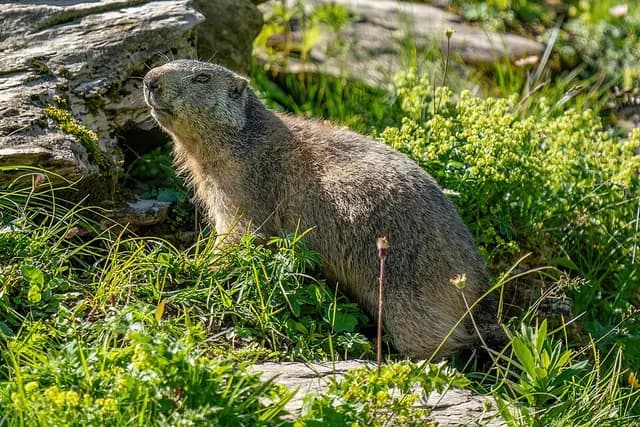
🐿️Alpine marmot
Das Alpenmurmeltier (Marmota marmota), süddeutsch und österreichisch auch Mankei oder Murmel, in der Schweiz auch Mungg oder Murmunda, ist ein besonders in den Alpen verbreitetes Nagetier. Es ist nach dem Biber und dem Stachelschwein das drittgrößte in Europa vorkommende Nagetier. Jungtiere des Alpenmurmeltieres erreichen in der Regel im dritten Jahr ihre Geschlechtsreife und verlassen frühestens dann ihren Familienverband. Bedingt durch diese späte Abwanderung der Jungtiere leben Murmeltiere sozial in Gruppen zusammen, die bis zu 20 Individuen umfassen können. Alpenmurmeltiere sind typische Vertreter einer eiszeitlichen Tierwelt, die während des Pleistozäns auch im europäischen Tiefland zu finden waren. Ein sechs bis sieben Monate währender Winterschlaf ermöglichte ihnen das Überleben in diesem Habitat. Während des Winterschlafes leben sie ausschließlich von körpereigenen Fettreserven, im Darm lebende Parasiten werden abgestoßen. Heute sind Murmeltiere als sogenanntes Eiszeitrelikt in ihrer Verbreitung auf Gebirgshöhenlagen begrenzt, da sie nur hier geeignete Umweltbedingungen finden. Bei dieser Besiedelung der Hochalpen hat das Alpenmurmeltier durch einen Flaschenhalseffekt den Großteil seiner genetischen Vielfalt verloren und konnte diesen durch seine an die Eiszeit angepasste Lebensweise auch nicht wieder aufbauen. Das Alpenmurmeltier gilt damit als eines der Tiere mit der geringsten genetischen Vielfalt überhaupt.
Text: Wikipedia, CC BY-SA 4.0.
IUCN Red List assessment, 2024.
- Body mass
- 3.5 kg
- Body length
- 0.6 m
- Shoulder height
- not recorded
- Top speed
- not recorded
- Bite force
- not recorded
- Maximum lifespan
- 18 years
Everything we know about the Alpine marmot
Typical adult figures. Where a value is an estimate rather than a measurement, it says so.
Body mass3.5 kgCOMBINEOther figures ↓Hide ↑
Source: COMBINE · v1 (Soria et al. 2021) · CC BY 4.0
Figures vary
- 3.5 kgAnAgeAnAge build 15, 2023-07-03 (HAGR)data quality: acceptable
Body length0.6 mCOMBINEDetails ↓Hide ↑
Source: COMBINE · v1 (Soria et al. 2021) · CC BY 4.0
Brain mass15 gCOMBINEDetails ↓Hide ↑
Source: COMBINE · v1 (Soria et al. 2021) · CC BY 4.0
Maximum lifespan18 yearsCOMBINEOther figures ↓Hide ↑
Source: COMBINE · v1 (Soria et al. 2021) · CC BY 4.0
Figures vary
- 17 yearsAnAgeAnAge build 15, 2023-07-03 (HAGR)data quality: acceptable
Generation length6.86 yearsCOMBINEDetails ↓Hide ↑
Source: COMBINE · v1 (Soria et al. 2021) · CC BY 4.0
Age at maturity2.3 yearsCOMBINEDetails ↓Hide ↑
Source: COMBINE · v1 (Soria et al. 2021) · CC BY 4.0
Gestation35 daysCOMBINEOther figures ↓Hide ↑
Source: COMBINE · v1 (Soria et al. 2021) · CC BY 4.0
Figures vary
- 35 daysAnAgeAnAge build 15, 2023-07-03 (HAGR)data quality: acceptable
Litter sizeabout 4COMBINEOther figures ↓Hide ↑
Source: COMBINE · v1 (Soria et al. 2021) · CC BY 4.0
Figures vary
- 4AnAgeAnAge build 15, 2023-07-03 (HAGR)data quality: acceptable
Trophic levelHerbivoreCOMBINEDetails ↓Hide ↑
Source: COMBINE · v1 (Soria et al. 2021) · CC BY 4.0
Activity cycleDiurnalCOMBINEDetails ↓Hide ↑
Source: COMBINE · v1 (Soria et al. 2021) · CC BY 4.0
Home range0.01 km²COMBINEDetails ↓Hide ↑
Source: COMBINE · v1 (Soria et al. 2021) · CC BY 4.0
Population density584 per km²COMBINEDetails ↓Hide ↑
Source: COMBINE · v1 (Soria et al. 2021) · CC BY 4.0
Volume l3.5 LaverageDetails ↓Hide ↑
Body mass at ~1.0 kg/L, the density of vertebrate tissue.
average = a mean across sexes or species in a group.
Not recorded for Alpine marmot yet: shoulder height, top speed, bite force.
Family tree
- kingdomAnimalia
- ›phylumChordata
- ›classMammalia
- ›orderRodentia
- ›familySciuridae
- ›genusMarmota
- ›speciesMarmota marmota
- classMammals · Mammalia
- orderRodents · Rodentia
- tribeMarmotini
- genusMarmota
All 15 branches ↓Fewer branches ↑
- kingdomMetazoa
- phylumChordata
- subphylumCraniata
- subphylumVertebrata
- superclassGnathostomata
- superclassSarcopterygii
- superclassTetrapoda
- classMammals · Mammalia
- subclassTheria
- superorderEuarchontoglires
- orderRodents · Rodentia
- suborderSciuromorpha
- familySciuridae
- tribeMarmotini
- genusMarmota
More about the Alpine marmot


No videos of the Alpine marmot yet.
We have 44,653 videos so far, and none of them features this animal yet.
All videos →Compare the Alpine marmot
Pick a tool — the Alpine marmot is already selected.
Compare every stat with any other animal.
Stand them on the same floor and see who's bigger.
How speed, brain and bite scale with body size. This animal isn't in the sample yet.
See where it sits in the tree of life.