
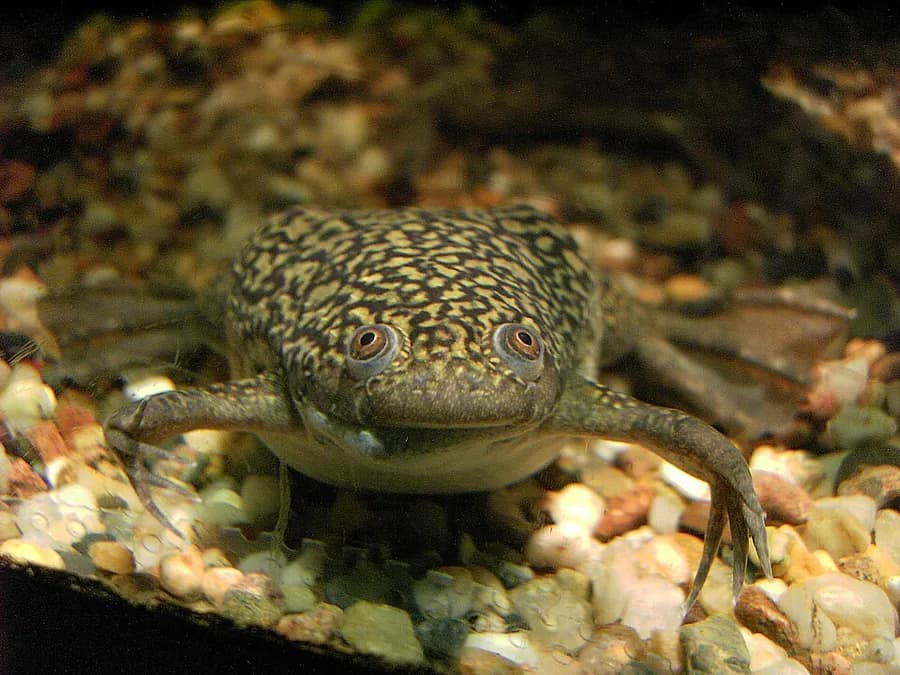
🐸African clawed frog
Der Glatte Krallenfrosch (Xenopus laevis), auch Afrikanischer Krallenfrosch, Apothekerfrosch, Glatter Spornfrosch oder oft einfach nur Krallenfrosch genannt, ist eine der Arten aus der Gattung der Krallenfrösche (Xenopus) innerhalb der Zungenlosen Frösche (Familie Pipidae). Wissenschaftlich nicht mehr gültige Synonyme sind: Pipa laevis, Pipa bufonia, Xenopus boiei, Xenopus victorianus, Xenopus muelleri (Peters, 1844). Krallenfrösche stellen das afrikanische Gegenstück zu den südamerikanischen Wabenkröten (Gattung Pipa) aus derselben taxonomischen Familie dar. Die Artentwicklung bei Xenopus ist genetisch betrachtet sehr interessant, da sie aufgrund der Allopolyploidie mit verschiedenen Polyploidiestufen in Verbindung gebracht wird. Der Glatte Krallenfrosch ist daher seit Anfang des 20. Jh. an vielen Universitäten ein bevorzugter Modellorganismus für Forschung und Lehre, z. B. in den Fakultäten Molekular- und Zellbiologie.
Text: Wikipedia, CC BY-SA 4.0.
IUCN Red List assessment, 2025.
- Body mass
- 0.13 kg
- Body length
- 0.15 m
- Shoulder height
- not recorded
- Top speed
- not recorded
- Bite force
- not recorded
- Maximum lifespan
- 30 years
Everything we know about the African clawed frog
Typical adult figures. Where a value is an estimate rather than a measurement, it says so.
Body mass0.13 kgAnAgeOther figures ↓Hide ↑
data quality: acceptable
Source: AnAge · AnAge build 15, 2023-07-03 (HAGR) · CC BY 3.0
Figures vary
- 0.13 kgAmphiBIOv1 (Oliveira et al. 2017)
Body length0.15 mAmphiBIODetails ↓Hide ↑
Source: AmphiBIO · v1 (Oliveira et al. 2017) · CC BY 4.0
Maximum lifespan30 yearsrecord 30 years · AmphiBIOAnAgeDetails ↓Hide ↑
data quality: acceptable
Record: largest individual on record
Source: AnAge · AnAge build 15, 2023-07-03 (HAGR) · CC BY 3.0
Gestation2 daysAnAgeDetails ↓Hide ↑
data quality: acceptable
Source: AnAge · AnAge build 15, 2023-07-03 (HAGR) · CC BY 3.0
Dietarthropods, vertebratesAmphiBIODetails ↓Hide ↑
Source: AmphiBIO · v1 (Oliveira et al. 2017) · CC BY 4.0
Volume l0.1 LaverageDetails ↓Hide ↑
Body mass at ~1.0 kg/L, the density of vertebrate tissue.
average = a mean across sexes or species in a group.
Not recorded for African clawed frog yet: shoulder height, top speed, bite force.
Family tree
- kingdomAnimalia
- ›phylumChordata
- ›classAmphibia
- ›orderAnura
- ›familyPipidae
- ›genusXenopus
- ›speciesXenopus laevis
- classAmphibians · Amphibia
- orderFrogs & toads · Anura
- genusXenopus
- subgenusXenopus subgenus Xenopus
All 15 branches ↓Fewer branches ↑
- kingdomMetazoa
- phylumChordata
- subphylumCraniata
- subphylumVertebrata
- superclassGnathostomata
- superclassSarcopterygii
- superclassTetrapoda
- classAmphibians · Amphibia
- superorderBatrachia
- orderFrogs & toads · Anura
- superfamilyPipoidea
- familyPipidae
- subfamilyXenopodinae
- genusXenopus
- subgenusXenopus subgenus Xenopus
More about the African clawed frog
No videos of the African clawed frog yet.
We have 44,653 videos so far, and none of them features this animal yet.
All videos →Compare the African clawed frog
Pick a tool — the African clawed frog is already selected.
Compare every stat with any other animal.
Stand them on the same floor and see who's bigger.
How speed, brain and bite scale with body size. This animal isn't in the sample yet.
See where it sits in the tree of life.